
When a hospital bed frame develops a squeak at 3 a.m. or a caster seizes mid-transfer, the performance failure goes far beyond a warranty claim—it disrupts patient care and strains nursing staff. As a medical hardware engineer who has spent nearly two decades inside factory production lines and quality control labs, I’ve seen that most procurement teams evaluate hospital beds by spec sheets alone: they check the listed load capacity, count the number of motor functions, and maybe glance at the warranty length. Those numbers matter, but they don’t tell you whether the bed will still adjust smoothly after 5,000 cycles or whether the guardrail locking mechanism will hold after a year of daily use. Real performance evaluation means understanding how the bed is built, not just how it’s described. This article walks you through the manufacturing-side checks I use when assessing hospital bed performance, so you can ask suppliers the same questions I ask our own production floor.
Structural Integrity Starts with the Metal Skeleton
The performance of any hospital bed hinges on its metal frame and the quality of its welding. In our factory, we use Liuzhou steel for bed tops and thick-gauge iron for the frame—materials chosen because they resist deformation under repeated loading. But even good steel can fail if the welds are inconsistent. When evaluating a bed’s structural performance, ask the manufacturer about their welding inspection process, not just the material specification.

We’ve found that cold-rolled steel sheets with a thickness of at least 0.8mm perform well for stamped bed panels, but the real differentiator is uniform welding. A bed that easily supports 250 kg on paper may develop stress cracks at weld points after 10,000 elevation cycles if the welding current or speed was off during production. This is why in our facility, critical frame joints undergo magnetic particle inspection or dye penetrant testing—methods that reveal subsurface flaws invisible to the naked eye.
Structural testing is only one part of the durability picture; ongoing maintenance also extends bed life. <Ultimate Guide to Cleaning and Maintaining Your Adjustable Hospital Bed> covers how cleaning practices affect electrical components and frame corrosion, which directly impacts long-term performance in clinical environments.
For procurement teams, a practical step is to request the manufacturer’s destructive test data on weld samples. If the supplier can share tensile strength results from sample welds taken from the production line, you have a tangible way to compare frames rather than relying on marketing claims.
Bed Panels and the Surprising Impact on Patient Comfort
Bed panels seem straightforward—flat steel sheets that support a mattress—but their construction quality has an outsized effect on patient comfort and nursing workflows. Stamped willow steel panels, like the 900mm width 4-section units we produce, are designed to flex slightly under weight without permanent deformation. This controlled flexibility reduces pressure points for patients, while still providing the rigid support needed for procedures like CPR.

On the other hand, ABS plastic head and footboards serve a different role: they must withstand repeated impacts from walls and doorways without cracking. We’ve learned that ABS components with reinforced snap-on structures can be removed in under 30 seconds for emergency access, which is a performance metric that spec sheets rarely list. When evaluating bed panels, look for multi-section designs that allow independent replacement of a damaged section rather than forcing a full panel swap. The 0.9mm thick stamped steel used in our crank bed panels strikes a balance between load-bearing stiffness and weight, but if your facility moves beds frequently, ask about the panel thickness and whether the edges are curled for added rigidity—curled-edge designs distribute stress better than flat cuts.
Casters and Mobility: The 24/7 Wear Test You Can’t Skip
A bed that looks solid in the showroom may fail on the ward within six months if the casters are underspecified. Full-wrapped TPR casters, for instance, use a soft thermoplastic rubber tread over a polypropylene core to achieve quiet rolling and good floor grip without marking. The key performance indicator for hospital bed casters is not just load rating but braking reliability after repeated use.

In our testing, central-locking casters with a reinforced hexagonal pad and welded transmission arms hold their locking force through thousands of engagement cycles. Loose central-locking pedals, on the other hand, cause uneven wheel locking, which can make the bed drift slightly. A simple field check: engage the central brake and push the bed from multiple angles. If any wheel rotates or the bed shifts, the pedal linkage or weld points on the transmission arm may be weak. Also ask if the caster fork is made of stamped metal or cast iron; stamped forks with thick gauge material resist bending better during frequent directional changes in tight corridors.
Guardrails and Accessories: Where Safety Performance Is Built or Missed
Guardrails are the most touched, pulled, and leaned-on part of any hospital bed, yet they’re often evaluated by appearance alone. The engineering truth is that a guardrail’s folding mechanism and locking design determine whether it will fail when a patient puts weight on it. Aluminum alloy guardrails with die-cast connection points, like our bend-tube models, offer a good strength-to-weight ratio, but the failure mode we watch for is loosening at the pivot pins over time.

When I evaluate guardrails, I look for automatic locking buttons that engage positively without requiring the user to visually confirm they’re locked. A guardrail that rattles slightly but doesn’t lock firmly indicates either worn pivot bushings or a weak return spring—both are manufacturing tolerance issues that worsen with use. For accessories like IV poles and drainage hooks, the performance evaluation should include a metal fatigue check: stainless steel poles with a wall thickness below 0.8mm can bend under a full drip bag load, especially if the pole height adjustment relies on a thin locking clip.
Actuator and Electrical System Reliability for Electric Beds
Electric hospital bed performance lives or dies by the actuators and control system. In our five-function electric bed, each motor operates independently to adjust backrest, leg elevation, height, and Trendelenburg positions. We test each actuator to at least 10,000 full-load cycles, measuring both speed consistency and noise output (targeting ≤45 dB). Performance drops are easy to miss if you only test once—ask the manufacturer to share cycle test data, not just the declared load rating.
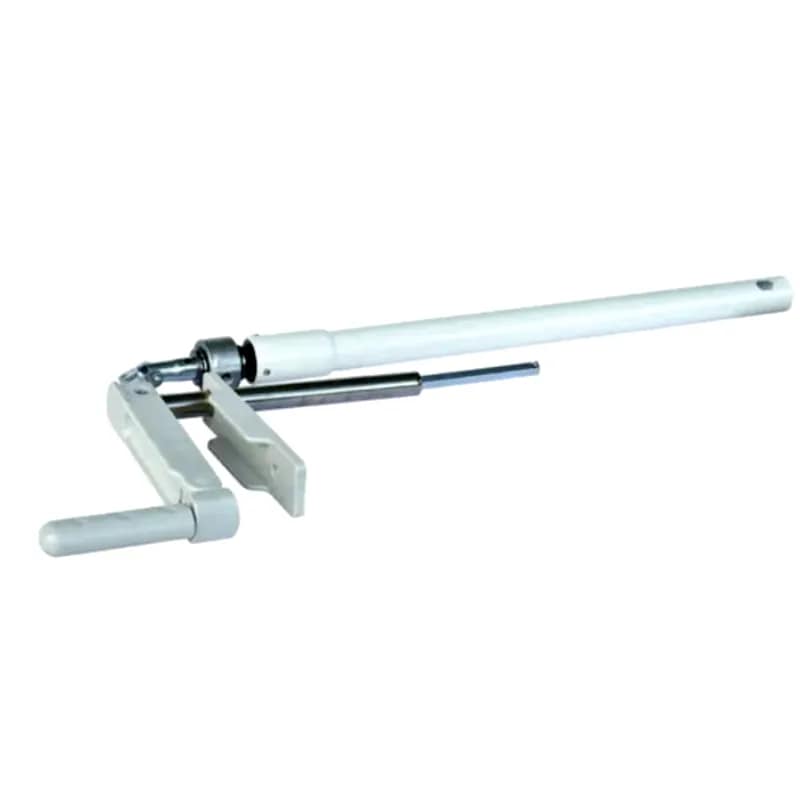
A common performance failure is the backup battery not holding charge long enough for a full bed adjustment during a power outage. We specify that the manual override (via crank or battery) must complete a full backrest lift within 60 seconds. If your evaluation doesn’t include testing the emergency backup under simulated power failure, you’re missing the most critical performance scenario. Also verify that the motor mounts are welded, not just bolted, to prevent vibration-induced loosening over years of use.
What to Demand from Supplier Performance Data
Shifting from marketing claims to verifiable performance data is the single most effective step a procurement team can take. The table below summarizes the performance metrics we track internally and what we recommend you request from any manufacturer.
| Performance Area | What to Request | Why It Matters |
|---|---|---|
| Frame welding integrity | Tensile test reports on weld samples | Prevents stress fractures under repeated loading |
| Bed panel flex tolerance | Cycle test data on panel deformation | Ensures patient comfort and CPR support over years |
| Caster braking force | Lock holding test after 5,000 engagements | Avoids bed drift that poses fall risks |
| Guardrail lock cycle | Durability test on locking mechanism at full load | Confirms long-term patient safety |
| Actuator noise and speed | Noise level (dB) and lift time at full load | Affects patient rest and nursing efficiency |
Not every supplier will have all this data pre-packaged, but a manufacturer that cannot provide at least weld strength and caster test reports is unlikely to have a controlled production process. You’re not just buying a bed; you’re buying the manufacturing discipline that keeps it safe over a decade of use.
If your procurement evaluation involves complex technical specifications or large-volume orders, our team can share specific test protocols and data from our production line. Send your requirements to [email protected] or call +8613528198959, and we can walk you through the performance metrics that match your patient population and facility layout.
Common Hospital Bed Performance Questions
How can I tell if a hospital bed’s load capacity claim is credible?
A claimed load capacity of 250 kg means little without knowing the safety factor used in design. In practice, we engineer with a safety factor of at least 2.5 for critical bed frame components, so the frame should withstand over 600 kg before permanent deformation. Ask the manufacturer for the design standard they follow (such as IEC 60601-2-52) and whether they test to destruction. If they only provide the working load and no test evidence, assume a lower safety margin and budget for earlier replacement.
Do stamped steel bed panels really outperform ABS panels?
It depends on the application. Stamped steel panels, like our 840mm width 4-section units, provide consistent flex support and can be replaced section-by-section, which lowers maintenance cost. ABS panels offer easier cleaning and a softer visual appearance but may crack if subjected to concentrated impact. In high-occupancy wards where beds get bumped frequently, stamped steel tends to outlast ABS by several years, while in low-acuity settings ABS may suffice.
What’s the most overlooked performance factor in electric beds?
Noise, by a wide margin. An actuator rated at 55 dB on the spec sheet may sound fine in a warehouse but will disrupt light sleepers on a quiet night ward. We target ≤45 dB at full load, and we test each motor with a sound meter placed at the patient head position. Ask for audio test results, not just the component spec, because the bed’s frame resonance can amplify motor noise.
How do I evaluate a supplier’s quality consistency over multiple orders?
Request a process control sheet for three recent production batches and compare the measurements of the same key dimension (such as caster fork width or guardrail pivot diameter) across batches. A supplier with tight process control will show less than 0.2 mm variation on critical dimensions. This is a far more reliable quality indicator than a single pre-shipment inspection. If you’re sourcing from multiple facilities or need independent verification, we can provide historical batch data to demonstrate our repeatability—reach out at [email protected] for actual measurement reports.
If you’re interested, check out these related articles:
Essential Materials for Quality Medical Bed Parts Manufacturing
Understanding Lead Times for Hospital Bed Parts Manufacturing
Leading Hospital Bed Parts Manufacturers: A Comprehensive Guide