
Most procurement decisions for bariatric hospital beds focus on a simple number: weight capacity. But a 250 kg load rating printed on a specification sheet tells you nothing about how the bed achieves that capacity, or whether it will still hold that weight safely three years into daily use in a busy ward. The difference between a bed that merely passes a static load test and one that performs reliably for years comes down to frame engineering, material selection, and manufacturing discipline. As a medical hardware engineer who has spent nearly two decades inside a hospital bed factory, I have watched procurement teams choose suppliers based on catalog numbers while overlooking the structural details that actually determine safety and service life.
The Engineering Behind a Bariatric Bed That Actually Holds Up
The frame of a bariatric bed is not simply a wider version of a standard bed. The higher center of gravity created by a wider mattress platform, combined with the concentrated load of a heavier patient, introduces bending moments and torsional stress that a standard frame was never designed to handle.
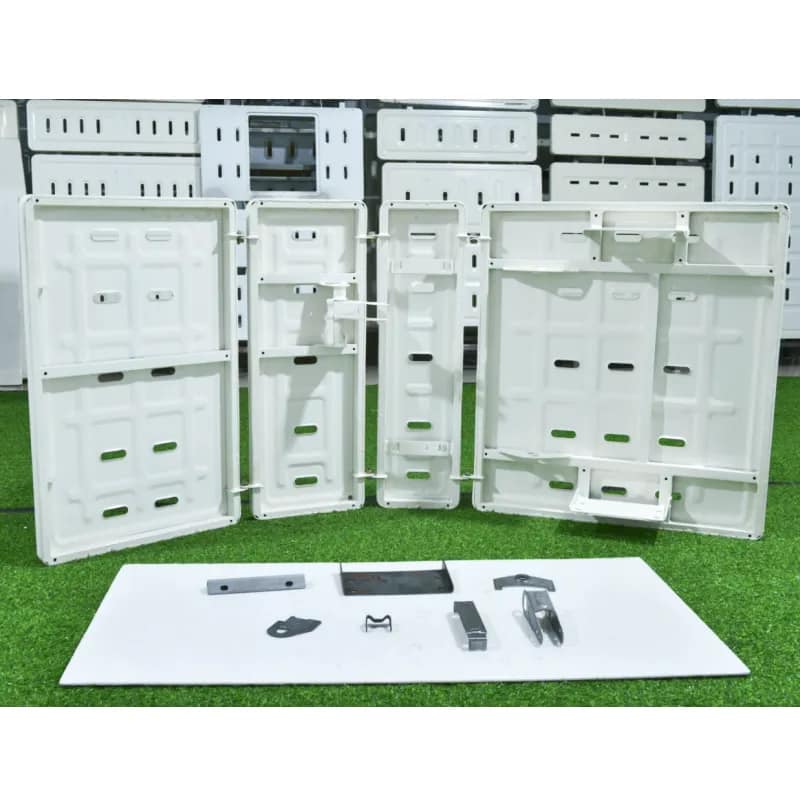
In our production line at Yingyun Hardware, the bed top for bariatric models uses Liuzhou steel sheet formed into stamped panels with curled edges for rigidity. That material choice is not accidental. Liuzhou steel offers a consistent yield strength and surface quality that cheaper cold-rolled alternatives do not match. The stamping process itself creates structural ribs that resist deflection without adding excessive weight. For a bed that must accommodate a patient weighing 250 kg, every section joint becomes a potential failure point. We reinforce those joints with double-piece connecting ears and transmission parts machined from solid bar stock, not castings.

Another overlooked factor is the bed’s wheel assembly. A bariatric bed fully loaded exerts far more lateral force on casters when staff move it. Standard hospital bed casters with plastic hubs can deform under repeated side loading. The bariatric beds we build use central-locking double-face casters with TPR treads on both wheel faces, mounted on reinforced sleeves and pedals. The brake mechanism uses a hexagonal pad and laser-cut locking components to prevent creep, even on hospital flooring that has been waxed.
How to Verify a Manufacturer’s Quality Claims for Heavy-Duty Beds
If you are sourcing bariatric beds for a hospital or nursing home, the manufacturer’s quality claims should be verifiable through more than a certificate on the wall. Here are the three points I would insist on checking.
First, ask about the bed panel material specification. A reputable manufacturer can tell you the exact steel grade, thickness, and source of their stamped panels, not just “steel.” For instance, our standard bed panels are formed from 0.9 mm willow steel, selected for its balance of strength and formability. Thicker is not always better; a panel that is too thick may transfer vibration to the patient and make the bed harder to adjust. The design of the panel’s ribs and the number of sections matter more. A four-section panel reduces the unsupported span length compared to a two-section design, which directly increases the load capacity without adding material weight.
Second, inspect the crank or motor mounting points. On manual bariatric beds, the crank system uses an ABS or iron crank handle with in-place protection to prevent over-rotation. The fixed seat of the rocker mechanism must be stamped from at least 2.5 mm steel and welded, not just screwed, to the frame tube. I have seen budget beds where the rocker seat is a thin bracket that bends after a few weeks of use by a 150 kg patient. On electric models, the motor fixing seats are laser-cut from 3 mm iron plate and welded into the frame, not bolted on as an afterthought.
Third, request a welding sample photograph or, if possible, visit the factory floor. The quality of the MIG welds at critical joints, such as the base support plate and the swing arms, reveals more about structural integrity than any load test graph. Consistent penetration, no porosity, and smooth profile are the minimum. At Yingyun, our welding stations for bariatric frame components use jig setups that hold the tubes square while welding, because any misalignment at the joint multiplies stress when the bed is fully loaded.
Custom Dimensions and Features That Improve Care for Obese Patients
Standard hospital bed widths of 900 mm are inadequate for many bariatric patients. A patient with a hip width exceeding 800 mm needs a sleeping surface of at least 1,100 mm to avoid pressure against the side rails and to allow safe repositioning. The mattress platform must also be longer, typically 2,200 mm or more, to prevent the patient’s feet from hanging over the edge and creating a fall risk during bed exit.
Beyond width, the side rail design requires specific attention. Bariatric patients exert more lateral force on rails when rolling or transferring. We use bent-tube guardrails with a minimum of six vertical bars, made from high-strength aluminum alloy or steel with a powder-coated finish. The rail locking mechanism must engage fully with an audible click and resist upward pull of at least 50 kg. In our factory, every guardrail assembly goes through a cycle test before shipment.

Mattress support is another area where customization adds value. A bariatric patient on a standard mattress will bottom out quickly, creating pressure points. We often supply beds with a reinforced orthopedica leg-split panel that integrates with a thicker foam mattress base, giving the care team the option to position the legs independently without compromising support.
If your facility treats bariatric patients regularly, consider ordering beds with a wider bed foot cover and larger casters. The 5-inch or even 8-inch central-locking casters distribute the load over a broader contact patch and make the bed easier to move on carpet or uneven floors.
Manual vs Electric Bariatric Beds: Where the Investment Matters
Procurement teams often assume that electric is always better for heavy patients, but the decision depends on the care environment. The table below compares key factors.
| Factor | Electric 5-Function | Manual 3-Crank |
|---|---|---|
| Weight capacity | 250 kg | 250 kg |
| Adjustment range | Backrest 0–75°, Knee 0–40°, Trendelenburg ≥12°, height 460–720 mm | Backrest 0–75°, Knee 0–40°, height 430–760 mm |
| Noise level | ≤45 dB | No motor noise |
| Power dependency | Requires outlet; battery backup available | Fully mechanical |
| Maintenance | Motor drive units, control box, pendant | Crank mechanisms, screw lubrication |
| Initial cost per bed | Higher | Lower |
In an ICU setting where frequent position changes and Trendelenburg positioning are required, an electric five-function bed pays for itself through reduced nursing time. In a long-term care facility where the bed is adjusted mainly during morning and evening care, a manual three-crank bed with robust mechanical drives often proves more reliable over a decade because there is no electronic control board to fail.
One nuance that gets missed: on electric bariatric beds, the actuators must be sized for the combined weight of the mattress, patient, and bed platform moving against gravity. If the manufacturer uses the same actuator on a standard bed and a bariatric bed by swapping only the frame width, the motor will wear out prematurely. We specify actuator stroke forces based on a worst-case loaded condition, not just a static rating.
If your program involves patients above 200 kg with limited caregiver staff, it is worth confirming the actuator model and duty cycle with the manufacturer before finalizing your purchase, reach out at [email protected].
Working with a Bariatric Bed Manufacturer: From Spec to Delivery
Once you have verified the engineering, the next step is translating your facility’s needs into a finished product. Many hospitals need beds that meet specific door-opening widths, elevator dimensions, or regional safety standards. A manufacturer that offers OEM services can adjust the bed length, width, color, side rail style, and even the headboard and footboard design.
We frequently work with hospitals in the Middle East and Southeast Asia where facility layouts require a bed length of 2,100 mm rather than the European standard of 2,200 mm, while maintaining the full 1,100 mm width. The stamped panels, guardrails, and bed ends are all producible with the modified dimensions from our standard tooling, which keeps lead times reasonable. A full bariatric bed order from Yingyun typically ships within 40–45 working days after drawing approval, depending on customization complexity.
Shipping logistics matter for these products because a bariatric bed kit is heavy and bulky. Our packaging uses reinforced wooden crates and foam cushions, with a gross weight of around 80 kg per unit, designed to protect the powder-coated finish during sea freight. We also supply spare parts catalogs with every order so that maintenance staff can identify replacement components, such as the central-locking pedal or the bed panel connecting ears, without confusing part numbers.
For large projects, such as outfitting an entire bariatric unit, we recommend ordering one sample bed for on-site evaluation before committing to the bulk shipment. This lets the clinical team test patient transfers, bed movement through doorways, and interface with existing mattress systems. A field trial also reveals whether the bed’s brake system is adequate for the floor surface and if the IV pole sockets are positioned where the nursing staff expect them.
Questions About Bariatric Hospital Bed Manufacturing
What is the realistic weight limit for a properly built bariatric hospital bed?
A well-engineered bariatric bed with a four-section stamped steel platform, reinforced swing arms, and heavy-duty casters can support 250 kg as a safe working load. The limiting factor is rarely the frame itself; it is the mattress and the caregiver’s ability to reposition the patient without injury. We build our beds to hold that load statically and during adjustments, but the clinical team must still follow safe patient handling protocols. If your facility sees patients exceeding 250 kg, we can discuss a reinforced frame with thicker tube walls and larger casters.
How long does a bariatric bed from a factory like yours typically last?
With proper maintenance, a factory-direct bariatric bed should remain in service for 8–10 years. The components that wear first are the casters, which accumulate floor debris and require cleaning and lubrication, and the side rail locking buttons, which experience the most mechanical cycling. We stock spare parts for all our models, including bed panel connecting ears, crank handles, and central-locking pedals, so a bed does not need to be retired because a small hardware part fails. I recommend facilities order a spare parts kit with the initial bed purchase to minimize downtime.
Can a bariatric bed be designed to fit through narrow hospital doorways?
Yes. While a bariatric bed is wider than a standard bed, the overall width with the guardrails folded can be kept under 1,050 mm for a 1,100 mm mattress platform. We achieve this by designing the side rails to fold inside the bed frame footprint, not outward. For facilities with particularly tight corridors, we offer a 1,000 mm mattress platform width that still provides more space than a standard 900 mm bed while clearing most doorways without removing the bed ends. Send your specific corridor and doorway dimensions and we can confirm whether a standard or modified width fits.
Is it possible to get a bariatric bed that also works as a standard bed for lighter patients?
The frame of a bariatric bed is inherently heavier and wider, so it cannot convert into a standard bed. However, we can supply beds with adjustable mattress platform sections that can accommodate a range of mattress widths by using removable side bolsters. For a facility that admits both bariatric and standard patients, it is often more economical to order a mixed fleet with clear weight capacity labeling rather than forcing one bed to serve both populations. If your census varies by month, share your patient mix data and we can suggest a proportional bed count that minimizes idle beds while maintaining safety compliance.
If you’re interested, check out these related articles:
Leading Hospital Bed Parts Manufacturers: A Comprehensive Guide
Can Adjustable Hospital Beds Be Customized for Homecare Needs
Ensuring Quality Control in Hospital Bed Parts: A Comprehensive Guide
Comparing Prices for Hospital Bed Parts Manufacturers Effectively