
Hospital bed safety testing standards matter because a medical bed is a load-bearing device, not just ward furniture. The real question is whether the manufacturer can show how the bed performed against specific clauses, not whether a certificate exists. I look for evidence of component-level loading, side rail locking, castor braking, and powered-function fault behavior before accepting any test summary. A CE mark alone does not tell a buyer what passed, what was deformed, or what was corrected during development. For procurement and clinical engineering teams, the test report behind the bed matters more than the marketing claim.
What Does Hospital Bed Safety Testing Actually Cover?
I break hospital bed safety testing standards into four groups: structural and mechanical, electrical, functional, and documentation. Structural testing covers frame and bed panel loading, side rail strength, gap dimensions, mattress retention, and castor brake performance. Electrical testing applies to powered beds and covers leakage current, grounding, insulation, abnormal operation, and electromagnetic compatibility. Functional testing verifies movement limits, duty cycle, battery backup, emergency lowering, and fault behavior when a control fails. Documentation review is the part buyers often skip: checking that the test report, risk management file, and performance definition match the exact bed configuration being quoted.
| Test category | What it verifies | Common failure point |
|---|---|---|
| Safe working load | Frame and panel deformation under repeated load | Labeled load not matched by test setup |
| Side rail and gap safety | Locking, deflection, mattress-to-rail gap | Rail movement under body pressure |
| Castor braking | Locking force on front and rear casters | Brake does not hold on slope |
| Electrical safety | Leakage current, grounding, insulation under load | Abnormal operation not fully tested |
| Fault performance | Movement limits, emergency lowering, power loss behavior | Manual backup not verified |
Each row is a test family, not a single pass or fail. The first question for a supplier is not whether the bed passed a category, but which exact clause, setup, and cycle count the report covers.
Which Mechanical Hospital Bed Safety Tests Prevent Falls?
Mechanical safety is where most patient falls and entrapment events begin. I look at four areas first: safe working load, side rail locking, gaps, and castor braking. A safe working load is not only the final number. It requires a defined loading condition, a cycle count, and an acceptable deformation limit after the test. For our standard adult beds, the safe working load is 250 kg across the bed panel and frame combination. Many failed inspections start because the bed was loaded once, not cycled, and the rail was not tested with the mattress used in the ward.

Side rails are a locking system, not a barrier. The test should show that the rail stays in the raised position under repeated force, that the release mechanism cannot be triggered by a patient’s body weight, and that the gap between rail and mattress does not create an entrapment zone. We use aluminum alloy and steel rail constructions with locking buttons and nylon-to-metal connection points. The exact gap depends on mattress thickness, so the test report must state the mattress used during verification.
Component-level safety checks also depend on having the same tested parts available through production. <Understanding Lead Times for Hospital Bed Parts Manufacturing> covers how lead time planning can prevent last-minute substitutions of unverified panels, rails, or caster hardware.
Castor braking is easy to overlook because a bed may roll normally and still fail under a patient transfer. I want to see braking force applied on both front and rear casters, with the bed loaded to its safe working load on a slight incline. A central-locking brake that only engages on one side creates a pivot point rather than a stationary bed.

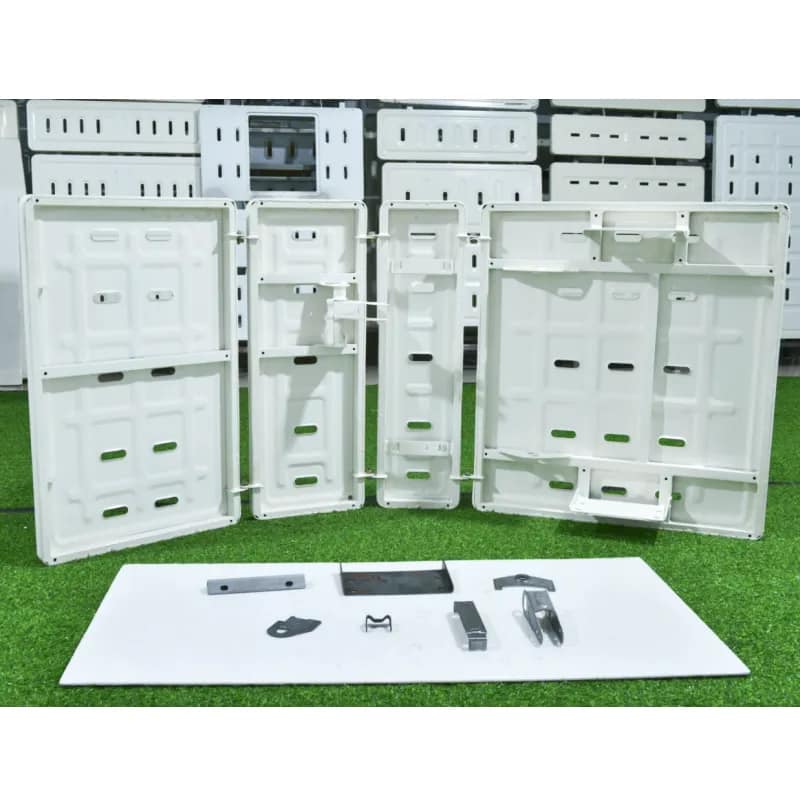
Bed panel design then determines how the load transfers into the frame. Stamped willow steel panels in our range use a thickness of 0.8 mm to 0.9 mm. That alone is not a safety claim. The safety comes from the combination of panel thickness, rib depth, weld position, and the connecting ears between sections. Buyers should ask for the test report for the panel set, not only the complete bed.
What Electrical Safety Tests Apply to Powered Hospital Beds?
Powered hospital bed testing is a different risk profile. The bed is no longer a static structure; it combines moving parts, electrical circuits, actuators, hand controls, and sometimes battery backup. Buyers should expect electrical safety evidence under IEC 60601-1, with particular rules in IEC 60601-2-52 for medical beds. Those tests cover creepage and clearance distances, protective grounding, leakage current under normal and single-fault conditions, and insulation integrity at operating temperature.
Function testing often matters more in daily use. A five-function electric bed is only safe if its movements stay within the specified angles and the bed stops predictably when something obstructs the mechanism. Our five-function configuration uses five independently driven motors for backrest, legboard, overall lifting, and forward and backward tilt. It is rated for a 250 kg safe working load and noise at or below 45 dB under normal operation. In a test report, I look for repeated motion at full load, stalled actuator response, and power interruption behavior.
Reverse Trendelenburg and Trendelenburg positions are specified at 12 degrees or more in our electric five-function bed. This needs angle verification under load, because a bed that tilts correctly empty may not hold the angle with a patient.
If your program includes powered beds with Trendelenburg positioning, cardiac chair posture, or integrated patient weighing, confirm which IEC 60601-1 clauses the test report covers before finalizing your bed specification. Send the bed model and target market to [email protected] and we can confirm which test clauses and certificates apply.
How Do You Verify Hospital Bed Safety Test Documentation?
Documentation is where I see the biggest gap between buyer expectation and what a manufacturer actually has. A certificate is a summary; a test report is the evidence. A CE mark, ISO 13485 certificate, or a single-page test summary does not automatically cover the exact bed model you are ordering, with the exact options and mattress configuration.
Verify the test report against the same model number, function set, and optional accessories as the quotation. Check that the report lists the standard and clause number, not only the standard name. Confirm the risk management file covers the intended patient population and that any design change triggered a new test. Ask whether the manufacturer can show the report for the exact configuration being shipped, not a similar bed from the same family.
A test report is only as useful as the supplier’s ability to reproduce the documented configuration at order volume. <Top Wholesale Hospital Bed Parts Manufacturers & Suppliers> covers how wholesale suppliers differ in documentation consistency and order handling, which matters when tested components are sourced in bulk.
For overseas procurement, ask for a redacted sample or the report summary before the order, with the model number visible. At final inspection, check that the shipping configuration matches the report. If motors, casters, or side rails differ from the tested sample, the original report may no longer apply.
What Should Buyers Require Before Accepting a Hospital Bed?
A safer spec is specific enough to be inspected. Request the exact safe working load, bed width and length, height adjustment range, side rail type and locking confirmation, caster size and central brake function, and the applicable electrical standard for powered beds. In our range, a manual three-crank bed measures 2170 mm long by 970 mm wide, with a height adjustment range of 430 mm to 760 mm. Electric three-function models go from 430 mm to 840 mm, and reverse Trendelenburg is at least 12 degrees on the five-function ICU configuration. These numbers should be visible in the quotation and matched in the test report.

When the bed is configured for homecare or a nonstandard ward, safety testing still needs to follow that exact configuration. <Can [Adjustable Hospital Bed](https://hospitalbedaccessories.com/product-category/hospital-bed/)s Be Customized for Homecare Needs> covers how customization changes bed dimensions, rail choices, and function selection, and why those choices should be carried into the test report.
Those requirements only work if the test evidence follows the bed to your dock. If the documentation stops at a certificate, request the clause-by-clause report. For your next hospital bed or accessory order, send the bed type, required standards, and target market to [email protected] or call +8613528198959. We can confirm which test reports and compliance documents can be shared before shipment, and which test setup applies to your configuration.
What Else Should Buyers Ask About Hospital Bed Safety Testing?
Are hospital bed safety testing standards the same in every market?
No. Most medical bed requirements are built around IEC 60601-2-52, but each country adds its own national deviations, import documentation, and field labeling requirements. A report accepted in one market does not automatically transfer to another without review. A hospital buying for multiple sites should fix the target countries before design freeze. That way, the manufacturer can confirm the correct standard edition, national differences, and required certificates instead of applying a single generic report to every shipment.
Do manual hospital beds need electrical safety testing?
A common assumption is that a manual bed has no safety testing obligation because it has no electrical circuits. That is not correct. Manual beds still require mechanical loading, side rail locking, gap and entrapment checks, castor braking, and cycle testing of the crank system. In our factory, manual crank systems are checked for smooth movement and in-place protection after repeated bed adjustments. Electrical tests do not apply, but the mechanical test file matters just as much.
What load capacity should a standard hospital bed have?
It depends on the patient population and the mattress, but for general adult wards a safe working load of 250 kg is common in our standard hospital beds and accessories. That number should be combined with a test cycle count and deformation limit, not printed on the label alone. If the facility treats bariatric patients or uses heavy therapy mattresses, the mechanical test report should be checked against the higher expected load before order confirmation.
Does a CE certificate mean a hospital bed has passed all safety tests?
Not exactly. A CE mark indicates that the manufacturer declares conformity with applicable European requirements, but it does not automatically give the buyer a complete clause-by-clause test report. The declaration should be backed by a technical file, risk management documentation, and test evidence for the specific model. Buyers who need assurance should request the test report scope and confirm that it matches the bed model, accessories, and mattress configuration being ordered.
How can buyers verify test reports from an overseas manufacturer?
The most useful question is not whether a report exists, but whether it covers the exact bed model being shipped. Ask the manufacturer to identify the model number, standard edition, clause list, tested accessories, and mattress thickness in the report. Then compare those details with the quotation and shipping configuration at final inspection. If motors, casters, or side rails differ from the tested sample, the report may no longer apply. Send your bed model and target market to [email protected] and we can confirm which test documentation is available before shipment.
If you’re interested, check out these related articles:
Essential Certifications for Medical Bed Parts Manufacturers
Ensuring Quality Control in Hospital Bed Parts: A Comprehensive Guide