
A hospital bed load capacity test is the difference between a rated number and a bed that can hold a patient safely through years of repositioning, transport, and accessory loading. A 250 kg rating on a datasheet tells you almost nothing unless you also know how the bed was loaded, what deformed during the test, and what the manufacturer did after unloading. I have spent nearly twenty years on hospital bed manufacturing and component qualification, and the tests that separate dependable beds from marginal ones are rarely the ones shown in a first quotation. This article explains what to check before you accept a hospital bed for patient use.
What Does a Hospital Bed Load Capacity Test Actually Measure?
A hospital bed load capacity test is only meaningful when the tested configuration matches how the bed will be used. We start by applying an evenly distributed load across the mattress support surface, not a single point load at the center. The test then records whether the bed keeps functioning under that load: no permanent frame or panel deformation, no loss of adjustment, and no failure in the locking parts. The safe working load is the number that matters, and it sits below the ultimate failure point.
| Bed configuration | Rated load capacity | Load path to verify |
|---|---|---|
| Manual hospital bed | 250 kg | Crank support points, stamped bed panels, frame joints |
| Electric hospital bed | 250 kg | Actuator mounts, weld joints, head and knee sections |
| Emergency transfer stretcher | 250 kg | Side rail latches, base frame, wheel locks |
| Overbed table | 25 kg | Desktop mounting only, not a patient support surface |
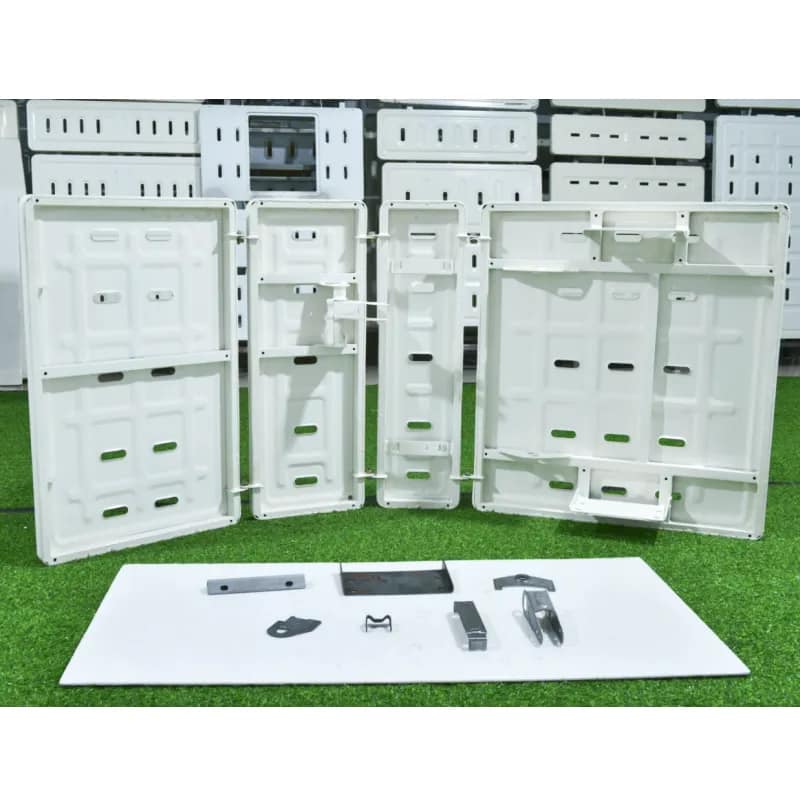
A 250 kg working load rating on our manual and electric hospital beds refers to the full patient support system, assuming the mattress, side rails, and any attached accessories are within their own ratings. If someone reads that number without checking the test layout, they can easily approve a configuration that was never actually tested.
Which Components Limit a Hospital Bed Load Capacity Rating?
A hospital bed rating is only as high as its weakest load path. In my experience, the main frame tubes are rarely the first parts to fail. Casters, stamped bed panels, side rails, and actuator mounting points usually reach their limits earlier because they carry concentrated loads or reverse direction under use.

Why do casters affect the full bed load rating?
Casters carry a moving point load as the bed rolls over thresholds and into elevators. A 5 inch central locking caster may roll well on a flat floor but still transmit high bending stress through its stem and brake housing when the wheel is locked and the bed is pushed. We check for play between the wheel, stem, and frame insert because even small movement there changes the bed’s real capacity.

What happens when the head section is raised during load testing?
The load shifts toward the seat and lower back panels. The bed panels and lift mechanism must hold the raised section without drift, chatter, or sudden drop. For an electric bed, we watch the actuator mounts and cables while the backrest cycles with weight on the surface. For a manual bed, we load the crank mechanism and check that the handles and shafts do not bind or slip.

Casters, side rails, and actuator systems do not all share the same load path. If a higher load rating requires a different caster set or heavier panel, the change affects more than the test report. <Understanding Lead Times for Hospital Bed Parts Manufacturing> covers what to expect when component changes move into production scheduling.
What Changes When Hospital Bed Load Capacity Testing Adds Movement and Fatigue?
A static load test shows immediate strength. It does not show what happens after repeated movement with weight on the bed. I have seen electric beds pass a stationary load check and later show weld cracking around the actuator mounts after several hundred positioning cycles. The failure mode is not usually a sudden break; it is gradual loosening, noise, and loss of positioning accuracy.
Is a static load test enough for electric beds?
No. An electric bed needs cycle testing because motors, mounting plates, and cable routing all move under load. We check for actuator slowdown, abnormal noise, and any change in the height adjustment stroke after the test. A bed that passes a static check but slows noticeably under cycle load is not ready for clinical use.
What is the difference between a proof load and a working load?
Working load is the rated safe load for normal operation. A proof load is a higher load applied for a limited period to confirm the structural margin. If a bed passes its 250 kg working load but shows permanent deformation at 275 kg proof load, the margin is too small for repeated hospital stress.
If your program includes bariatric patients or frequent powered positioning, it is worth confirming the proof load and cycle test conditions before finalizing the specification. Share your target patient weight, bed function list, and accessory loading with [email protected].
How Should Buyers Read a Hospital Bed Load Test Report?
A credible load test report names the tested configuration, the load magnitude, the load distribution, the duration, and the acceptance criteria. If the report only says “250 kg passed” without stating whether side rails, casters, and the mattress platform were installed, it is not enough. Request deformation measurements or photographs from after the test, not just a certificate.
A load rating is only as credible as the manufacturer behind it. <Identifying Reliable Brands for [Adjustable Hospital Bed](https://hospitalbedaccessories.com/product-category/hospital-bed/)s> covers how to check whether a supplier’s brand claims align with documented production and testing practices.
The report should also identify which components were tested as a set. A bed frame tested without casters or side rails has not demonstrated the same load path as the bed you will actually place in a ward.
What Should Buyers Confirm Before Accepting a Hospital Bed Load Rating?
Most buyers do not get to watch the test, so they rely on whatever the supplier puts in writing. That gap is where unclear load ratings become field problems. Before accepting a bed, confirm the proof load, the tested configuration, and the residual deformation after unloading. Ask for the same report after any change in bed panels, casters, or actuator type.
Load capacity can also change the price. <How Much Does an Adjustable Hospital Bed Cost on Average> covers how electric functions, frame ratings, and feature sets move the unit cost.
If your project involves heavy patients, frequent bed movement, or accessory loaded rails, confirm the test conditions before you place the order. Send your bed configuration and target load to [email protected] or call +8613528198959 and we will confirm which test report and component set applies to your order before production starts.
Common Questions About Hospital Bed Load Capacity Testing
How is hospital bed load capacity different from a patient weight limit?
Load capacity is the total allowed weight on the bed including the patient, mattress, bedding, and any supported accessories. Patient weight limit is only one part of that total. A 250 kg hospital bed does not automatically mean every 250 kg patient can use every accessory and position. The buyer should ask what the 250 kg includes and what configuration was used for the rating.
Does raising the back section reduce the safe working load?
Many buyers assume the rated load stays constant in every bed position, but that is not how the structure works. When the backrest lifts, weight concentrates on fewer panel supports and the actuator or crank carries extra force. The bed should be tested at the raised back angle with realistic load, not only flat. If the report only covers the flat position, request additional positioning tests.
Can a 250 kg hospital bed safely hold a 250 kg patient?
It depends on load distribution and how often the bed moves. A 250 kg patient centered on a stationary bed may fall within the rating, but side rail pressure, Trendelenburg positioning, or rolling over thresholds can add concentrated forces. For bariatric use, I would derate the working number or specify a test that includes rail loading and moving load conditions instead of assuming the full 250 kg is available in every position.
What test documents should a buyer request from a hospital bed supplier?
In our factory, we prepare two types of records for load related approvals: the test report and the component drawing set. The test report should show load level, duration, distribution, and pass criteria. The component set should show the exact casters, panels, rails, and actuators tested. If either document is missing, the rating cannot be traced to the bed you are buying. Share your required load and bed configuration to [email protected] and we will confirm which reports apply to your order.
If you’re interested, check out these related articles:
How to Choose the Right Adjustable Medical Bed for Your Clinic: A Comprehensive Guide
Ensuring Quality Control in Hospital Bed Parts: A Comprehensive Guide