
Hospital bed color customization transforms a standard medical device into an intentional element of ward identity and patient experience. It is not only about matching hospital branding or interior design schemes. For procurement managers and hospital planners, ordering 100 beds in a precise shade of green also means understanding powder coating adhesion on Liuzhou steel, color consistency across production batches, and what a 40-working-day lead time actually covers. I have spent nearly twenty years in hospital bed manufacturing at Yingyun Hardware, working directly with overseas buyers who bring us color samples and expect identical results on bed frames, ABS headboards, and aluminum side rails. The gap between a color swatch and a finished batch of hospital beds is where most misunderstandings live. This article works through that gap, so you can specify colors with confidence and receive exactly what your project demands.

Color Customization Options for Hospital Beds
Every visible component on a hospital bed can be color-customized, but not all materials accept color the same way. Understanding the substrate is the step that separates a clean specification from a manufacturing headache.
The bed frame, typically fabricated from rectangular steel tubing (our standard is 25×50×1.5 mm), receives an electrostatic powder coating. We apply imported Great Wall Aksu antibacterial powder, which provides the color layer plus antimicrobial and corrosion protection. For the frame, any RAL or Pantone color can be matched, though dark tones tend to show less scuffing in daily transport. Head and footboards are usually injection-molded from ABS engineering plastic. ABS is colored at the raw material stage by mixing masterbatch pigments before injection. This means the color is integral to the plastic, not applied as a surface coat, and it will not peel. Side rails present a mixed case: aluminum alloy rails are powder-coated or anodized, while ABS rail sections follow the masterbatch coloring route. Even casters, IV pole hooks, and bed panel support plates can be matched if the order quantity warrants it, although small hardware parts are more commonly supplied in standard white or gray.
The practical implication is that a single RAL code may look slightly different on powder-coated steel versus pigmented ABS. As a manufacturer, we manage this by providing pre-production samples that show the exact color appearance on each substrate. If you request a uniform appearance across all materials, be prepared for a two-stage sample approval process: one swatch for metal components and another for plastic parts.
The durability of a colored component depends heavily on the material choice, not just the finish. <Essential Materials for Quality Medical Bed Parts Manufacturing> covers why steel grade, ABS purity, and aluminum alloy composition directly affect coating adhesion and long-term color retention in high-use wards.
The OEM Color Customization Process
What happens between sending your color target and receiving finished beds is a sequence of material preparation, application, and curing, each with its own failure points.
For powder-coated metal parts, the process begins with surface preparation. The steel bed frame sections, after welding and grinding, pass through a phosphate pre-treatment to remove oils and create a micro-rough surface for powder grip, then are dried and electrostatically coated with the specified color powder, and cured in an oven at approximately 180–200°C for 15–20 minutes. The entire sequence occurs on a conveyor line, meaning the batch is processed continuously and color must be stable for the full run. For ABS components, plastic raw material is dried to remove moisture, mixed precisely with a measured percentage of masterbatch color pellets, and injection-molded at controlled temperature and pressure. The cycle time for a headboard mold is around 60–90 seconds, producing one piece. Color consistency depends on the masterbatch dosing accuracy and the absence of contamination between color changes. When we switch from white to a custom blue, the injection machine barrel must be fully purged with the new material mixture until no trace of the previous color remains. In a production run of 500 beds, a single contaminated shot inside the barrel can cause streaking that appears halfway through the batch.
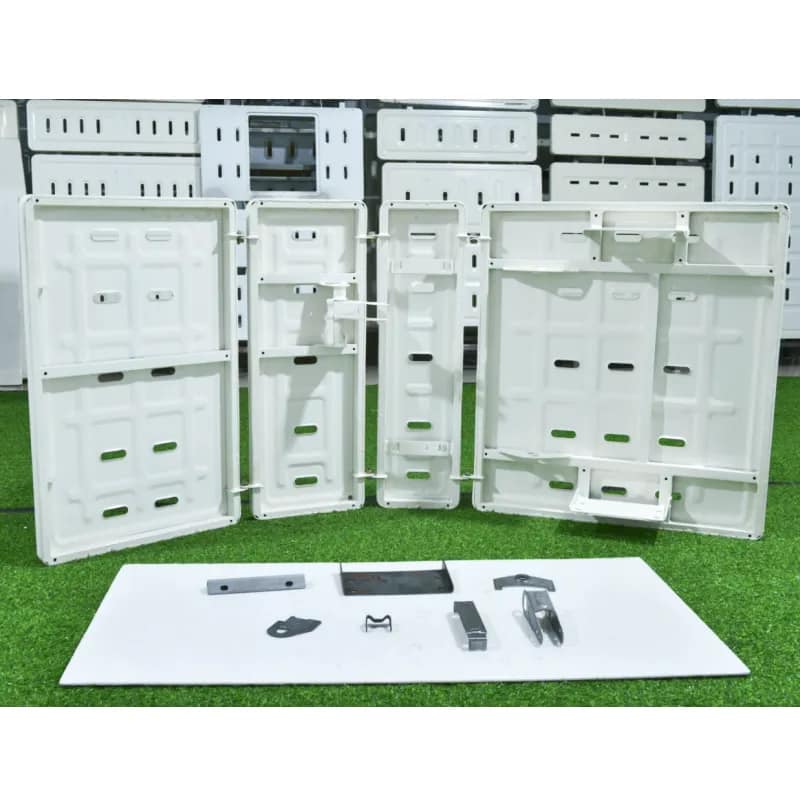
After individual components are colored, we assemble the bed and perform a final visual inspection under controlled lighting. This step catches variations between powder-coated and plastic parts. I have seen cases where a RAL 9016 powder coating looked distinctly cooler than the same specification achieved through ABS masterbatch, and the buyer had not anticipated the contrast. We now flag those substrate differences in the pre-production sample stage so no one discovers them after container loading.
Procurement Factors: MOQ, Lead Time, and Cost Structure
Custom color projects differ from standard product purchases in minimum order quantity, lead time extension, and cost allocation. Knowing these numbers before you issue a tender prevents post-order surprises.
Minimum order quantity (MOQ) is the first gate. Our standard white hospital bed can be ordered in quantities as low as 20–50 units depending on the model. When a custom color enters the workflow, we require a higher MOQ to absorb the setup costs. As a reference point, for powder-coated frames, an MOQ of 50 beds is workable but tight; at 100 units, the per-bed setup cost amortization becomes reasonable. For ABS components like headboards and bedside cabinets, the masterbatch supplier typically has a 25 kg minimum purchase per color, and that quantity can color several hundred plastic parts, making the incremental cost modest if you order enough units. If you need only 20 beds in a bespoke color, expect a significant surcharge, roughly a 15–25% premium over the standard white price, because the fixed setup costs distribute across fewer units.

Lead time extends by 10–15 working days compared to standard orders. A typical electric 3-function hospital bed from our production line has a lead time of 40–45 working days in standard white. Adding a custom color pushes that to 55–60 working days, accounting for powder procurement, color matching, line purge, and sample approval cycles. The longest delay in my experience has been the back-and-forth on color sample approval; buyers who plan to complete approval within 5 working days from receiving physical samples avoid cascading delays. I recommend asking your manufacturer for a lead time breakdown that separates standard production from color-specific steps, so you can see exactly where the buffer sits.
Cost structure consists of three layers: a one-time color development fee that covers the powder or masterbatch matching and sample production (typically a few hundred dollars, credited back if the order exceeds a certain volume), a per-unit color surcharge reflecting higher raw material cost (custom powder costs roughly 20–30% more than standard white, and custom masterbatch carries a similar premium), and increased quality control time because every colored component must be visually inspected against the approved master sample. Procurement teams should request that the color development fee be refundable against the main order, a common arrangement with repeat OEM manufacturers.
Maintaining Color Consistency Across Batches
Hospitals often order beds in phases. If the second phase arrives a year later and the beds are a slightly different green, the ward aesthetics break. Color consistency across production batches is one of the hardest promises to keep in custom manufacturing, and it relies on rigorous process controls, not luck.
We maintain consistency through four mechanisms. First, we retain a physical master sample from the initial approved batch, stored in opaque packaging to prevent light fading, and every subsequent batch is matched under D65 standard lighting to that master, not to a digital file. Second, we source powder coating from the same manufacturer lot whenever possible; when a lot change is unavoidable because the original formulation has been updated, we run a lab draw-down panel and send it to the buyer for comparison before production begins. Third, for injection-molded plastic parts, we document the exact masterbatch brand, grade, and let-down ratio (typical ratio is 2–4% by weight) and we never substitute without notification. Fourth, we keep a color reference sample from each production lot, labeled with the batch date, so if a complaint arises two years later, we can retrieve the physical evidence and compare.
The practical risk buyers need to know is that small color shifts can occur between batch runs due to ambient humidity during powder curing or slight fluctuations in injection molding barrel temperature. These shifts are usually imperceptible unless you place two beds from different batches directly adjacent under bright white light. In most hospital ward configurations, where beds are spaced a meter apart, the difference is invisible. If your facility design calls for beds to be pressed side-by-side, such as in a recovery bay, request that all beds for that area be produced in a single production run.
Integrating Custom Colors into Healthcare Environments
Color in a hospital setting is not purely decorative. It serves functional roles in wayfinding, patient psychology, and infection control. Procurement decisions about color should start from those functions, not from a paint catalog.
Light, neutral colors such as soft beige, light gray, or pale blue are favored in general wards because they project cleanliness and do not compete with medical equipment colors. Pediatric wards often use brighter, warmer tones like orange or light green, though the specific shade must still work under fluorescent and LED ward lighting, which can shift color perception. I recommend testing color samples under the actual lighting conditions of the intended facility, because a warm beige under showroom halogen can appear dull green under 4000K ward lighting. High-gloss finishes show dirt less than matte finishes, a consideration for emergency departments where beds are cleaned frequently. For long-term care and nursing homes, wood-grain finishes on headboards and side rails are popular; we offer a wood-grain ABS headboard (model YY-WS03) that combines the warm appearance of timber with the infection-control advantages of sealed plastic.
The role of color in infection control is indirect but real. Darker colors can mask stains and scratches for longer, but lighter colors force more visible and frequent cleaning, which aligns with infection prevention protocols. Antimicrobial powder coating, which we use as standard on all metal parts, continues to function regardless of color; the titanium dioxide or silver-ion additive is embedded in the powder and does not depend on the pigment.
Selecting the Right OEM Manufacturer for Color Customization Projects
Not every hospital bed manufacturer handles custom color production efficiently. The selection process should evaluate process documentation, sample management, and the manufacturer’s prior experience with multi-batch color consistency.
First, ask the manufacturer to describe their color management process in writing, not just a promise. They should be able to name the powder brand they use (we use Aksu), the masterbatch supplier, the lighting standard for color evaluation (D65 is the industry norm), and their procedure for handling lot changes. Second, request to see physical samples from two separate production batches of the same color, ideally produced at least six months apart. Place them side by side and judge the match under the lighting that will be used in your facility. Third, clarify the ownership of color formulations. Some manufacturers will register the custom color formulation under your company name, so if you switch suppliers later, you can transfer the color data. Others treat the formulation as their own intellectual property. I have seen cases where a buyer developed a signature blue with one factory and could not reproduce it elsewhere because the exact masterbatch recipe was proprietary, forcing them to redevelop the color from scratch at their own cost.
Finally, discuss the warranty coverage for color. Our standard warranty is one year for mechanism and structure, but color fading falls under a separate consideration. Normal wear and cleaning will not fade properly cured powder coating within five years, and ABS masterbatch coloring is even more resistant because the pigment is distributed throughout the material, not just on the surface. That said, prolonged direct UV exposure, such as through a sun-facing window, will gradually degrade any color. In regions with intense sunlight, ask for UV-stabilized powder and confirm the lightfastness rating.
OEM color customization done well gives a healthcare facility a distinct visual identity without compromising the bed’s clinical performance. The procurement approach that works is one where you treat color not as an afterthought but as a technical specification, with material requirements, sample gates, and batch consistency controls written into the purchase agreement. If your project involves custom-colored hospital beds and you are uncertain about substrate matching, lead time buffers, or UV resistance for your climate, share your specifications with us at [email protected] or reach us at +8613528198959. We will review the feasibility and propose a sampling plan before you commit to an order.
Common Questions About Hospital Bed Color Customization
Is custom color more expensive than standard white, and by how much?
A custom color typically adds 10–25% to the unit cost, depending on order quantity and the number of components being colored. The largest cost driver is the fixed setup expense: powder coating line purges, masterbatch procurement, and sample creation. The per-unit premium drops noticeably above 100 units. We quote color development fees separately and credit them back when the main order exceeds a negotiated volume, so the net impact is lower.
Can I match the exact color of another manufacturer’s bed?
It is possible to match an existing bed’s color, but the result will be close, not identical. Even if we use the same RAL code, the substrate and the coating supplier’s specific formulation create slight variations. The safest approach is to provide a physical sample and agree on an acceptable tolerance range, usually measured as a Delta E value below 1.5 under D65 lighting. For projects where beds from different suppliers must sit next to each other, I recommend ordering sample panels early and aligning on visual compatibility rather than chasing a theoretical exact match.
Will the color fade or scratch over time?
Powder coating cured according to manufacturer specifications retains its color for years under normal indoor use, and antimicrobial additives remain effective independent of color. Scratches and impacts can expose the bare metal underneath, but those are mechanical failures, not color degradation. ABS components are colored throughout the polymer, so surface scratches do not reveal a different underlying color. Fading due to UV exposure is location-dependent; if beds are placed near unfiltered sunlight, request UV-stabilized additives in the powder or ABS formulation. In most indoor ward settings, the color outlasts the bed’s functional service life.
How do I specify colors for a multi-product order that includes beds, cabinets, and trolleys?
Provide a single color reference, either a RAL code or a physical sample, and ask the manufacturer to create substrate-specific approval swatches. A RAL 7035 light gray on a powder-coated bed frame, an injection-molded ABS bedside cabinet, and an anodized aluminum trolley handle will never look perfectly identical, but a visual coordination that is close enough for a ward is achievable if the differences are acknowledged and approved during sampling. We handle this by sending a set of color chips on each material type for buyer sign-off before full production begins.
What happens if the delivered color is not what I approved?
The contingency should be laid out in the purchase contract. We require signed approval of a physical master sample, which becomes the reference for the entire production. If the delivered goods deviate beyond the agreed tolerance, we either rework the affected components or deduct a percentage from the invoice. Practical resolution starts with a comparison under standard D65 lighting against the retained master, not against a memory or a photo from a phone screen. Having that master sample in your possession, not only with the manufacturer, gives you the strongest position. If your order specification includes custom color requirements, we can work through the sampling and contract terms together to minimize risk. Share your timeline and expected quantity with us at [email protected] and we will outline the sample schedule before production.
If you’re interested, check out these related articles:
Leading Hospital Bed Parts Manufacturers: A Comprehensive Guide
Understanding Lead Times for Hospital Bed Parts Manufacturing