
Most hospital bed procurement guides stop at purchase price and a checklist of features. Those matter, but they don’t tell you which bed will still function reliably five years into daily use or what maintenance workload each design commits your biomedical team to. I design and manufacture these beds. Over nearly two decades, I’ve seen electric and manual units returned for repair, torn down, and rebuilt. The real difference isn’t just a motor versus a hand crank — it is a completely different mechanical stress profile, cost structure, and maintenance burden that the spec sheet won’t show you.
How Electric and Manual Beds Differ in Core Operation
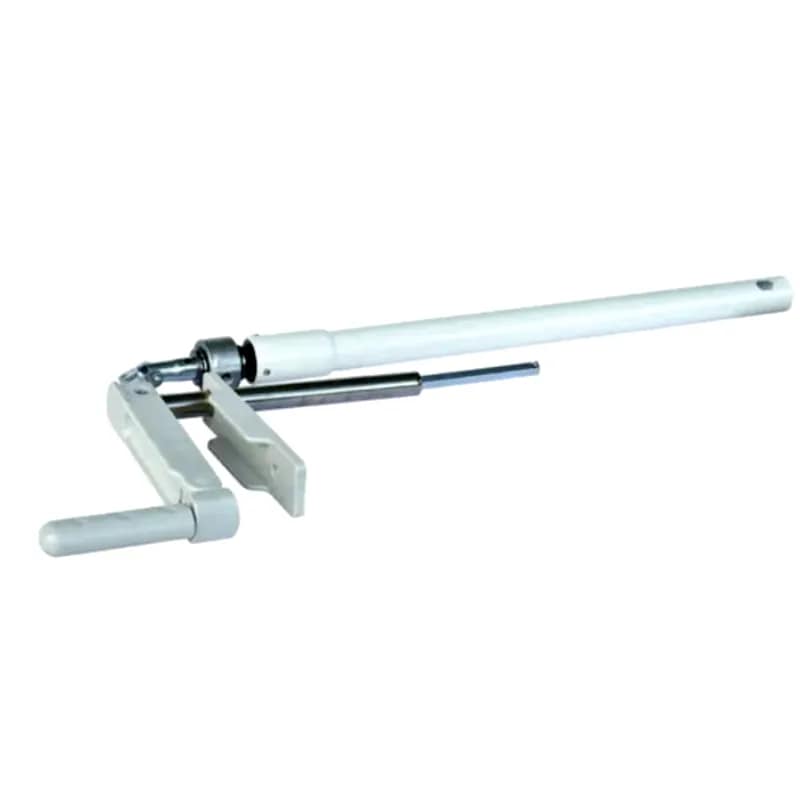
A manual hospital bed uses a system of hand cranks, lead screws, and linkage arms to mechanically adjust the backrest, knee section, and sometimes bed height. The operator rotates a foldable handle at the foot of the bed, transferring torque through a universal joint and hexagonal shaft into a screw mechanism that moves the bed panel sections. Two-crank and three-crank configurations add more adjustment points. A three-crank bed, for example, can raise the backrest to about 75 degrees, elevate the knee section to roughly 40 degrees, and adjust the overall bed height between approximately 430 mm and 760 mm. The load capacity for these manual beds typically reaches 250 kg, using a frame built from Liuzhou steel and ABS head and footboards.
An electric hospital bed replaces the crank and screw assemblies with linear actuators — independent motors that push or pull each bed section on button command. A five-function electric bed uses five separate actuators: one each for backrest tilt, leg elevation, height adjustment, and Trendelenburg/reverse-Trendelenburg positioning. The patient or caregiver presses a hand pendant, and the motor silently moves the bed segment, typically producing less than 45 dB of operating noise. The bed frame is similarly built from steel with ABS or PP boards, and the actuators are secured to the frame with motor fixing seats — small but critical stamped iron brackets, one designated A and one B, produced by laser cutting and then formed to hold the motor in precise alignment. A 3 mm thick motor fixing seat doesn’t appear on a comparison chart, but one that corrodes or cracks under repeated side-loading can disable an electric bed entirely.
While spec sheets describe electric beds as push-button adjustable, the core difference lies in the actuation mechanism. <Electric vs Manual Adjustable Beds: A Comprehensive Comparison> covers how linear actuator placement and control board design affect bed responsiveness, and why a five-function bed with independent motor control gives nursing staff faster positioning than a shared-drive two-motor system.
Which Components Fail First in Electric Versus Manual Beds
Component failure follows completely different patterns in each bed type, and this is where the long-term maintenance budget gets defined. Manual beds use an ABS or iron crank handle with an in-place protection mechanism that locks the handle in position during use. The crank system includes a universal joint and hexagonal steel driveshaft that transfers rotational force to the bed’s lead screw. The weakest points in a manual bed are the crank handle bearing socket, the universal joint coupling, and the lead screw nut. I’ve seen crank handles that spin freely because the socket bore rounds out after years of use. The universal joint, typically iron, develops play where the cross pin seats, creating a sloppy feel before eventual failure. The lead screw itself is protected by a two-way limit mechanism, but the nut assembly wears slowly, especially in environments where beds are adjusted multiple times per shift.
Electric beds concentrate failure risk into the actuator motors and control electronics. The five motors in a five-function ICU bed are independently driven, so one motor failing leaves the other functions intact — but a motor replacement means disassembling that bed section’s mounting bracket, which is labor-intensive. The motor fixing seats (A) and (B) mentioned earlier are designed for a specific tube diameter, and if a bed frame sees uneven floor loading that twists the base steel channel, those fixing seats can deform. A twisted motor bracket misaligns the actuator shaft, accelerating wear on the motor’s internal spline. This isn’t something a facility catches during a visual inspection. It becomes apparent only when the bed starts making a grinding noise or the backrest sags under patient weight.
The casters represent another divergent failure pattern. Both bed types use medical-grade TPR casters, commonly 5-inch or 6-inch double-face or full-wrapped designs with central locking pedals. On an electric bed with trend and reverse-trend motions, the casters’ swivel bearings absorb more directional shear during height changes. The locking mechanism, whether a central-locking pedal or plunger-type brake, can bind if the hexagonal pad of the central-locking brake or the sleeve tube of the castor accumulates corrosion. A central-locking pedal that won’t release forces staff to lift the bed to re-position it. On a manual bed, casters see less dynamic stress because the bed remains stationary during adjustments — no motor vibration, no tilting shifts — so pedal mechanisms and swivel bearings often last longer before service.

Total Cost of Ownership Beyond the Initial Purchase Price
The purchase price of an electric hospital bed is higher — two to three times that of an equivalent manual bed. But the purchase price tells you almost nothing about what a 200-bed facility spends over a decade. A manual three-crank bed uses a crank system with replaceable components: an ABS crank with in-place protection, an iron handle, a stainless steel crank system for MRI-safe rooms, or a standard iron handle with universal joint. Replacing a worn crank mechanism costs a fraction of an actuator. A manual bed’s metal bed panels — stamped from 0.8 mm or 0.9 mm willow steel, available in 2-section, 4-section, or orthopaedic leg-split configurations — can be welded or replaced individually. The bed panel fixing parts (fixed part 1 and fixed part 2, stamped metal brackets) are accessible and low-cost.
Electric beds require keeping spare actuators, control boards, and pendant cables on hand. When you operate a fleet of 50 electric beds across an ICU ward, you will eventually need to stock bed-specific actuators, which each manufacturer may source from different suppliers. The actuator’s motor is a serviceable assembly, but it is not universally interchangeable across brands. Our company’s five-function bed uses independently driven motors with a battery backup for emergency manual operation when power fails; that battery is another replaceable component on a predictable cycle. If you’re budgeting for a full electric bed deployment, factor in the cost of at least 5% spare actuator inventory, plus the time your biomedical team spends diagnosing control board faults.
Then there are the bed peripherals. Electric and manual beds share many of the same replaceable parts: bed side rails (aluminum alloy, bend tube, or ABS European-style guardrails), head and foot boards (ABS or stainless steel), IV poles with 2 or 4 hooks (stainless steel, diameter 16 mm or 19 mm outer tube), drainage hooks, bed panel supports, overbed tables, and bedside cabinets. An ABS bedside cabinet with one drawer, waterproof and anti-drop, mounts on silent casters and serves both bed types equally. Across a fleet, standardizing on these shared accessories reduces inventory complexity. Where electric beds add unique peripherals — like the electric bed’s large support plate or the sliding channel for mounted accessories — manual beds use simpler counterparts such as the fixed seat of a simple rocker or a U-shape connector of the bed shelf. Those welded bed-frame connectors don’t fail under normal use.
Understanding per-bed cost requires knowing real manufacturing lead times and material choices. <Comparing Prices for Hospital Bed Parts Manufacturers Effectively> covers how stamped steel part pricing differs from cast components, and why negotiating on annual blanket orders rather than one-off per-bed pricing reduces your effective cost.

Safety Standards and Patient Considerations Across Both Bed Types
Both electric and manual beds sold into regulated healthcare markets must meet dimensional, load-bearing, and stability standards. Our manual and electric beds share a common 250 kg load capacity, a bed-frame dimension of approximately L2170 x W970 mm, and a bed height adjustment range from 430 mm (low position) to 760 mm (high position) on electric models. The low bed position matters more for patient fall safety than many procurement teams realize: a bed that lowers to 430 mm reduces injury risk from an uncontrolled exit, while a bed that only goes down to 540 mm does not. Electric beds with five functions also offer Trendelenburg positioning, which is clinically required for certain emergency interventions.
Side rail design is another safety variable that procurement often underweights. The range of guardrails we manufacture includes bend tube, straight tube aluminum alloy, ABS European-style, inflatable, and door-type railings, each with different locking mechanisms. The rail must not unlock under patient weight shifting, yet must release quickly during an emergency — a dual requirement that separates well-engineered rail systems from commodity imports. On our aluminum alloy and bend tube rails, a die-cast aluminum clamping joint locks the rail in the upright position with a metal handle and automatic locking button; the mechanism relies on a spring-loaded detent that should not deform after repetitive cycling. For pediatric beds, shorter rail heights and smaller gap spacing between bars are standard, and the head and foot boards come in customized colors to reduce patient anxiety.
Infection control considerations also differ. An electric bed’s motor housing and wiring channels are sealed against fluid ingress, but the actuator boot seals degrade with exposure to cleaning chemicals. Manual beds have no motor housings to seal, so the cleaning protocol is more straightforward: the metal bed panels (curled-edge stamped panels with a smooth surface) and ABS head/footboards resist quaternary ammonium disinfectants, and the crank handles can be wiped down as part of routine terminal cleaning. The bed panels themselves, whether 840 mm, 900 mm, or 820 mm width, 2-section or 4-section, are designed with drainage channels and optional welding to eliminate crevices where fluids can pool.
When evaluating adjustable beds, safety often comes down to component-level consistency. <Essential Safety Features for Adjustable Medical Beds> covers rail locking mechanism testing, emergency CPR release requirements, and how to verify that bed height adjustments maintain stability under the full rated load.
Bulk Procurement Factors When Ordering Electric or Manual Beds
When you’re sourcing beds for a new facility or an upgrade, the difference between electric and manual extends into logistics, minimum order quantities, and after-sales support. Our manual and electric beds share a typical MOQ of 50 pieces per model, with packaging using foam and export-grade cartons or wooden boxes for larger units like electric ICU beds. Manual beds generally pack more compactly; an electric five-function bed’s crate dimensions are larger due to the integrated motors and control boards. That difference translates into container loading capacity — a 40-foot container holds more manual beds than electric beds of equivalent size — which affects per-unit shipping cost, especially for overseas deliveries to Africa, the Middle East, or Europe.
Lead time also diverges. Manual bed production runs faster because the crank mechanisms and stamped panels are standard; typical lead time for manual single-crank, double-crank, or three-crank beds is 15-20 working days for accessories and 40-45 working days for complete bed assemblies. Electric beds require additional electrical safety testing and motor calibration, extending lead time. If your facility needs beds on an urgent timeline, manual beds with ready-stock components can be assembled and shipped faster. For a custom project — say a bed with specific color-matched ABS panels, wood-grain guardrail finish, or non-standard width like 850 mm — both bed types can accommodate OEM customization but the electric control system firmware adds another layer of design review.
Installation and staff training are the final procurement-stage variables. Electric beds require initial charge of battery backup systems, pendant testing, and calibration of limit switches. Manual beds need staff instruction on crank operation and a schedule for periodic lubrication of the universal joint and lead screw. Most facilities handle manual bed setup in-house with basic tools. Electric bed commissioning often requires the manufacturer’s technical support for the first unit, particularly when integrating with nurse call systems or verifying the CPR quick-release function.
If your bed deployment spans multiple wards with different clinical needs, consider a mixed fleet: electric five-function beds for ICU and high-acuity wards, manual three-crank beds for general wards, and a small stock of single-crank manual beds for overflow or emergency surge capacity. This mix controls capital spend while reserving powered positioning for the patients who gain the most clinical benefit from it. We supply both beds from the same manufacturing line, so the component commonality — same bed panels, same guardrail mounting system, same casters — simplifies spare parts management across the entire fleet.
What Matters After the Order Is Placed
Choosing between electric and manual hospital beds is ultimately a decision about how your facility weighs clinical flexibility against mechanical simplicity and budget predictability. Neither bed type is categorically better; each makes a different set of operational promises that your biomedical team and nursing staff will live with every day for years. Electric beds reduce physical strain on caregivers and give patients more autonomy, but they bring a larger spare parts inventory and a steeper repair learning curve. Manual beds stay closer to “what you see is what you get” mechanically, but they require staff effort for every adjustment, which matters at scale.
I recommend procurement teams start by mapping their highest-acuity wards first, then work backward. If you’re equipping a new hospital or nursing home, share your ward layout, patient acuity mix, and budget envelope with a manufacturer who produces both bed types. That way you get a specification that matches clinical need without forcing electric beds where manual beds would actually reduce maintenance overhead, or vice versa. For a detailed discussion about your specific bed requirements — including lead time estimates, custom color matching, or container-optimized packing — contact us at [email protected] or call +8613528198959. We can provide a per-ward recommendation based on the bed types we manufacture and support globally.
Common Questions About Electric vs Manual Hospital Beds
Which really lasts longer in daily use, an electric or manual hospital bed?
Manual beds, when properly maintained, tend to outlast electric beds in terms of major component life. The limiting factors are mechanical — crank handle wear, universal joint play — rather than electronic failure, and replacement parts are simpler. That said, a well-built electric bed with a battery-backed actuator system and a robust motor fixing bracket can deliver 10 years of service in a general ward. The key variable is not whether the bed is electric or manual but whether the frame was built with thick-gauge Liuzhou steel, properly powder-coated against corrosion, and assembled with stamped metal connectors that don’t flex under full load.
Can we convert manual beds to electric later?
Direct conversion is not practical because the bed frame mounting points, motor fixing seats, and wiring channels are designed into the frame at the manufacturing stage. A manual bed’s lead-screw linkage and crank bracket position differs from the actuator mounting pattern of an electric bed. However, some manual bed components — side rails, head/footboards, casters, IV pole sockets — are identical across both bed types from the same manufacturer. If you think your facility might upgrade to electric beds within five years, buying from a supplier who uses shared component architecture means you can retain your rail and panel inventory when you refresh the fleet.
Are electric hospital beds significantly harder to maintain?
Yes, because the failure points shift from simple wearable parts (crank handle, screw nut) to electrical subsystems (actuator motor, control board, battery backup, pendant cable). A manual bed complaint — “the crank handle is loose” — is typically a 10-minute swap of the crank assembly. An electric bed complaint — “the backrest intermittently fails to lift” — can be a loose connector at the control board, a failing actuator limit switch, or a deformed motor fixing bracket, each requiring a different diagnostic path and spare part. Allocating one trained biomedical technician per 80-100 electric beds is a realistic staffing ratio for planned maintenance.
What lead time should we expect if we order 200 beds for a new hospital?
Lead times depend on bed complexity and current production queue. Our manual bed assemblies ship in approximately 40-45 working days from order confirmation; electric beds typically add 5-7 working days for motor calibration and electrical safety testing. Custom color matching, special guardrail finishes, or non-standard dimensions extend lead time further. For a 200-bed project, we recommend staggering delivery by ward so that ICU beds arrive first, followed by general ward beds, allowing installation and staff training to proceed in sequence. Sharing your project timeline early lets us plan production and container booking. For a specific delivery schedule and per-ward bed specification, send your requirements to [email protected].
If you’re interested, check out these related articles:
Comparing Prices for Hospital Bed Parts Manufacturers Effectively
How Much Does an Adjustable Hospital Bed Cost on Average
Essential Safety Features for Adjustable Medical Beds
Essential Certifications for Medical Bed Parts Manufacturers
Are Adjustable Hospital Beds Covered by Insurance or Medicare