
African government hospital projects operate under constraints that shape every procurement decision: variable grid power, tropical humidity, high patient loads per ward, maintenance budgets that thin out after initial construction, and tender timelines tied to ministry approval or donor funding cycles. A hospital bed that performs well in a temperate, climate-controlled referral center can fail quickly in a humid district hospital with long generator gaps. This guide walks procurement teams through the bed types, technical specifications, documentation, and supplier checks that matter most for government hospital projects across Africa — with the goal of separating durable ward-ready equipment from bids that only look affordable on paper.
Understanding African Government Hospital Bed Requirements
Government hospital bed procurement differs from private clinic purchasing in three ways. First, the specification must survive public tender scrutiny: every load rating, dimension, and safety requirement should be traceable to a named standard or a measurable acceptance test. Second, the beds must function in buildings that may have narrow doorways, uneven ward floors, and unreliable electrical supply. Third, the fleet is used at high occupancy rates, often for patients weighing far more than the historical average, so structural reserve matters more than cosmetic finishing.
The most important single concept in the specification is Safe Working Load (SWL). This is the maximum patient mass the bed must support while both static and during actuation of the backrest, knee section, or height adjustment. For general ward beds in government tenders, a 250 kg SWL is a common baseline; bariatric wards may require 350 kg or above and should be specified separately. SWL must be confirmed through the manufacturer’s test data rather than inferred from frame material alone.
Safety for electric beds falls under IEC 60601-2-52, the particular standard for medical beds [1]. It governs mechanical hazards, side rail gaps, electrical safety, and the safe working load conditions under which powered movement may operate. Procurement teams should treat compliance with this standard as a minimum technical gate in the tender, not as an optional quality badge.
Matching Bed Types to Ward Functions
No single bed type fits every ward in a government hospital. The bed mix should follow clinical workflow, nurse-to-patient ratio, and power reliability.
Manual beds should remain the backbone of general wards. A manual three-crank hospital bed offers backrest lifting, knee-section lifting, and full-bed height adjustment through mechanical cranks, which means the bed remains functional during power outages and requires no actuator maintenance. The physical effort on nursing staff is higher, so manual beds are best assigned to wards where patients are mobile or where care tasks are scheduled rather than emergency-driven. For wards with limited nursing coverage, a double-crank configuration that omits height adjustment still meets the basic needs while keeping mechanics simpler.
electric hospital beds belong in ICU, high-dependency, and recovery units where frequent position changes support respiratory function, pressure injury prevention, and early mobilization. A five-function electric bed adds Trendelenburg and reverse Trendelenburg positioning — clinically relevant in intensive care for hemodynamic management — while retaining a manual backup in case of power failure. Government procurements should specify that any electric bed offered for ICU duty includes battery backup or manual override, because generator transfer intervals in many facilities are long enough to matter clinically.
Emergency and transfer routes need separate consideration. An emergency transfer stretcher with height adjustment and a high load rating supports safe patient movement between ambulance, triage, and imaging. The confusion between stretchers and transport trolleys is the most common specification error in new hospital projects; a stretcher has a patient support surface designed for horizontal transfer and emergency use, while a transport trolley prioritizes moving equipment or patients over short distances with different positioning allowances.
| Ward type | Recommended bed | Key reasons |
|---|---|---|
| General ward | Manual three-crank or double-crank | Power-independent, low maintenance, cost-effective at scale |
| ICU / high dependency | Electric five-function with battery/manual backup | Trendelenburg positioning, frequent powered adjustment, staff efficiency |
| Maternity / post-surgical recovery | Electric three-function | Backrest, knee, and height adjustment without ICU-level complexity |
| Emergency / transfer | Transfer stretcher with height adjustment | Patient transfer without re-bedding risk, high load reserve |
| Bariatric ward | Reinforced manual or electric bed with 350 kg+ SWL | Structural reserve for high patient mass |
In many government tenders, the choice between manual and electric beds becomes a lifecycle-cost decision rather than a feature-list decision. <Electric vs Manual Adjustable Beds: A Comprehensive Comparison> covers total cost of ownership, maintenance burden, and the ward conditions under which each type is the better investment.
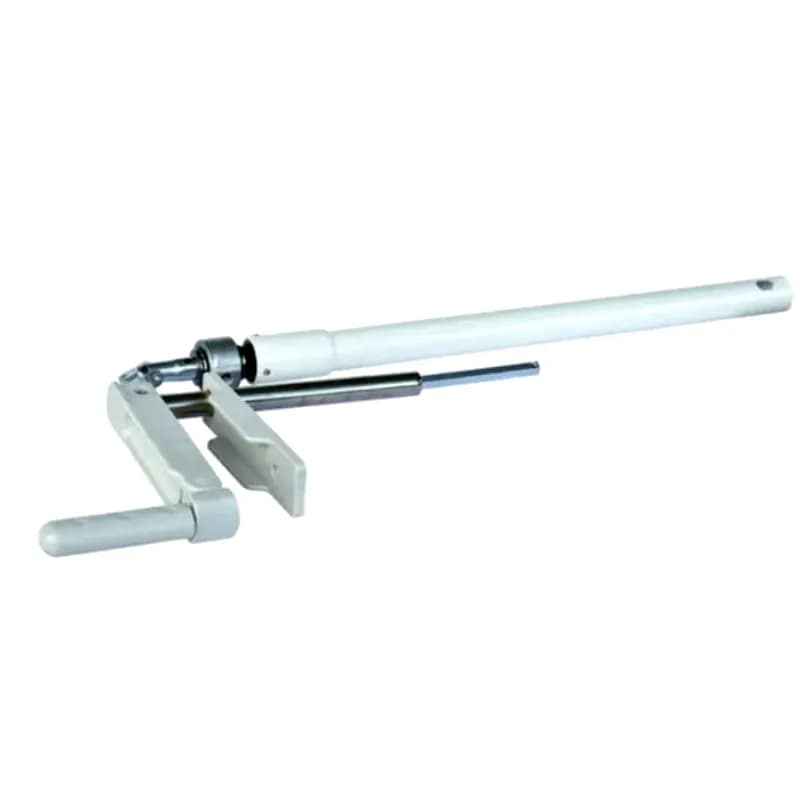
The manual crank system shown above matters more than procurement teams often assume. A crank with in-place protection prevents the handle from overriding past the safe travel point, which reduces both actuator strain and caregiver injury risk during repeated head-of-bed adjustment.
Technical Specifications That Matter in the Field
Frame and panel construction determine whether the bed survives disinfection, humidity, and daily cleaning. For bed panels, stamped willow steel with a thickness of 0.8 mm to 0.9 mm provides a cleanable surface with predictable load distribution. ABS head and footboards resist shatter, tolerate frequent wiping, and are designed for quicker disassembly during emergency care. The choice between stamped steel panels and ABS panels is not cosmetic; it affects cleaning protocol, panel replacement cost, and the bed’s resistance to warping under sustained load.
Bed dimensions should be checked against the actual corridor and doorway clearances of the receiving facility. A bed panel set with an 820 mm, 840 mm, or 900 mm width reflects real ward design trade-offs: narrower panels fit tighter doorways and older buildings, while 900 mm panels improve surface contact and patient comfort. The procurement specification should name the width and the door clearance requirement in the same tender line, because a bed that meets the clinical brief but cannot pass through the existing ward doors creates a costly retrofit problem after delivery.

stamped hospital bed panels are load-bearing components, not passive surfaces. The panel sections, connecting ears, and transmission parts form the movable structure that carries the patient through backrest and knee adjustment. Surface rust on a display sample is a warning sign; the production panel material and coating specification should be stated in the tender, not assumed.
General safety requirements for powered beds fall under IEC 60601-1, which addresses basic electrical and mechanical safety for medical electrical equipment broadcast at the system level [2]. It complements the bed-specific requirements in IEC 60601-2-52: the bed-specific standard controls mechanical risks, while IEC 60601-1 sets the electrical safety baseline for motors, controls, and any patient-adjacent powered function.
Mobility hardware is where government beds fail fastest in the field. Casters on hospital beds handle repeated locking and unlocking, exposure to cleaning agents, and movement over hard floors and thresholds. A central-locking caster group lets caregivers lock all four wheels from a single pedal, which is faster in emergencies and reduces the risk of partially locked beds rolling during patient transfer. The wheel tread material should be specified for low noise and hard-floor durability; TPR treads are widely used in medical furniture for their balance of grip, quiet rolling, and resistance to cleaning chemicals.

Guardrails are fall prevention devices, not optional accessories. For government wards with elderly and disoriented patients, a folding guardrail that locks into position and leaves no pinch gap between rail and mattress platform is the minimum safety requirement.

Material selection directly determines how the bed survives years of disinfection, humidity, and heavy use. <Essential Materials for Quality Medical Bed Parts Manufacturing> covers frame steel, ABS panels, coating systems, and the material trade-offs that separate long-service beds from those that need structural replacement early.
Procurement, Logistics, and Supplier Evaluation
Government tender documentation should require a technical datasheet at bid stage, not after award. The datasheet must state SWL, bed dimensions, panel material and thickness, actuator count for electric beds, caster type and tread material, guardrail configuration, and the applicable safety standard for each powered function. A bid that lists only model numbers without these parameters cannot be technically evaluated against alternatives.
Import readiness is a practical gate in African government procurement. The supplier should provide the correct harmonized system (HS) code for the bed type, country-of-origin documentation, and applicable compliance records before shipment. International hospital bed shipments are typically moved as containerized freight, and the tender should require a container loading plan so that the quantity per order is optimized against the flat-pack or assembled configuration. Lead times also belong in the evaluation matrix: manual and electric hospital beds commonly carry a production lead time of 40–45 working days, while casters and accessories may run 15–20 working days when ordered against existing stock. A supplier that cannot quote a committed production lead time at bid stage should be treated as a scheduling risk.
Quality management maturity is best verified through the manufacturer’s quality system. ISO 9001 certification provides evidence of documented design control, production control, and corrective action processes [3]. Government buyers should treat it as a minimum organizational requirement, then verify it with a factory audit or third-party inspection before the first bulk order.
After-sales capability is frequently undervalued in government tenders because the procurement office and the ward operate on different timelines. The evaluation should capture the warranty term on mechanism and structure, the availability timeline for spare parts like cranks, casters, guardrails, and actuator assemblies, and the manufacturer’s remote technical support capacity. A maintenance program without spare parts access will see bed availability decline steadily from year two onward; the WHO medical device technical series identifies structured maintenance and spare parts planning as a core condition for medical equipment reliability in resource-limited settings [4].
Once the specification is issued, the next risk is supplier reliability. <Choosing a Reliable Hospital Bed Parts Manufacturer: A Comprehensive Guide> covers audit points, certification checks, and the communication signals that separate consistent manufacturers from trade-only intermediaries.
For a government tender in the final pricing stage, request a direct quotation from the manufacturer’s export desk rather than routing through unverified intermediaries. Send the bed type, quantity, target delivery port, and tender deadline to [email protected]. The response should include a full technical datasheet, container loading plan, HS code reference, committed lead time, and country-specific export documentation list — if any of those elements is missing, treat the bid as incomplete.
Tender Support and Next Steps
A government hospital bed tender should leave no ambiguity in the acceptance criteria. Before issuing the final request for quotation, the technical committee can finalize the bed mix by ward type, confirm the SWL and panel width for each line item, and lock the documentation requirements into the bid instructions.
ZhongShan YingYun Hardware Products Co.,Ltd. manufactures hospital beds, bed panels, casters, guardrails, cranks, and structural metal parts through an in-house production and quality control process that has supported hospital furniture projects since 2006. For the current tender stage — specification review, datasheet preparation, sample evaluation, or container planning — contact the export engineering team at [email protected] or +8613528198959. The inquiry should include the bed quantity, configuration, and delivery port so the response can address lead time, container optimization, and country-specific import requirements with engineering precision.
Frequently Asked Questions
What bed types should a government hospital include in a single tender?
A complete tender normally includes manual beds for general wards, electric beds for ICU and high-dependency use, and transfer stretchers for emergency and interdepartmental movement. Specific wards such as bariatric, maternity, and pediatric units may require separate line items due to dimension or load rating differences.
What load capacity and dimensions are required for government hospital beds?
A general ward bed specification typically requires a 250 kg safe working load, with bariatric beds specified separately at 350 kg or above. Bed width should be matched to corridor and doorway clearances; common panel widths are 820 mm, 840 mm, and 900 mm, and the dimension requirement should appear in the tender alongside the door clearance constraint.
How should electric beds be specified for facilities with unreliable power?
Electric beds intended for ICU or high-dependency use should specify battery backup or a manual override for all powered functions, or both. The tender should require this explicitly, because the standard electrical safety requirements in IEC 60601-1 and IEC 60601-2-52 do not by themselves guarantee operation during a power outage [1][2].
What import documentation is required for hospital beds shipped to African countries?
The minimum documentation set usually includes the commercial invoice, packing list, bill of lading or airway bill, certificate of origin, and the applicable HS code declaration. Destination countries may add conformity assessments, pre-shipment inspection certificates, or health ministry clearance. The supplier should confirm the destination-specific requirements at bid stage.
How long does delivery take for government hospital bed orders?
Manual and electric hospital beds typically carry a production lead time of 40–45 working days, while accessories such as casters and cranks may be available in 15–20 working days. Ocean freight transit time is additional and depends on the origin port, destination port, and routing. A committed production lead time should be a tender requirement.
What warranty and after-sales support should a government tender require?
The tender should require at least a one-year warranty on the bed mechanism and structure, a written spare parts availability timeline for commonly replaced components, and a named technical contact for post-delivery support. The contract should also state the process for defective part replacement and the response time for technical inquiries.
References
[1] IEC 60601-2-52:2009/AMD1:2015, Medical electrical equipment — Part 2-52: Particular requirements for the basic safety and essential performance of medical beds, International Electrotechnical Commission, Geneva, 2015.
[2] IEC 60601-1:2005/AMD1:2012/AMD2:2020, Medical electrical equipment — Part 1: General requirements for basic safety and essential performance, International Electrotechnical Commission, Geneva, 2020.
[3] ISO 9001:2015, Quality management systems — Requirements, International Organization for Standardization, Geneva, 2015.
[4] World Health Organization, Medical Equipment Maintenance Programme Overview, WHO Medical Device Technical Series, Geneva, 2011.
If you’re interested, check out these related articles:
Identifying Reliable Brands for Adjustable Hospital Beds
Leading Hospital Bed Parts Manufacturers: A Comprehensive Guide
Comparing Prices for Hospital Bed Parts Manufacturers Effectively
Unlocking Comfort and Care Benefits of Adjustable Hospital Beds