
Sourcing a mechanical hospital bed supplier for a clinic is not simply about comparing unit prices. A bed that fails structurally or wears out prematurely compromises patient safety and disrupts clinical workflows. This guide applies an engineering perspective to help procurement teams and clinic owners evaluate the construction quality, functional features, and supplier credentials that determine whether a manual clinic bed will perform reliably over years of daily use. We draw on nearly twenty years of hospital bed manufacturing experience to highlight what separates a durable investment from a short-term cost saving that becomes a liability.
Evaluating Mechanical Hospital Bed Construction Quality
The frame and bed panel are the backbone of any mechanical hospital bed. When a clinic bed fails, it is rarely the crank mechanism alone; more often, the bed panel material fatigues, welds crack, or the frame’s coating peels, exposing bare metal to moisture and cleaning agents. In our factory, we use Liuzhou steel for bed panels, cold-rolled to a thickness of 0.8 mm or 0.9 mm for stamped panels. This is a common benchmark for mid-to-high-tier manual beds. Some low supplier quotes will cite 0.6 mm steel without specifying the grade, and that is a red flag.
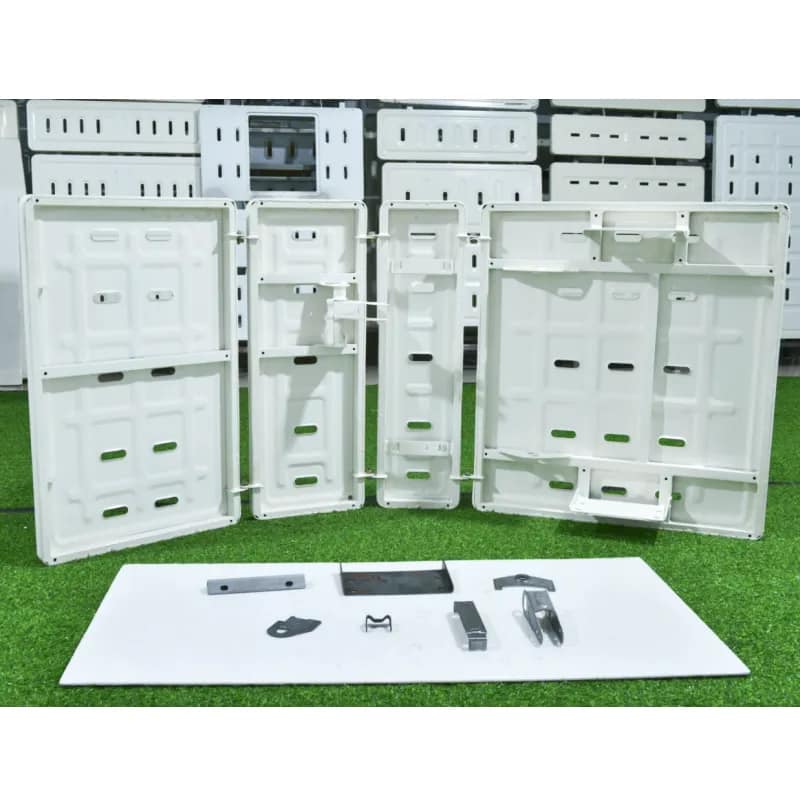
Weld quality matters equally. On a three-crank bed, the pivot points for backrest and knee-rest adjustment undergo repetitive stress. In manufacturing, robotic welding with consistent penetration depth yields joints that survive dynamic loading without micro-cracks. When assessing samples, look for smooth, uniform weld beads, not spotty or uneven seams. An experienced supplier will share weld penetration test reports if asked.
Bed frame tubing is typically rectangular steel with wall thickness of 1.2 mm to 1.5 mm. Thinner wall tubing might save a few dollars per unit, but it increases the risk of deformation under lateral load, especially when patients lean on side rails or when beds are moved aggressively. I recommend specifying a tubing wall thickness minimum of 1.2 mm in your RFQ and confirming it through a cut-section inspection of a sample.
Surface finish is another durability indicator. Manual beds undergo frequent cleaning with disinfectants that attack powder coating over time. High-quality electrostatic powder coating, cured at 180°C to 200°C, resists chipping and chemical degradation. Unexposed edges or thin coating spots become rust initiation points in humid climates. If you receive a sample, inspect edges and hidden corners for coating consistency.
| Component | Quality Indicator | Common Problem |
|---|---|---|
| Bed panel | 0.8–0.9 mm Liuzhou steel, uniform stamping | 0.6 mm ungraded steel, uneven stamping |
| Weld joint | Smooth, consistent bead with penetration test data | Spotty seams, visible porosity |
| Frame tubing | 1.2–1.5 mm wall thickness, specified steel grade | Thinner walls, generic material claim |
| Powder coating | Electrostatic application, full edge coverage, chemical resistance test | Thin spots, edge rust, peeling after cleaning |
Key Functional Features for Clinic Mechanical Beds
Clinics do not always need the full tilt and Trendelenburg positions found in ICU electric beds, but the manual bed functions must match daily clinical tasks. The most common manual configurations are single-crank (backrest adjustment only), double-crank (backrest and knee-rest), and three-crank (backrest, knee-rest, and full bed height adjustment).
A single-crank manual bed suits basic examination or minor recovery use. The backrest raises to about 75°, providing sitting support without knee articulation. For a small clinic that only needs a reclining surface for short procedures, this is a pragmatic choice. If the clinic also handles leg elevation for circulation or dressing changes, a double-crank bed offers the knee lift function with an angle up to approximately 40°.
Three-crank beds add overall height adjustment, typically raising from 430 mm to 760 mm. This matters in clinics where staff need to transfer patients to wheelchairs or where examination tables require matching heights. The height range also impacts ergonomics for clinicians performing procedures; a fixed-low bed forces bending and increases back strain.
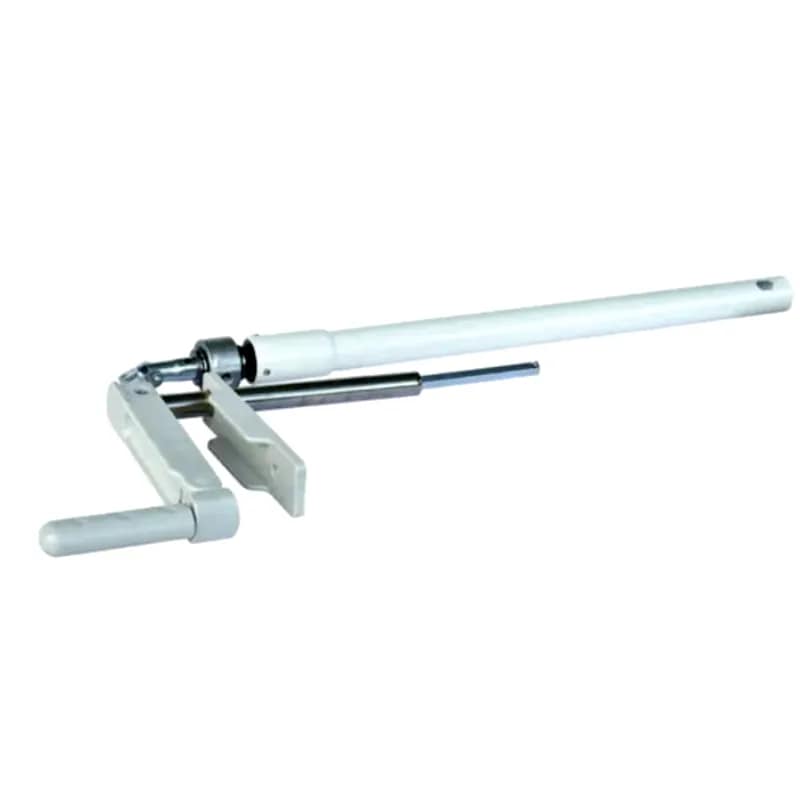
Manual crank systems rely on worm gear mechanisms. The durability of these gears hinges on material choice. Our factory produces cranks in ABS, iron, and stainless steel. For most clinics, an ABS crank with in-place protection (which prevents the handle from snapping back under load) is sufficient. Iron cranks can corrode in high-humidity environments if the surface treatment is inadequate. Stainless steel cranks are non-magnetic and corrosion-resistant, often specified for MRI suite beds or coastal clinics.
Side rails and casters complete the functional picture. Aluminum alloy guardrails with automatic locking buttons improve patient safety during bed mobility. Casters should have a central-locking or individual braking system. For clinics that move beds between rooms, I recommend TPR material casters with a 5-inch diameter and a lock mechanism that holds firmly on smooth flooring. Full-wrapped or double-face casters with a plunger brake resist floor scuffing and make cleaning underneath easier.

If your clinic’s layout demands exact bed dimensions or specific caster configurations, sharing your floor plan and patient profile with the supplier early can prevent ordering mismatched equipment. You can reach us at [email protected] to discuss non-standard sizing.
How to Assess a Hospital Bed Supplier’s Manufacturing Credibility
A supplier’s website may list many hospital bed models, but a procurement buyer needs to verify manufacturing depth. One of the first filters is whether the supplier owns its stamping, welding, and powder coating lines or outsources those critical processes. A factory with in-house stamping can control panel consistency and thickness verification at each batch. When production is outsourced, material substitution becomes harder to detect.
Certifications are a baseline, not a differentiator. CE marking and ISO 13485 (medical device quality management) are expected for export to regulated markets. However, I recommend also checking whether the factory holds ISO 9001 for general quality systems and can provide test reports for weld strength, load capacity, and powder coating adhesion. Our own benches test bed panels to 250 kg static load, well beyond typical patient weight, and we can share test videos with serious buyers.
A practical evaluation step is the factory visit or third-party audit. During a tour, check the steel coil storage: a manufacturer that uses large-diameter, low-grade steel coils to reduce cost will show that. Look at the assembly line for signs of organized workflow, labeled jigs, and calibrated gauges, which indicate process maturity. If a visit is not feasible, ask for a live video walkthrough of the production floor, focusing on the stamping presses, welding cells, and finished goods packaging.
The supplier’s component supply chain also matters. Casters, side rail locking mechanisms, and ABS headboard molds come from specialty vendors. A supplier with long-standing casting partnerships can provide replacement parts years after purchase, which is critical for ongoing service. Ask whether the supplier manufactures or sources its crank worm gears; in-house machining usually means tighter tolerance control and readily available spare gears.
Comparing Long-Term Value Beyond the Unit Price
Unit price per bed is the number that procurement software prioritizes, but the true cost of a mechanical clinic bed includes freight, expected lifespan, maintenance needs, and replacement part availability. A bed that costs fifty dollars less upfront but requires caster replacements every eighteen months or develops squeaking crank mechanisms after a year will erode that savings quickly.
Freight and packaging present another cost layer. Fully welded beds that cannot be partially disassembled occupy more container volume, raising per-unit shipping cost. Our range includes models whose ABS headboards and footboards snap on and off in thirty seconds, allowing flat stacking for container loading and reducing freight cost per unit. This matters especially for bulk orders destined for clinics in Africa, the Middle East, or Southeast Asia, where container utilization directly affects landed cost.

Warranty terms indicate a manufacturer’s confidence. A one-year warranty on mechanisms and structure is standard; extendable warranties or coverage on specific components like casters or crank gears signal higher quality expectations. However, warranty value is only as good as the supplier’s willingness to ship replacement parts quickly and at no charge. Before ordering, ask how replacement parts are handled: shipped with the initial order as spares, or upon warranty claim. A supplier that includes a two to three percent spare parts kit with bulk orders reduces clinic downtime.
Common Procurement Pitfalls with Manual Clinic Beds
One frequent oversight is ignoring the bed’s compatibility with existing clinic infrastructure. Bed dimensions should clear doorways and elevators. A standard manual bed length is approximately 2170 mm and width about 970 mm, but some models are narrower or wider. Measure the narrowest doorway and the turning radius from corridor to exam room; beds that cannot fit without disassembly add daily friction.
Another pitfall is ordering based on spec sheets without physical samples. A PDF can state “250 kg load capacity” without revealing whether that refers to static load on a flat surface or dynamic load during bed movement and backrest articulation. I suggest requesting a sample bed and performing a hands-on inspection: fully extend the backrest and press firmly on the edge to check for deflection; cycle the crank through full range several times to feel for gear binding or play; roll the bed with brakes applied to test caster lock stability.
Suppliers who accept small trial orders or low minimum order quantities allow clinics to evaluate real product quality before committing to larger volumes. Our factory offers MOQs as low as 50 units for many models, which suits new clinic projects or pilot deployments. A supplier’s willingness to ship a single sample, even at a higher per-unit price, is a practical indicator of transparency and confidence in their product.
Finally, confirm whether the supplier provides installation and maintenance documentation in the buyer’s language. Some manufacturers ship beds with factory-direct packaging but no assembly or maintenance guide. Clinics with less technical staff need illustrated setup instructions and a maintenance schedule for lubricating crank mechanisms, inspecting caster brakes, and checking side rail locking functions.
If your clinic is planning a bed purchase and needs a supplier who can deliver detailed product specifications, material certifications, and a sample for hands-on evaluation, send your requirements to [email protected] or call +8613528198959. We will confirm the right mechanical bed configuration for your patient profile and provide a quote based on your volume and delivery destination.
Common Questions About Mechanical Hospital Bed Sourcing
What is the difference between a mechanical and electric hospital bed?
A mechanical hospital bed uses hand cranks to adjust backrest, knee-rest, and sometimes bed height. Electric beds use motors. Mechanical beds are simpler, need less maintenance, cost less upfront, and remain operational during power outages. For clinics with lower patient throughput or budgets where electrical infrastructure is limited, a mechanical bed is often the more practical choice. The trade-off is that manual adjustments require staff effort on each repositioning.
A common misconception is that cranks are maintenance-free
Many first-time buyers assume manual crank mechanisms operate indefinitely without attention. In reality, worm gears require annual lubrication and periodic inspection for wear. Neglecting this leads to binding, difficult cranking, and eventual gear tooth failure. I encourage every clinic to ask potential suppliers for a maintenance checklist, not just a product brochure. A factory that provides a detailed service guide is showing long-term support commitment.
Are mechanical beds suitable for long-term care clinics?
They are suitable, but the specification must match the environment. For a long-term care facility, a double-crank or three-crank bed with a thick bed panel (0.9 mm), durable powder coating, and lockable casters will serve reliably. Pay extra attention to side rail ease of operation because staff will raise and lower rails many times each day. Aluminum alloy guardrails with automatic locking mechanisms reduce daily operational wear.
In the programs we have supported, the most overlooked factor is spare part continuity
A bed is a multi-year asset, and the casters, crank handles, and side rail locks encounter daily wear. Before finalizing a supplier, ask for a spare parts price list and confirm how quickly they can ship a replacement caster or crank assembly to your clinic. Our factory keeps common parts on standby and can ship within five working days for urgent requests, which prevents a single broken component from sidelining an entire bed.
If your sourcing timeline is tight or you need to confirm that replacement parts will be available for the bed model you select, share your part number and quantity requirements with us at [email protected]. We will confirm stock availability and lead time for your destination.
If you’re interested, check out these related articles:
Essential Certifications for Medical Bed Parts Manufacturers
Identifying Reliable Brands for Adjustable Hospital Beds