
The decision to source a three-function manual hospital bed often comes with a list of supplier brochures that all start to look the same: 75° backrest, 40° leg rest, 250 kg load. Those numbers alone do not separate a bed that stays in service for eight years from one that develops crank slop and panel rattle in two. I say that as someone who has spent nearly twenty years inside a hospital bed factory, from the stamping line to the finished ward-ready bed. The deeper difference is in manufacturing precision, material choices, and process discipline — none of which you can read off a spec sheet. This article walks through the practical manufacturing indicators that predict whether a three-function manual bed will hold up in a high-use ward, and how to spot them before you place an order for a 200-bed facility.
What Separates a Reliable Manual Bed Manufacturer From a Catalog Listing
A manufacturer that actually produces the bed frame, panels, and crank system runs a different operation from one that assembles bought-in parts. When I walk a procurement team through our factory, I show them the steel before it becomes a bed — Liuzhou steel coils, 0.9 mm thickness for the stamped panels, not 0.7 mm. That matters because bed panels bear patient weight and lift force every day. Thinner gauge panels flex under load, and flexing leads to weld fatigue. A manufacturer that invests in in-house stamping dies, CNC tube bending, and robotic welding is building structural integrity from the raw material stage. The bed we produce (Model YY-3C) uses a bed top of that 0.9 mm Liuzhou steel, an iron frame with powder coating over the entire surface, and ABS/PP head and footboards that snap off in 30 seconds for emergency access. If a supplier cannot show you the steel gauge or the weld penetration standard they follow, that is a gap to investigate.

Which Manufacturing Details Predict Bed Longevity
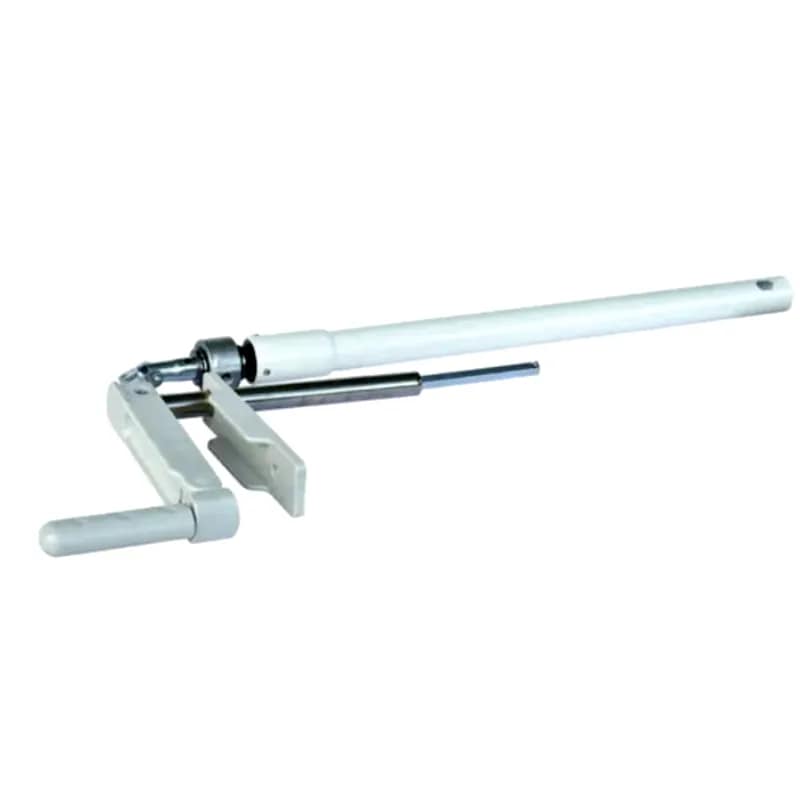
In our quality reviews, we track three mechanical stress points that typically show weakness first: the crank transmission joints, the bed panel connecting ears, and the caster mounting plates. For the three-function manual bed, the crank system is the heart of daily operation. Each backrest, leg rest, and height adjustment relies on a lead screw inside a telescoping transmission tube, connected through a steel universal joint. We have seen imported beds where the universal joint is a single-stamped part with no reinforcement — it develops play within twelve months of continuous use. Our crank assemblies use a two-sided welded ear with a 10.5 mm pivot pin that maintains zero-play contact through an in-place retention ring, not a snap clip. The difference is the difference between a bed that cranks smoothly at year five and one that requires a caregiver to rock the handle to find engagement.
The bed panel connections are the second point. Four-section stamped panels — 900 mm wide, 750/250/350/460 mm lengths — connect via transmission ears and support plates mounted with M8 bolts through 2.5 mm thick fixed plates. If those connections rely on bare steel contact without a polymer sleeve, the abrasion from patient repositioning wears the bolt holes oval over time, introducing lateral shake. Our support plates include a polymer bushing at each pivot, and the connecting ears are double-pressed from 3 mm steel. These are the sorts of details you can ask about in a factory video call — request a close-up of the bed panel pivot point, and a legitimate manufacturer will show it without hesitation.
How to Read a Three-Function Bed Specification With A Critical Eye
The datasheet for our manual three-function bed lists backrest tilt 75°±5°, knee board tilt 40°±5°, height adjustment range 430–760 mm, and overall dimensions 2170×970×480 mm. That looks similar to many datasheets. What the sheet does not tell you is whether the height adjustment mechanism uses the same load-rated screw as the backrest, or a lower-grade component. In our bed, all three cranks use an identical steel lead screw with a two-way limit protection system; the crank body is either ABS with a metal core or full stainless steel for magnetic-field-sensitive environments. The stainless crank option (YY‑00050) added roughly 12% to the component cost but is often specified for MRI-adjacent wards or humid climates where corrosion resistance matters.
When you compare beds, ask for the screw diameter and thread pitch, not just the tilt angle. A 10 mm lead screw with 2 mm pitch generates more lifting force with less crank effort than an 8 mm screw, which matters in a ward with frequent position changes. Also confirm whether the height-adjustment crank is positioned on the same side as the backrest crank — some layouts force the caregiver to walk around the bed twice during a full positioning routine. Small ergonomic choices accumulate into nursing time saved or lost.

What Customization and OEM Capabilities Reveal About A Manufacturer
A manufacturer willing to show you their stamping tool library and color matching booth is signaling that they can adapt to your facility’s requirements beyond the standard catalog. We have produced beds with 840 mm wide panels for narrow ward layouts, with custom-printed wood-grain headboards for senior living facilities, and with integrated drainage hook positions for specific post-surgical protocols. Each deviation from the standard 900 mm frame requires a separate stamping die, a dedicated jig for the frame welding robot, and a new packaging layout to keep freight volume efficient. If a supplier agrees to every customization without asking about your order volume or pointing out tooling lead time, they are likely outsourcing the fabrication or not planning to deliver on the modified spec. Real in-house customization produces a tooling change notice and a minimum order volume to amortize that die — for us, that number sits around 100 units per custom bed width, but we openly discuss it rather than burying it in a later invoice.
Practical Procurement: MOQ, Lead Time, and Container Optimization
A standard container loads 18 to 22 units of a fully assembled three-function manual bed, depending on whether the bed is packed knocked-down or semi-assembled. Our factory packs each bed in a wooden crate at approximately 2020×950×340 mm, gross weight 80 kg, which gives a 40-foot container capacity of roughly 20 units with safe stacking. That matters for landed cost calculations. We also offer a 50-unit MOQ, which is a trade-off: below 50 units, the per-unit cost increases by about 8% due to setup charges on the powder coating line and batch testing overhead. We are transparent about that because a project manager ordering 30 beds for a clinic renovation should know whether it is worth ordering their full projection now or staging a partial order at a slightly higher unit price to match cash flow.
Lead time for our three-function manual bed is 40 to 45 working days from deposit confirmation. That timeline includes 15 days for steel procurement and panel stamping, 10 days for frame welding and powder coating, and the balance for assembly, inspection, and crate packing. If a supplier quotes 20 days for a full container of manual beds, ask what portion of that timeline is spent on final quality inspection; a rushed inspection window is where warranty claims originate.
If your project involves a mix of manual and electric beds, specifying consistent guardrail and caster types across the fleet reduces maintenance training effort and spare part inventory. This is something we work through with procurement teams early — matching the horizontal folding guardrail and central-locking caster specification across both bed types so that nurses encounter identical operation at every bedside.

After-Sales Support That Actually Reduces Downtime
A one-year mechanism and structure warranty is standard, but what makes a difference is whether the manufacturer can ship a replacement crank assembly or bed panel support within three working days when a ward bed goes down. We keep buffer stock of the top 20 replacement SKUs — cranks, casters, side rail locking buttons, bed panel connecting ears — specifically for existing customers. We also provide a bed maintenance manual with torque specifications and lubrication intervals for the lead screw, because in many facilities the maintenance staff is responsible for 300 beds and a missing manual means preventive care gets skipped. A manufacturer that sends a PDF manual before you ask for it is taking after-sales seriously.
For projects in humid regions, we offer an upgraded powder coating specification using Aksu antibacterial powder, which adds about 4% to the bed cost but significantly reduces surface rust complaints in our African and Southeast Asian deliveries. These are the specifics worth confirming early, because retrofitting a coating spec after 200 beds are already in-country is not practical.
Common Questions About Selecting Manual Hospital Beds
Can a three-function manual bed serve in an ICU setting?
It depends on the ICU’s patient acuity profile. A manual bed lacks the Trendelenburg tilt and rapid CPR release of a five-function electric ICU bed, so for ventilated or hemodynamically unstable patients, an electric bed is the appropriate choice. However, for step-down ICU units or post-surgical observation wards where patients are stable but require frequent backrest and leg rest adjustment, a well-built three-function manual bed works and eliminates motor failure as a downtime concern. In our experience, some hospitals use a mix: electric beds for the highest-acuity rooms and manual beds for the remaining monitored beds, which keeps the capital budget manageable.
What is the real difference between a two-crank and three-crank manual bed?
A two-crank bed adjusts backrest and leg rest. A three-crank bed adds whole-bed height adjustment, which affects caregiver ergonomics and patient transfer safety. The height range on our three-function bed is 430–760 mm; the lower setting allows a patient to place feet flat on the floor for transfers, and the upper setting reduces the need for the nurse to bend deeply during dressing changes or wound care. For a nursing home where fall risk is a daily concern, the height‑adjustable crank is worth the incremental cost because it enables a lower sleep surface at night and a working height during care routines.
How do I confirm a manufacturer’s quality certifications?
Ask for the ISO 13485 certificate number and verify it on the issuing body’s online directory. Also request the specific test reports for the bed model you are considering — load capacity certification (we test to 250 kg static load), weld inspection criteria (we follow a visual plus sample destructive test per production batch), and surface coating adhesion test results (we use a cross-hatch test per ASTM D3359). A manufacturer that declines to share batch test records is either not doing the tests or does not want you to see the results.
What spare parts should I order with the initial container?
We recommend at least two sets of casters (four or five per set depending on the bed), two crank assembly spares, and one full set of bed panel connecting hardware. These are the parts that see mechanical wear and are small enough that including them in the initial shipment costs very little extra freight but saves a future air shipment at a much higher rate. For a 20-bed order, adding a spare parts kit of about 15 kg adds roughly $120 to the sea freight line item and can prevent a bed from being out of commission for two weeks while a replacement caster is shipped.
If your facility has specific requirements for bed dimensions or needs guidance on mixing manual and electric beds across your ward layout, share your floor plan and patient census with our team and we will confirm the most cost-effective configuration — reach out at [email protected] or +8613528198959.
If you’re interested, check out these related articles:
Choosing a Reliable Hospital Bed Parts Manufacturer: A Comprehensive Guide
Ensuring Quality Control in Hospital Bed Parts: A Comprehensive Guide
Identifying Reliable Brands for Adjustable Hospital Beds
Essential Materials for Quality Medical Bed Parts Manufacturing
Essential Safety Features for Adjustable Medical Beds