
A manual hospital bed with two cranks or three cranks is one of the most common procurement decisions for general wards, and the choice affects patient positioning, nursing workflow, and long-term maintenance costs. While both types rely on hand-cranked screw mechanisms instead of electric motors, the difference in adjustability and structural complexity creates a practical divide between short-term savings and lasting versatility. Having evaluated and assembled both configurations in house for over a decade, I believe the three crank manual bed is usually the better long-term buy for facilities that admit patients with diverse care needs, but a two crank bed is still the right call for standardized, low-acuity wards where only backrest and knee lift are required. This article breaks down what the crank count really changes, where the extra money goes, and how to match the bed to your clinical workload so you avoid both overspending and underbuying.
Understanding Manual Crank Mechanisms
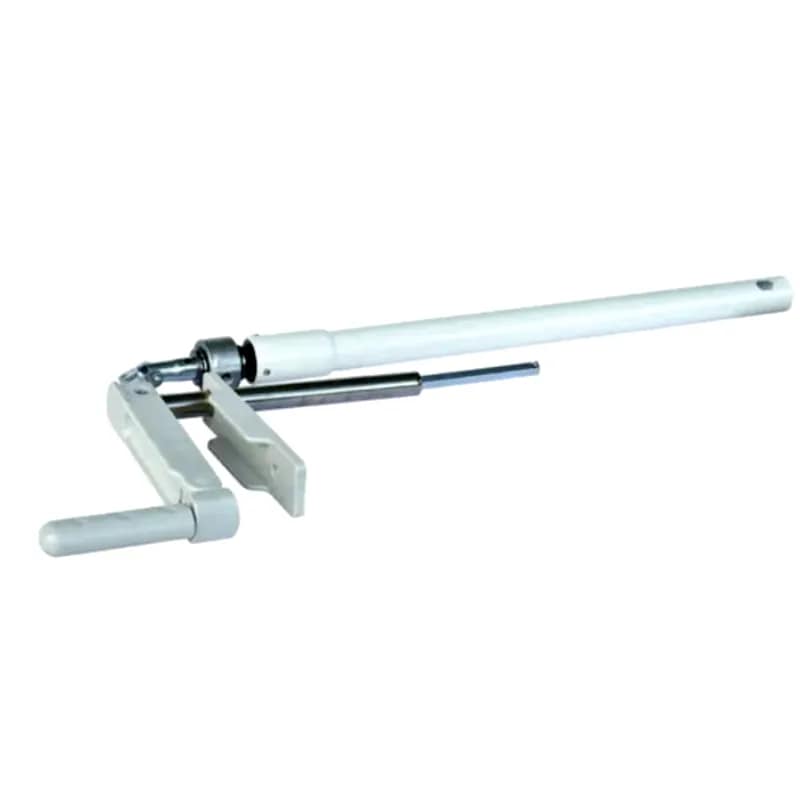
A manual hospital bed functions through a system of lead screws, universal joints, and hexagonal steel shafts that convert the rotation of a crank handle into linear movement of bed panels. The crank handle is typically stored under the footboard when not in use and slides onto a shaft when a caregiver needs to adjust the bed. The internal transmission parts, including swing arms and connecting ears between bed panels, carry the load, so the quality of these stamped metal components directly affects how smoothly the bed adjusts over years of daily use.
The crank system on a manual bed is a purely mechanical, standalone adjustment method. It works without electricity, which eliminates motor failure risk and makes these beds suitable for facilities where power supply is unpredictable or where beds need to be used in temporary treatment areas. The trade-off is that the caregiver has to physically rotate the handle, and the effort required increases if the mechanism is poorly machined or inadequately lubricated. I have inspected crank assemblies where the iron handle and ABS body had visible casting flash that caused binding after a few months, a defect that is entirely preventable with proper quality control at the stamping and finishing stage.
Functions and Adjustability: Two Crank vs Three Crank
The functional difference is straightforward. A two crank manual bed provides backrest tilting (up to approximately 75°) and knee board tilting (up to approximately 40°), allowing a patient to sit up and elevate the legs. It does not raise or lower the entire bed frame. A three crank manual bed adds a full bed height adjustment, typically from around 430mm to 760mm, which lets nursing staff set the mattress at a safe working height for wound care, transfers, or patient access.
| Feature | Two Crank Manual Bed | Three Crank Manual Bed |
|---|---|---|
| Backrest adjustment | Yes (0–75°) | Yes (0–75°) |
| Knee board adjustment | Yes (0–40°) | Yes (0–40°) |
| Bed height adjustment | No | Yes (430–760mm) |
| Typical applications | General wards, short-stay units | General wards, geriatric care, rehabilitation |
| Mechanical complexity | Lower | Moderate |
| Manual effort per full adjustment cycle | Fewer cranking points | Slightly higher due to extra crank |

If your nursing workflow requires frequent patient transfers or if the bed serves patients with limited mobility who need the mattress lowered for safer entry and exit, height adjustment becomes a daily operational need rather than a nice-to-have. A double crank hospital bed without height adjustment forces caregivers to bend and lift in ways that increase injury risk over time, especially in wards with higher patient turnover.
Structural and Mechanical Differences
Adding a third crank affects more than just the adjustment range. The bed frame must incorporate additional transmission arms, a dedicated height adjustment screw, and often a longer linkage to connect the crank input to the lifting mechanism. The stamped bed panel configuration also changes. On a three crank bed built with four-section stamped panels, each panel section pivots independently to support the backrest, seat, thigh, and leg movements while the height mechanism raises the entire platform. The panel material, typically Liuzhou steel or similar willow steel at 0.8–0.9mm thickness, must maintain structural integrity under repeated articulation and a 250kg working load, a requirement that is identical across both bed types but places more fatigue cycles on the three crank design over its lifetime.
The connection points between panels, the swing arms, and the bed foot cover sections all see higher stress in a three crank system because the added height mechanism introduces new load paths. In my experience overseeing product quality, I pay close attention to the transmission parts: the “7” shape force arm, the base support plate, and the connecting ears. These are the points where a lower-quality stamping will develop play within two to three years, causing the bed to wobble or make the crank handle feel loose. A single crank hospital bed is mechanically simpler still, but that is a different comparison and sits outside the two-crank-versus-three-crank decision.
Procurement and Maintenance Considerations
From a procurement standpoint, a three crank manual bed costs more upfront, but the premium is modest when viewed against the nursing efficiency it enables over a seven-to-ten-year service life. The bill of materials for a three crank bed includes an extra universal joint, hexagonal steel shaft, and crank handle assembly, plus longer transmission rods. That incremental material cost is not the main driver of price; the assembly labor and quality inspection time is, because each additional adjustment axis must be verified for smooth operation and limit protection.
On the maintenance side, the crank mechanisms on both types require periodic lubricant replenishment and inspection of the ABS or iron crank bodies for cracking. The height adjustment screw on a three crank bed is exposed to more dust and cleaning fluid in a ward environment, so it needs more frequent cleaning. If your facility has an in-house biomedical engineering team that performs quarterly bed inspections, the difference is negligible. If maintenance is outsourced or performed only on an as-needed basis, the two crank bed may be more forgiving of neglect, simply because there is one less mechanism to go out of adjustment.
For wholesale or turnkey project orders, I recommend asking the manufacturer about the crank system certification and whether the screw mechanism incorporates bidirectional limit protection. The crank handle itself should have an in-place protection feature, preventing it from disengaging during use. An ABS crank with a locking collar is a reliable choice for high-traffic wards, while a stainless steel crank system adds non-magnetic properties that matter in MRI-adjacent environments, though that specification is rare for manual beds.

Choosing the Right Bed for Your Facility
Start with the patient profile. If the ward treats relatively mobile patients recovering from surgery and the primary need is backrest and leg elevation for comfort, a two crank bed will perform capably. If the patient population includes geriatric, bariatric, or long-term care patients where caregiver-assisted transfers are frequent, the height adjustment of a three crank bed becomes a safety and retention factor for nursing staff.
Evaluate your maintenance capacity honestly. A facility that struggles to keep electric beds operational due to power instability or budget constraints often gravitates toward manual beds, but the same logic applies within the manual range. The three crank bed requires marginally more upkeep. If your biomedical team can handle it, the clinical benefit justifies the extra work.
Procurement teams ordering in bulk should align the bed type with each ward’s defined workload, not a uniform spec across the entire hospital. A 50-bed general ward might use twenty two-crank beds for its ambulatory patient section and thirty three-crank beds for its higher-acuity section. This mix avoids overspending on standard-care areas while still providing full positioning where it is genuinely needed.
For current pricing, lead times, or to request a sample crank mechanism for evaluation, contact Yingyun Hardware at [email protected] or call +8613528198959. If you send your bed specification requirements along with the quantity and delivery timeline, we will prepare a detailed quotation aligned with your project schedule.

Common Questions About Manual Hospital Bed Configurations
Does a two crank manual bed meet most ward requirements?
In a ward where patients are generally self-mobilizing and staff perform mainly seated or overhead tasks, yes. The backrest and knee lift functions handle the majority of comfort and basic care positioning. The limitation appears when staff need to transfer a patient or perform procedures at a specific working height. Without height adjustment, they must adopt suboptimal body mechanics, which is why many facilities upgrade to three crank beds even when they initially buy two crank models.
Is a three crank bed heavier and harder to move during cleaning?
The weight difference is small, typically under 10kg, because the additional crank assembly and linkage rods are not massively heavy. The larger factor is the bed’s overall frame construction and caster type. Five-inch TPR full-wrapped casters with central locking make either bed easy to reposition during housekeeping. If mobility is a concern, specify casters with low rolling resistance rather than judging by crank count.
How do I know if the crank mechanism is well-made before buying?
Request a sample crank assembly and check three things: the smoothness of the internal screw thread as you turn it by hand, the absence of side-to-side play in the universal joint, and the firmness of the in-place protection when the crank handle is engaged. A crank that rattles at the handle right out of the box will only get worse. At Yingyun Hardware, we provide crank samples on request for wholesale buyers precisely because the crank mechanism determines the daily usability of the whole bed. If you are evaluating a large order, ask your supplier whether crank samples can be shipped with the initial quotation.
If you’re interested, check out these related articles:
Identifying Reliable Brands for Adjustable Hospital Beds
Can Adjustable Hospital Beds Be Customized for Homecare Needs