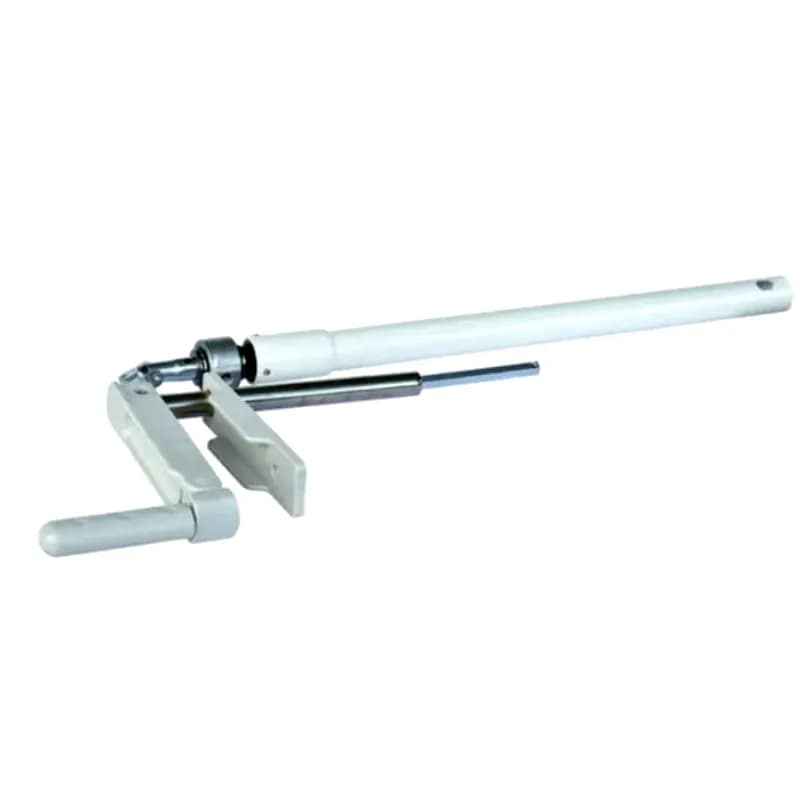
Material selection for medical bed parts begins with the component, its drawing and the intended operating environment. A material name alone does not establish load capacity, interchangeability or cleaning compatibility. Buyers need to connect the material description to the part number, dimensions, finish and supporting records.
This guide uses specifications listed in the YingYun product catalogue as purchasing examples. These catalogue entries are a starting point for an inquiry; the final order should identify the agreed material and drawing revision for the specific component.
Start with the Part Number and the Material Actually Listed
Different parts need different information. A motor mounting seat is defined partly by its fixing interface, a caster by its mounting and brake arrangement, and a bed panel by its section dimensions and connection points. Compare the following published descriptions before requesting further details:
- Motor fixing seat (A), YY-000472: the description specifies 3 mm iron material, laser cut and then stamped. The specification table lists customizable dimensions and a powder-coating color according to the customer’s requirements.
- YY-C51 five-inch caster: the table lists 304 stainless steel and TPR, with a size of 5 inch. This is an assembly material description; it does not identify every internal component or establish a load rating.
- 840 mm four-section stamped bed panel, YY-5BP01: the listing specifies steel and a thickness of 0.8 mm.
- 900 mm four-section stamped bed panel, YY-4BP01: the listing specifies steel and a thickness of 0.9 mm.
- ABS dining board, YY-DT04: the specification table uses the material label ABS / PP. Confirm which resin is supplied for the selected version rather than treating the two names as an exact formulation.
These examples should not be used to infer that all products in the same category have the same material or finish. Quote the exact model and request its current specification when comparing offers.
Specify the Metal Grade, Thickness and Formed Geometry Together
Descriptions such as iron or steel do not identify a complete material grade. Ask for the grade designation used for the order, the applicable material specification and any material records required by your purchasing process. An unfamiliar translated material name should be clarified with the supplier rather than assigned an assumed alloy or processing route.
For the motor fixing seat, the published 3 mm thickness is only one input. The motor interface, fixing-hole positions, orientation and connection to the bed frame also need an approved drawing. Confirm which dimensions refer to the unfinished part and which apply after forming or coating.
The two stamped-panel listings illustrate why thickness must remain attached to a specific model: YY-5BP01 lists 0.8 mm steel, while YY-4BP01 lists 0.9 mm steel. The different widths and section geometry also matter. Neither thickness alone establishes the safe working load of a complete bed, and the two panels should not be treated as interchangeable on that basis.
Separate Caster Materials from Assembly Performance
The YY-C51 listing identifies 304 stainless steel and TPR for a five-inch caster. For procurement, ask which assembly parts use each material and request the mounting drawing. The mounting interface, brake arrangement and required clearances need to match the receiving bed or furniture assembly.
Wheel diameter and a material label do not by themselves establish rolling resistance, noise, load capacity or cleaning compatibility. If those properties are acceptance requirements, put them in the inquiry and ask for the relevant model-specific information and test conditions. Avoid transferring a result for one caster design to another model.
Confirm the Exact ABS or PP Version
For plastic dining boards, headboards, guardrail covers and crank housings, the general resin family is a starting point. Request the specified resin grade, color, component drawing and any application-specific material records. The ABS / PP wording in the YY-DT04 table leaves the supplied version to be clarified for the order.
Check the finished part as well as the resin description. Connection points, wall geometry and mating dimensions affect whether it fits the intended assembly. Where an existing sample is being matched, identify its model or drawing revision and ask the supplier to confirm the proposed replacement against those details.
Do not assume that a plastic described as easy to clean is compatible with every chemical or sterilization process. Request written compatibility information for the cleaning products and conditions intended for that component. Any required evidence should identify the material and finished part to which it applies.
Write the Surface Finish into the Purchase Specification
Material and surface finish are separate purchasing fields. For the motor fixing seat, the catalogue offers powder-coating color according to customer requirements. Confirm the coating system, color reference, coverage and relevant acceptance criteria before approving a sample or production order.
For plated, coated or exposed metal components, ask which surfaces are treated and whether mounting or mating areas have special requirements. A finish name alone does not establish corrosion performance or compatibility with a particular cleaning product. Request the finish-specific records needed for the intended application rather than relying on a general durability claim.
Request Records that Match the Actual Component
A quality-management certificate and a component material record answer different questions. If a supplier cites a quality-management standard such as ISO 13485, request the certificate holder and scope. Do not treat the certificate name as a substitute for the part’s material grade, approved drawing or relevant test records.
Identify the evidence required for the order in advance. Depending on the component and intended application, the review may include material documentation, dimensional inspection results, coating information or specific performance tests. Ask which model, material and test conditions each record covers. A general statement about testing does not establish that every component has the same evaluation or certification scope.
Include These Details in a Material and Fit Inquiry
- The product name, model and required quantity.
- The receiving bed or assembly drawing, with its revision.
- The required material grade, or a request to clarify the catalogue description.
- Thickness, mounting interfaces, hole positions and other critical dimensions.
- The required surface finish, color and any areas with special finish requirements.
- The intended cleaning environment and the compatibility information you need.
- Required material records, inspection documents and application-specific test evidence.
- The sample-approval process and which agreed specifications will apply to production.
Send the component drawing, quantity, material questions and finish requirements to [email protected] for a specification inquiry. Keep the agreed drawing and material description with the order so later replacement inquiries can refer to the same component version.
Frequently Asked Questions
Is a thicker steel part automatically the better choice?
No. Compare thickness together with the specified grade, part geometry, connection design and the evidence required for the assembly. The 0.8 mm and 0.9 mm panel listings describe different models, not a universal ranking of bed performance.
Does a 304 stainless-steel label establish the performance of a complete caster?
No. The YY-C51 catalogue description also names TPR and identifies a five-inch size. Confirm the component materials, mounting dimensions, brake arrangement and any required performance data for the complete caster.
Can ABS and PP be treated as interchangeable in an order?
Do not substitute one for the other without confirmation. For a listing that says ABS / PP, ask which version and grade will be supplied and approve that description against the intended component requirements.
What should I do when a supplier’s material name is unclear?
Request the grade designation, applicable material specification and relevant records. Keep the original supplier wording in the inquiry until it is clarified rather than replacing it with an assumed technical definition.
Related Component Photographs
The existing catalogue photographs below illustrate component types. A photograph does not establish a material grade, certification or test result; use the model-specific documents for those checks.