
Standard vs bariatric hospital bed specifications are not only a question of a wider deck and a larger published load. After nearly twenty years working on hospital bed frames, stamped panels, side rails, and casters, I have found that the gaps that matter are structural. Deck panel thickness, caster ratings, side rail locking, and doorway clearance create more risk than a single load figure. If a facility chooses the wrong unit for the patient mix, the failure usually appears during transfers, brake tests, or a difficult move through a ward corridor.
What Do Standard Hospital Bed Specifications Actually Include?
A standard hospital bed is built around a narrow set of baseline parameters that budget and general wards can use without special preparation. In the Yingyun range, the manual three crank bed is a useful reference: L2170 mm by W970 mm by H480 mm before height adjustment, a backrest tilting to 75 degrees plus or minus 5 degrees, a knee section tilting to 40 degrees plus or minus 5 degrees, and a safe working load of 250 kg. The bed top uses Liuzhou steel, the frame is iron, and the headboard and footboard are ABS or PP. The side rails in this class are commonly aluminum alloy and iron.
The deck width is the specification that controls most downstream decisions. Standard decks in the stamped panel line range from 820 mm to 900 mm wide, while the three function electric bed can go to about 1030 mm. That difference changes how the bed fits through doors and how easily staff can reach the patient. A 970 mm wide frame usually fits a standard hospital doorway, but the door swing and the frame around the door should still be checked before a bulk order.
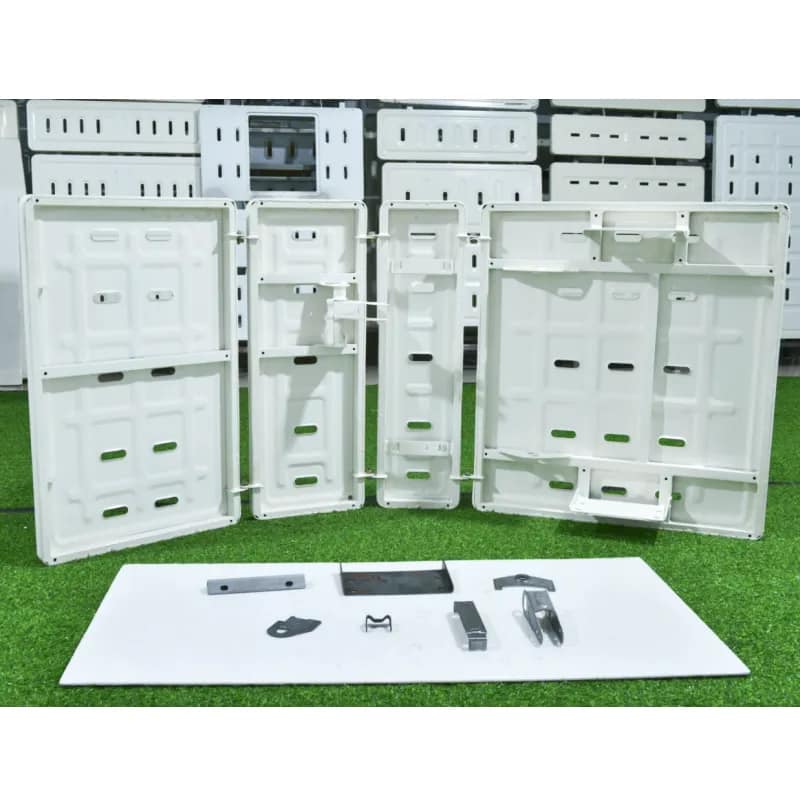
What I look at first on a standard specification is not the bed height alone. It is whether the deck sections, the frame rails, and the side rail brackets share the same load path. A standard bed can be correct for a 150 kg patient and consistently wrong for a 230 kg patient who transfers multiple times a day.
What Changes When a Bed Moves to Bariatric Specifications?
Bariatric specifications change four areas at the same time: deck width, load path, caster sizing, and side rail design. The deck width often moves toward 1000 mm to 1200 mm. The safe working load moves above 350 kg, but that number alone does not define the bed. The more important changes are hidden in the subframe and in the way force travels from the deck to the floor.
A true bariatric bed does not simply take a standard 250 kg subframe and make it wider. The platform sections must be thick enough to avoid flexing under a heavy patient, the side rails need to hold against lateral pressure during repositioning, and the casters need a higher per wheel rating because four wheels share a larger total load. If a supplier starts with a standard frame and only widens the sleeping surface, the unit may pass a static load check and still perform poorly after months of transfers.
Frame and deck material choices determine whether a wider bed stays stable under repeated loading. <Essential Materials for Quality Medical Bed Parts Manufacturing> covers how steel grade, tube wall thickness, and stamping depth affect the way a hospital bed frame holds up in daily use.

Where Do Standard and Bariatric Bed Specifications Differ Most in Daily Use?
The differences become visible in the deck, the side rails, and the casters. The table below is the comparison I use when a hospital asks whether a standard unit is enough.
| Specification point | Standard hospital bed reference | Bariatric bed requirement to verify |
|---|---|---|
| Deck width | 820 mm to 1030 mm in the current Yingyun range | Often 1000 mm to 1200 mm, depending on patient need |
| Safe working load | 250 kg on current Yingyun bed range | 350 kg or above when specified as bariatric |
| Deck material | Stamped willow steel at 0.8 mm to 0.9 mm | Thicker panel or added crossmembers and deeper stamping |
| Side rails | Aluminum alloy and iron folding rails | Extended height or split rail design for heavier body mass |
| Casters | 3 to 5 inch TPR or central locking casters | Larger diameter or dual wheel units with higher per wheel rating |
| Room fit | 970 mm width fits most standard doorways | Wider deck usually requires door, corridor, and lift checks |
Deck Platform and Frame Load Path
In the products I review, standard stamped bed panels are typically 0.8 mm or 0.9 mm willow steel. That works for general ward conditions because the sleeping surface is supported by the frame below it. A bariatric deck needs either thicker material or more support points if the same steel is used. The reason is simple: a heavier patient creates more point loading around the hips and shoulders, and a panel that flexes slightly may feel acceptable at first and then begin to crack at the mounting points.
Side Rail and Caster Interface
The side rail is not just a fall prevention device. It also takes lateral force when a patient pulls or when staff reposition the patient. Aluminum alloy and iron rails are common on standard beds, but a bariatric unit usually needs more rail height or a split rail design to match the larger body profile. The casters matter for a different reason. A 5 inch central locking TPR caster works well for a standard mobile bed, but a heavier bariatric unit can require a larger diameter, a dual wheel, or a different tread compound to keep rolling resistance and floor pressure under control.

Why Is a 250 kg Load Rating Not the Same as a Bariatric Bed?
A 250 kg rating is a useful baseline for general ward work, but it is not a bariatric specification. The rating is tested under specific static conditions. It does not fully describe what happens when a heavy patient changes position, grabs a side rail, or is transferred with a hoist. The side rail sees lateral force, the deck sections see point loading around the patient’s hips and shoulders, and the casters see impact loads when the bed passes over a threshold.
I have seen beds that met the published number but still showed panel flex and side rail loosening after extended use with patients near the upper limit. The issue was not the steel grade. It was that the frame was not designed for repeated asymmetric loading. That is why a proper bariatric review should look at the whole load path, not just the final total.
If your program includes patients above 250 kg or frequent assisted transfers, it is worth confirming deck section thickness, caster per wheel rating, and side rail locking before you finalize the bill of materials. Send your patient profile and room dimensions to [email protected].
How Should Procurement Teams Choose Between Standard and Bariatric Bed Specifications?
Start with the patient population, not the bed catalog. If the facility’s maximum patient weight is below 250 kg and doorways are standard, a standard bed is usually the lower cost maintenance path. If the bariatric population is regular rather than occasional, the cost of a few heavier duty beds is usually lower than the cost of staff injury, wall damage, or equipment failure from forcing the wrong bed into service.
Confirm Patient Weight and Transfer Patterns
A single recorded weight is not enough. The bed may need to hold a patient after fluid retention, post surgical weight gain, or family members sitting on the edge during visits. The transfer method also changes the load. A hoist transfer shifts force differently from a lateral slide or a seated reposition. I would rather specify for the highest realistic patient load than assume the daily weight is the maximum.
Check Doorways, Lifts, and Staff Workflow
The best bed specification fails if it cannot reach the room. Standard beds around 970 mm wide usually move through hospital corridors without much planning. A bariatric bed at 1100 mm or more can require a different route, a larger elevator, or a staged transfer plan. The same applies to staff workflow. If nurses cannot reach the patient comfortably, they will not use the bed the way the specification intended.
Room dimensions, patient mix, and bed functions interact more than a simple specification sheet shows. <How to Choose the Right Adjustable Medical Bed for Your Clinic: A Comprehensive Guide> covers how doorway clearance, staff workflow, and clinical tasks around the bed change the final selection.
Choosing between standard and bariatric specifications without checking the full patient profile can leave a ward with beds that are technically compliant but operationally wrong. If you are replacing a mixed general and bariatric ward, we can check your deck width, caster rating, side rail plan, and doorway clearance against the patient flows you expect. Send the room dimensions, patient weight range, and quantity to [email protected] or call +8613528198959.
What Questions Come Up Most Often About Standard and Bariatric Bed Specifications?
Is a wider bed always a bariatric bed?
No. A wider deck can accommodate a larger patient, but bariatric performance depends on the frame, deck sections, side rails, and casters working together. If a manufacturer widens the sleeping surface without changing the subframe or caster ratings, the bed may still flex or become hard to move. I look for a matched specification: the deck width, safe working load, and hardware load path all rise together. If only the width changes, the bed is a wide standard bed, not a bariatric bed.
Can a standard hospital bed be used for a patient over 250 kg temporarily?
A temporary placement does not remove the structural load issue. A patient above the rated capacity can overload the casters and side rails even during a short stay, especially during repositioning or transfers. The right temporary approach is not to ignore the rating. It is to use a bed rated for the actual patient weight and keep the standard unit for the population it was designed to serve. This protects both the patient and the staff who move the bed.
Do bariatric beds require different casters or floor protection?
It depends on the floor surface, the total bed weight, and how often staff move the bed. A heavy bariatric bed concentrating load on four small casters can mark vinyl or damage soft flooring. Larger diameter casters, dual wheel designs, or a wider tread reduce that risk. The floor surface should be checked before the bed order is confirmed, not after the unit arrives. A hallway that works for a 200 kg system may not hold up under repeated movement of a 400 kg system.
How do doorway width and patient lifts affect bariatric bed selection?
In projects I have reviewed, the doorway is usually the first hard constraint. A standard bed around 970 mm wide moves through many hospital doors without much planning. A bariatric bed at 1100 mm or more can require a different route, a wider elevator, or a transfer plan in the corridor. Patient lifts and hoists add their own clearance requirements. I would rather confirm these dimensions before the specification is locked than discover a delivery problem at the loading dock. Send your room dimensions and patient weight range to [email protected] and we can confirm whether a standard or bariatric bed specification fits the building and the care workflow.
If you’re interested, check out these related articles:
How Much Does an Adjustable Hospital Bed Cost on Average
Leading Hospital Bed Parts Manufacturers: A Comprehensive Guide