
A medical IV stand may look simple, but it sits directly between infusion safety, housekeeping durability, and clinician ergonomics. Choose the wrong Medical IV Stand Manufacturer and small defects, such as an unstable base, a weak locking collar, rough weld finishing, or poorly fitted hook clamps, become daily risks in the ward. The evaluation below moves beyond sample photos and unit price into the material, mechanical, quality-system, and compliance details that separate a production-grade supplier from a surface-level workshop.
What Defines a Qualified Medical IV Stand Manufacturer?
A qualified supplier should control the full manufacturing chain that affects an IV stand: tube cutting, bending, welding, grinding, polishing, fitting assembly, surface finishing, and packaging. The product may be mechanically straightforward, but the difference between a dependable stand and a problem-prone one is usually found in process control rather than appearance.
The strongest supply partners are usually manufacturers that already produce hospital bed accessories and related metal medical furniture. An IV pole shares design logic with bed rails, side rail supports, casters, bed hooks, and stamped bed panels. A factory that understands hospital bed tolerances, cleaning requirements, and load-bearing metal structures is better positioned to produce an IV stand that survives repeated disinfection, ward transport, and heavy infusion pump loading.
From a specification standpoint, Yingyun Hardware supplies medical IV poles in 201 or 304 stainless steel with 2-hook or 4-hook configurations. Outer tube diameters of 16 mm and 19 mm can be customized, standard minimum order quantity is 50 pieces, production lead time is 15–20 working days, and the warranty covers the mechanism and structure for one year. Product-level choices should be documented at RFQ stage so the quote reflects the intended clinical environment, not just a generic catalog model.
A manufacturer’s production scope matters as much as its catalog. <Choosing a Reliable Hospital Bed Parts Manufacturer: A Comprehensive Guide> covers how to verify whether a factory actually controls the processes behind its listed products.
Materials and Surface Finish
Material selection determines cleanability, corrosion resistance, weight, and long-term appearance. Most clinical IV stands use stainless steel because it resists rust and withstands frequent wiping with hospital-grade disinfectants. EN 10088-1 classifies grade 304 as austenitic stainless steel with roughly 17.5–19.5% chromium and 8–10.5% nickel [4]. Grade 201 is a lower-cost austenitic option with reduced corrosion resistance in aggressive cleaning environments, but it can be acceptable where exposure is less severe and budget pressure is high.
For a medical IV stand, the six areas that deserve close material inspection are the pole tube, welded joints, hook arms, clamp or lock collar, base plate, and caster stems. All exposed edges should be deburred, weld seams ground smooth, and polished areas blended into the adjacent tube so there are no crevices that trap cleaning residue or create a skin injury risk.
If the stand will be used in infection-sensitive areas, specifying 304 stainless steel is generally the lower-risk choice. The manufacturer should also confirm that hook wires and lock collars are made from compatible materials to avoid galvanic contact problems or mismatched surface hardness.
Material decisions affect cleanability, corrosion resistance, and surface hardness. <Essential Materials for Quality Medical Bed Parts Manufacturing> explains the same stainless steel and polymer choices used in IV stand production.
Tube diameter is not a cosmetic detail. Many hospital bed mounts, socket adapters, and infusion pump clamps are designed around 16 mm or 19 mm pole diameters. A spec table should state the precise outer diameter and whether the pole must fit an existing bed socket, a mobile base, or both. The 4 hooks IV Pole and 2 hooks IV Pole show why the hook set must also be specified clearly; hook count is a balance between infusion capacity and overall stability.
Stability, Casters, and Load Performance
The most common field complaint about IV stands is not rust or hook failure, it is instability. A stand that is top-heavy, has a narrow base, or rolls too freely creates a serious patient-safety hazard. A robust purchase specification should define the base style, the number and diameter of casters, whether wheels have brakes, and how the stand behaves when fully loaded and moved across a threshold or floor transition.
Caster material matters just as much as caster size. TPR and high-quality polyurethane wheels are commonly specified because they roll smoothly, reduce floor marking, and provide better grip than hard plastic wheels on smooth hospital flooring. Braking should be easy to operate and must hold securely when engaged. For IV poles mounted to mobile medical equipment, a central-locking caster system can be more stable than independently braked wheels.
A five-leg or weighted base generally improves tip resistance, but the base cannot compensate for a poorly specified caster or an offset hook load. The procurement team should request a loaded stability test or a documented internal test method for the intended maximum loading condition. Risk assessment under ISO 14971 should explicitly cover tip-over, caster brake failure, sharp edges, and pinch points during height adjustment [3].

For stands on mobile bases, the 5’8′ Central-locking single-face caster illustrates the type of load-bearing, easy-locking hardware that should be evaluated alongside the pole itself. Specify the wheel diameter, braked or unbraked configuration, mounting stem size, and whether the caster is washable and corrosion-resistant.
Adjustment, Locking, and Hook Configuration
Height adjustment must feel firm after locking, not gradual under load. A secure lock prevents the pole from dropping when an infusion pump or fluid bag is added. The lock can be a threaded collar, side clamp, spring-loaded pin, or friction grip, but the critical requirement is repeatable holding force after many adjustment cycles.
Hook configuration should be driven by clinical workflow. A two-hook design is often enough for standard single-infusion use, while a four-hook design supports additional lines, pumps, or secondary medications. More hooks should not create a top-heavy condition, and the hook arms should be spaced so attached lines do not tangle or catch on bedding and equipment.
The transition between pole sections should be smooth, with no sharp step at the locking collar. Tubing should align cleanly before welding, and any threaded or clamped connection should not require excessive force from nursing staff.
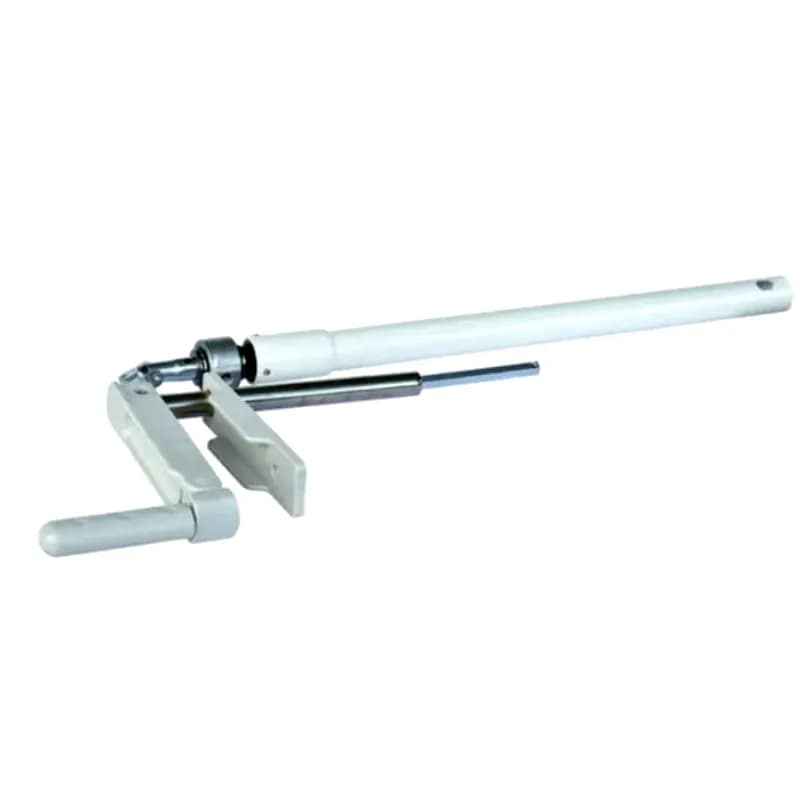
Similar mechanical adjustment discipline applies to this type of medical bed hardware: the lock and position-holding mechanism should be proven over repeated use, not only on a new sample. Buyers should ask for salt-spray test results, weld inspection records, and adjustment-cycle testing when the stand will be used continuously in ICU, emergency, or oncology settings.
Quality Systems, Compliance, and Factory Audit
A qualified medical IV stand manufacturer should operate under a formal quality management system. ISO 13485:2016 is the relevant medical device quality management standard because it establishes design, purchasing, production, traceability, and post-market requirements [1]. The presence of a certificate is not enough; the certificate scope must include the product category being purchased.
Regulatory expectations depend on the destination market. In the European Union, an IV stand placed on the market as a medical device must meet the applicable requirements of Regulation (EU) 2017/745, including risk management and technical documentation [2]. For facilities that use the stand alongside infusion pumps, system-level electrical safety assessments for the adjacent pump are typically handled under IEC 60601-1 [5].
Factory audit questions should focus on the production steps that create durable IV poles: incoming stainless steel tube inspection, dimensional verification of pole diameter, weld profile grinding, polish quality, hook alignment, caster fitment, and final packaging. Visual inspection of welded joints should follow a recognized method such as ISO 17637 [6]. Production records should show that finished goods were checked against a drawing or inspection plan, not only assembled and packed.
Certificates should be checked against product scope, not just the supplier name. <Essential Certifications for Medical Bed Parts Manufacturers> outlines which documents matter for metal and polymer medical equipment components.
A practical document request includes the ISO 13485 certificate, EU MDR or destination-market registration evidence where applicable, material test reports for the stainless steel grade, weld or finishing inspection records, and the one-year mechanism warranty terms.
Specification and Quote Preparation Checklist
The fastest way to get a production-ready quote rather than a catalog price is to send a complete specification set. The following table separates cosmetic preference from the technical requirements that affect safety, tooling, and price.
| Specification | What to Specify | Verification Point |
|---|---|---|
| Pole material | 201 or 304 stainless steel | Material test report or grade confirmation |
| Tube diameter | 16 mm, 19 mm, or custom | Drawing or sample fit check |
| Hook configuration | 2 hooks or 4 hooks | Hook count, spacing, and load balance |
| Height adjustment | Lock type and adjustment range | Repeated cycle test or user test |
| Base type | Fixed base, five-leg mobile base, or bed-socket mount | Loaded stability test |
| Casters | Diameter, material, brake type | Brake holding, floor compatibility |
| Surface finish | Polished, satin, or custom color | Visual standard and roughness expectation |
| Packaging | Export carton or palletized | Transit protection and quantity per carton |
| Documentation | Certificates, drawings, inspection records | Audit file review |
| Warranty | Mechanism and structure period | Warranty terms in quote |

The same drawing-level clarity used for tube-frame guardrails should be applied to IV stand procurement. A vague request such as “stainless steel IV pole” leaves too much room for mismatched diameter, weak hook welding, or a base that cannot handle the intended clinical load.
If you are preparing an RFQ for a hospital bed accessory project, ward expansion, or replacement program, include the completed specification table with your quantity and destination market requirements. Send drawings, target tube diameter, hook quantity, caster preference, and certification needs to [email protected] for a technical review; for urgent shipment or installation support, call +8613528198959.
Talk to a product engineer before you commit
The lowest-risk buying path is to move from specification to a direct technical review before final sampling. Confirm that the manufacturer can support the required outer tube diameter, hook layout, base configuration, surface finish, export documentation, and lead time. Request the specific product references that match your ward environment rather than accepting an unrelated stock item.
For a direct engineering response on medical IV stand specifications, OEM adjustment, or hospital bed accessory sourcing, email [email protected] or call +8613528198959 with your quantity, drawings, and destination market.
Frequently Asked Questions
What material is better for a medical IV stand: 201 or 304 stainless steel?
For most clinical settings, 304 stainless steel is the lower-risk choice because it offers better corrosion resistance and holds up well under frequent disinfection. Grade 201 can reduce cost where cleaning exposure is milder, but it should be confirmed against the intended environment before selection.
What should the safe working load of an IV stand be?
The required load should be defined by the actual clinical configuration, including fluid bags, infusion pumps, and attached lines. A supplier should confirm the loaded stability test method, base design, caster capacity, and maximum hook load rather than offering only a static weight number.
Can IV stands be customized with 2, 4, or more hooks?
Yes, 2-hook and 4-hook configurations are common, and many manufacturers can evaluate custom spacing, hook length, or additional fittings. Customization should always be checked for balance and stability because adding hooks shifts the center of gravity.
What documentation should a qualified manufacturer provide?
At minimum, request the ISO 13485 certificate scope, destination-market compliance evidence, material test reports for the specified stainless steel grade, inspection records, and warranty terms. Documentation should cover the product category being purchased, not only the company as a whole.
How long is typical production lead time?
For standard IV stands, manufacturing and packaging commonly require around 15–20 working days before shipment. The final lead time depends on customization, order quantity, finishing requirements, and export packaging.
How should IV stands be packed for export?
Export packaging should protect polished surfaces, hook arms, casters, and lock collars from transit damage. The manufacturer should confirm whether products are packed individually, grouped in export cartons, or palletized, and the packing should be reflected in the quote.
References
[1] ISO 13485:2016, Medical devices — Quality management systems — Requirements for regulatory purposes.
[2] Regulation (EU) 2017/745 of the European Parliament and of the Council on medical devices.
[3] ISO 14971:2019, Medical devices — Application of risk management to medical devices.
[4] EN 10088-1:2014, Stainless steels — Part 1: List of stainless steels.
[5] IEC 60601-1:2005+AMD1:2012, Medical electrical equipment — Part 1: General requirements for basic safety and essential performance.
[6] ISO 17637:2016, Non-destructive testing of welds — Visual testing of fusion-welded joints.
If you’re interested, check out these related articles:
Unlocking Comfort and Care Benefits of Adjustable Hospital Beds
What is an Adjustable Hospital Bed and How Does It Work: A Comprehensive Guide
Essential Certifications for Medical Bed Parts Manufacturers
Ultimate Guide to Cleaning and Maintaining Your Adjustable Hospital Bed