
Medical bed technical specifications shape patient safety, caregiver workload, doorway planning, and lifecycle cost. For procurement teams, facility engineers, and clinical leaders, the challenge is not reading a datasheet; it is knowing which parameters matter most and how to compare them across suppliers.
1. Bed Size, Width, Height, and Doorway Fit
Hospital bed dimensions should be checked against room layout, corridor width, elevator depth, and door openings before purchase. Full-size medical beds commonly sit in the 2100–2200 mm overall length range and around 960–1030 mm overall width, but there is no single universal size. A bed that measures 970 mm wide will not pass comfortably through a narrow 900 mm door opening, so doorway clearance, movable bed parts, and removable headboards must be part of the specification.
Height adjustment is equally important. As a manufacturer reference, Yingyun Hardware’s manual three-function hospital bed adjusts from 430 mm to 760 mm, while the electric three-function bed covers 430 mm to 840 mm. This low-height range supports easier transfers, while the higher setting reduces caregiver bending during routine care.
IEC 60601-2-52 establishes safety and essential performance requirements for medical beds, but it does not set one mandatory dimensional envelope [1]. Buyers must therefore define the patient population, room size, and access route before locking dimensions.
If you are still deciding which bed configuration fits your ward, <What is an Adjustable Hospital Bed and How Does It Work: A Comprehensive Guide> covers the main bed types and their bedside functions in a clearer clinical context.
2. Load Capacity and Frame Construction
Load capacity must cover more than patient weight. A safe working load calculation should include the mattress, mattress support panels, attached accessories, side-rail pressure, and occasional staff leaning during treatment. Many standard medical beds list a 250 kg load capacity, but buyers should confirm whether the figure is total safe working load or patient weight alone.
Frame design determines how reliably that rating is maintained over time. Stamped steel bed panels, reinforced side rails, and rigid welded joints all affect long-term performance. Yingyun’s four-section stamped bed panels use willow steel in 0.8 mm or 0.9 mm thickness, supporting independent back and knee positions while maintaining panel rigidity.


For bariatric or high-use applications, always request structural drawings, material certificates, and the exact test condition behind the stated load rating.
When you compare supplier proposals, <Essential Materials for Quality Medical Bed Parts Manufacturing> covers how steel type, thickness and surface treatment affect long-term hospital bed performance.
3. Adjustment Functions and Motor Performance
Medical beds are usually classified by the number of adjustable functions: backrest angle, knee section angle, bed height, and Trendelenburg positions. The table below compares representative Yingyun factory specifications.
| Specification | Manual 3-Crank Bed | Electric 3-Function Bed | Electric 5-Function Bed |
|---|---|---|---|
| Backrest angle | 75° ±5° | 75° ±5° | 75° ±5° |
| Knee board angle | 40° ±5° | 40° ±5° | 40° ±5° |
| Height adjustment | 430–760 mm | 430–840 mm | 460–720 mm |
| Trendelenburg / reverse | No | ≥12° | ≥12° |
| Noise level | N/A | ≤50 dB | ≤45 dB |
| Load capacity | 250 kg | 250 kg | 250 kg |
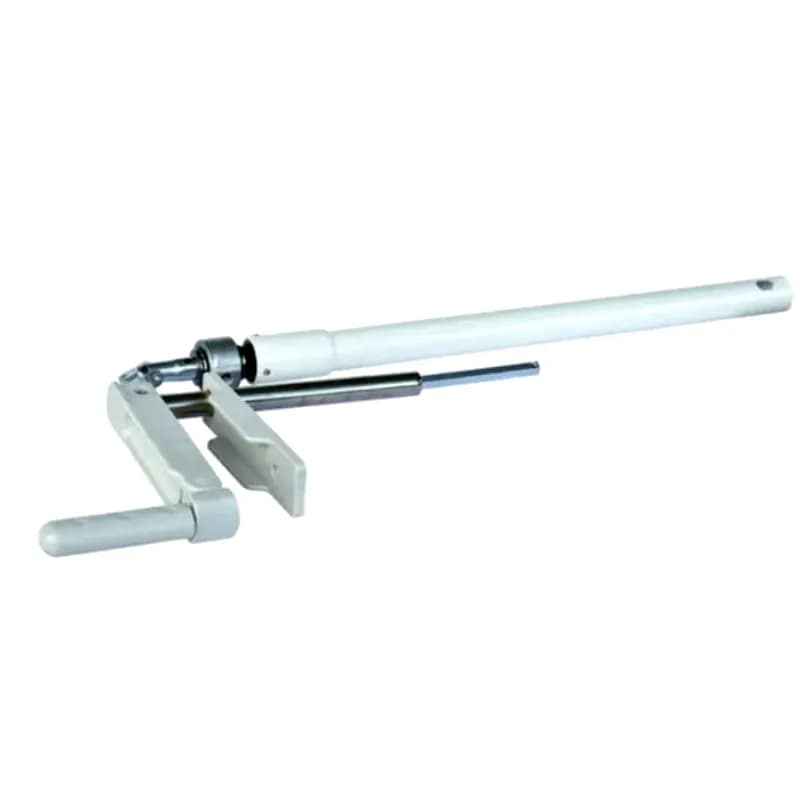
Manual crank systems still have a key role in smaller clinics and locations with unstable power. Crank handles should include in-place protection so the handle remains secure during rapid ward movement. Electric beds should be evaluated for motor noise, movement smoothness, and emergency lowering capability.
4. Panels, Surfaces, and Infection Control
Medical bed panels and headboards must withstand daily cleaning, chemical exposure, and repeated impact. ABS engineering plastic headboards and footboards are common because they resist damage and allow rapid removal. In some Yingyun bed designs, the snap-on ABS structure can be removed in about 30 seconds, which supports emergency access and in-room cleaning.
Bed deck panels should be formed to avoid sharp edges and fluid traps. The stamped willow steel panels used in Yingyun hospital beds are designed for articulation with a smooth upper surface, making them easier to wipe down between patients. Side rails, headboards, and frame coatings should be checked for scratch resistance and compatibility with the facility’s disinfection products.
5. Guardrails, Locking, and Fall Prevention
Side rails are not simply accessories; they are safety-critical components. Guardrail strength, locking force, gap openings, and release behaviour are all relevant under IEC 60601-2-52 [1]. A guardrail that is difficult for staff to operate will be left down, increasing fall risk, while poor gap design can create entrapment hazards.
Hospitals should compare guardrail types based on ward workflow. Horizontal tube folding guardrails provide full-length protection and fold down when space is limited. Door-type guardrails allow easier patient access. Aluminum alloy and steel-reinforced guardrails offer higher rigidity for high-traffic areas.

For a deeper look at side rail and bed safety priorities, <Essential Safety Features for Adjustable Medical Beds> covers guardrail locking behaviour and risk areas that should appear in your inspection checklist.
6. Casters, Braking, and Ward Mobility
Mobility specifications affect emergency response, housekeeping, and single-caregiver operation. Hospital bed casters should be evaluated for wheel diameter, tread material, braking type, and rolling noise. Central-locking casters allow staff to lock all wheels from one pedal, while individual-lock casters may be lighter but require more bending and checking.
TPR or polyurethane treads generally produce less noise and mark floors less than hard plastic wheels. Yingyun medical casters in 3, 4, 5, and 6 inch sizes are offered in full-wrapped, single-face, and double-face central-locking designs. The correct caster depends on flooring type, load rating, and whether the bed is used on carpet, vinyl, or epoxy ward floors.

Mid-specification check: Send your ward layout, doorway widths, and target bed quantity to [email protected] or call +8613528198959. Yingyun Hardware can review the dimensional and mobility requirements and provide a technical quotation with recommended bed configurations.
7. Electrical Safety and Backup Operation
Powered hospital beds must meet medical electrical equipment safety requirements. IEC 60601-1 covers general safety for medical electrical equipment, including leakage current, protective earthing, and mechanical hazards [2]. IEC 60601-2-52 adds particular requirements for medical beds used in patient environments [1]. Compliance should be supported by test reports, not only a supplier statement.
Backup operation is a practical issue in wards with frequent power interruptions. The Yingyun five-function electric hospital bed includes battery and manual operation as a double protection measure in case of power failure. The three-function electric bed also supports manual operation, which allows staff to lower the backrest or place the patient flat during an outage. These features should be defined in the technical specification, not left as an optional afterthought.
8. Standards, Testing, and Documentation Checklist
A strong medical bed specification includes the documents and test reports the supplier must provide. Risk management should follow ISO 14971 [3], and adjustable beds for disabled or homecare use may also be evaluated against EN 1970 [4].
| Document or Test | Why It Matters |
|---|---|
| IEC 60601-2-52 test report | Medical bed safety and essential performance |
| IEC 60601-1 certification | Electrical safety for powered models |
| Factory inspection records | Welding, coating, and dimensional control |
| Material certificates | Steel, ABS, and coating traceability |
| User and maintenance manual | Safe use, cleaning, and preventive maintenance |
Procurement teams should request the same test conditions from every supplier. Comparing a 250 kg load rating tested one way with a 250 kg rating tested another way can produce misleading conclusions.
Contact Yingyun Hardware
Yingyun Hardware has been engaged in hospital bed and bed accessory manufacturing since 2006. For specification review, OEM requirements, or bulk project support, contact [email protected] or call +8613528198959.
When you inquire, include the following:
- Required bed width and doorway clearance
- Target load capacity and patient population
- Manual or electric functions needed
- Quantity and destination country
- Required standards or test reports
Frequently Asked Questions
What is the standard size of a hospital bed?
There is no single global standard size. Full-size medical beds often measure around 2100–2200 mm in length and 960–1030 mm in width, but door openings, room size, and patient needs should determine the selected dimensions.
How much weight can a standard medical bed support?
Many standard manual and electric hospital beds use a 250 kg safe working load. Bariatric applications require reinforced frames, wider decks, and separate weight-capacity verification.
What is the difference between three-function and five-function hospital beds?
A three-function bed typically provides backrest adjustment, knee section adjustment, and height adjustment. A five-function bed adds Trendelenburg and reverse Trendelenburg positioning.
What safety standards apply to hospital beds?
Medical beds should align with IEC 60601-2-52 for particular medical bed requirements, IEC 60601-1 for general electrical safety, and ISO 14971 for risk management [1][2][3].
Do electric hospital beds work during a power failure?
Many powered beds include a manual crank backup, backup battery, or both. Buyers should verify the type of emergency operation and require demonstration during supplier evaluation.
How do I compare supplier technical specifications?
Ask for the same test conditions, tolerances, load definitions, and noise measurement methods from each supplier. Dimensional drawings, certificates, and factory inspection records should be reviewed together.
References
[1] IEC 60601-2-52:2009+AMD1:2015, Medical electrical equipment — Part 2-52: Particular requirements for the basic safety and essential performance of medical beds. International Electrotechnical Commission.
[2] IEC 60601-1:2005+AMD1:2012+AMD2:2020, Medical electrical equipment — Part 1: General requirements for basic safety and essential performance. International Electrotechnical Commission.
[3] ISO 14971:2019, Medical devices — Application of risk management to medical devices. International Organization for Standardization.
[4] EN 1970:2000, Adjustable beds for disabled persons — Requirements and test methods. European Committee for Standardization.
If you’re interested, check out these related articles:
Essential Safety Features for Adjustable Medical Beds
Ensuring Quality Control in Hospital Bed Parts: A Comprehensive Guide
Choosing a Reliable Hospital Bed Parts Manufacturer: A Comprehensive Guide
Electric vs Manual Adjustable Beds: A Comprehensive Comparison