
Getting hospital bed dimensions right matters more than most people realize. After nearly two decades of manufacturing beds and accessories, we’ve seen firsthand how the wrong measurements create problems that ripple through entire care workflows. A bed that’s too narrow increases fall risk. One that doesn’t adjust low enough makes transfers dangerous for both patients and staff. The specifications exist for good reasons, and understanding them helps facilities make smarter purchasing decisions.
Why Dimension Standards Exist and What They Actually Cover
Hospital bed dimensions follow strict international and regional standards because patient safety depends on predictable, compatible equipment. The International Organization for Standardization and the International Electrotechnical Commission set the baseline specifications that manufacturers worldwide reference. These aren’t suggestions. They’re requirements that determine whether a bed can safely accommodate different patient populations and work alongside other medical equipment.
Standard bed lengths typically fall between 80 to 88 inches (203 to 224 cm). Widths run from 36 to 42 inches (91 to 107 cm). The adjustable height range is where things get particularly important for daily operations. A bed that can lower close to the floor reduces fall injuries. One that raises high enough protects caregivers from back strain during procedures.
| Standard Body | Length Range (cm) | Width Range (cm) | Height Range (cm) |
|---|---|---|---|
| ISO 13485 | 200-220 | 90-100 | 40-80 |
| IEC 60601-2-52 | 200-220 | 90-100 | 40-80 |
| US FDA | 203-224 | 91-107 | 40-80 |
These international standards create a common language between manufacturers and healthcare providers across different markets. For more detail on how adjustable mechanisms work within these dimensional constraints, see 《What is an Adjustable Hospital Bed and How Does It Work: A Comprehensive Guide》.
How Bed Dimensions Affect Patient Outcomes and Daily Care
The relationship between bed size and patient outcomes is direct and measurable. A bed that’s too short for a tall patient forces awkward positioning that leads to pressure injuries. One that’s too narrow for a larger patient creates constant anxiety about rolling off the edge. These aren’t minor inconveniences. They affect recovery time, complication rates, and patient satisfaction scores.
Adjustable measurements go beyond just length and width. Backrest angles, leg rest positions, and height adjustability all factor into how well a bed supports different clinical scenarios. A bed that can position a patient at 30 degrees for respiratory support needs different engineering than one designed primarily for post-surgical recovery.
Getting Patient Ergonomics Right Through Proper Sizing
Pressure injury prevention starts with having enough surface area for proper weight distribution. When patients can shift their position without feeling cramped or at risk of falling, they move more. Movement prevents the tissue breakdown that leads to pressure ulcers.
The height adjustment range affects something facilities often underestimate: patient independence. A bed that lowers to 15 inches from the floor lets many patients get in and out without assistance. That independence matters for recovery and for staffing efficiency. Beds that work well with mobility assistance devices need adequate clearance and stable platforms at various heights.

What Goes Into Hospital Bed Frame Construction
Frame specifications determine how long a bed lasts and how much abuse it can handle. We build our frames using high-strength A3 steel and 304 stainless steel for components that face the most stress. The choice isn’t arbitrary. These materials resist corrosion from cleaning chemicals while maintaining structural integrity under repeated loading.
Our manual three-crank hospital bed (Model: Manual 3 Cranks Hospital Bed) and electric five-function hospital bed (Model: Electric 5 Function Hospital Bed) both support 250 KG loads. That capacity comes from precise welding of rectangular steel tubing and careful attention to stress points where frames typically fail. The casters matter too. Our 5 Inch 304 Stainless Steel_TPR Material Special Medical Bed Brake Casters handle the load-bearing requirements while rolling smoothly enough for single-person maneuvering.
| Frame Type | Material Composition | Load Capacity (KG) | Durability Factor |
|---|---|---|---|
| Standard | High-strength A3 steel | 250 | High |
| Bariatric | Reinforced steel alloys | 350+ | Very High |
| Electric Adjustable | Steel, ABS/PP components | 250 | High |
| Manual Adjustable | Steel, ABS/PP components | 125-250 | High |
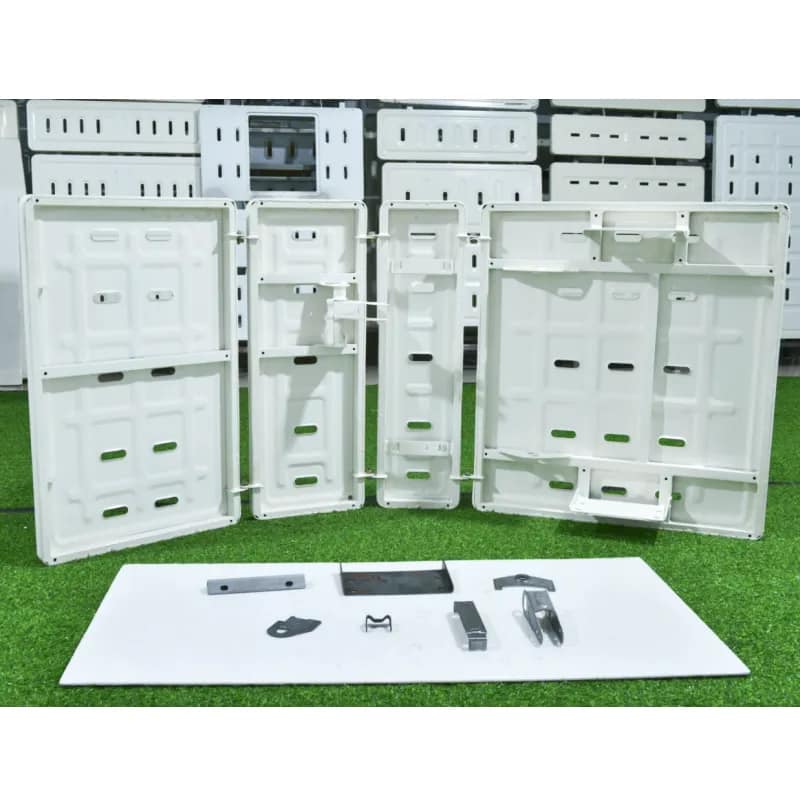
Every component contributes to overall performance. The Stamped Hospital Bed Parts we produce, including items like the 7 Shape Force Arm Hardware Products Precision Metal Stamping (Model No.: YY-00030), undergo the same quality standards as the major frame components.
Regulatory Requirements and Where Bed Technology Is Heading
Meeting regulatory requirements isn’t optional, and the requirements vary by market. ISO standards provide a foundation, but regional health authorities layer additional specifications on top. The EU has different documentation requirements than the US FDA. Asian markets have their own certification pathways. Our manufacturing processes account for these variations, ensuring that Electric Hospital Bed and Manual Hospital Bed models can ship to different regions without redesign.
Smart bed technology is changing what dimensions need to accommodate. Beds with integrated sensors for patient monitoring, fall prevention systems, and automated positioning require space for electronics and wiring that older designs didn’t anticipate. Future dimension standards will likely address these integration requirements more explicitly.
Working Through Different Regional Requirements
The practical challenge for manufacturers is building products that satisfy multiple regulatory frameworks simultaneously. A bed designed only for EU compliance might need modifications for US markets. The dimensional requirements often overlap, but documentation, testing protocols, and labeling requirements differ significantly.
Side rail height specifications illustrate the complexity. Different regions have different minimum heights based on their fall prevention research. Bed clearance requirements for cleaning equipment access also vary. Manufacturers who want to serve global markets need engineering teams that understand these regional nuances.

Matching Bed Dimensions to Facility Needs
The right bed dimensions depend entirely on what a facility actually does. A general medical floor has different requirements than a bariatric unit or a pediatric ward. Buying beds without considering the specific patient population leads to equipment that doesn’t quite fit anyone’s needs.
Bariatric care requires beds with widths up to 54 inches and load capacities exceeding 350 KG. Standard beds simply cannot accommodate these patients safely. Pediatric facilities need smaller beds with different safety rail configurations. Critical care units need beds that integrate with monitoring equipment and allow rapid position changes during emergencies.
Space constraints force difficult tradeoffs. A bed with a smaller footprint might sacrifice some patient comfort. Facilities with narrow hallways need beds that maneuver easily. The cleaning and maintenance requirements also factor into the decision. Beds with complex mechanisms take longer to service and may have more components that can fail.
Working with Yingyun Hardware on Your Bed Requirements
ZhongShan YingYun Hardware Products Co.,Ltd has manufactured hospital beds and accessories since 2006. We understand that dimension specifications aren’t just numbers on a spec sheet. They determine whether a bed actually works for the patients and staff who use it daily. Our engineering team can discuss your specific requirements and help identify the right configurations for your facility. Email: lily@yingyunmic.com | Phone: +8613528198959
Common Questions About Hospital Bed Dimensions
What are the standard dimensions for a hospital bed?
Standard hospital beds measure 80 to 88 inches long and 36 to 42 inches wide, with adjustable height ranges typically from 40 to 80 cm. These dimensions accommodate most adult patients while allowing adequate caregiver access. Our Hospital Bed products meet these specifications across all models.
How do hospital bed sizes impact patient comfort and care?
Bed dimensions directly affect pressure injury risk, fall rates, and patient mobility. Adequate width prevents patients from feeling confined. Proper length eliminates awkward positioning. Height adjustability affects both patient independence and caregiver safety during transfers. Our Adjustable Hospital Bed designs address all these factors.
Are hospital bed dimensions regulated by any organizations?
Multiple organizations regulate bed dimensions, including ISO, IEC, and regional health authorities like the US FDA and EU medical device regulators. These standards ensure safety and compatibility across healthcare systems. All our Hospital Bed Manufacturer products comply with applicable regulations.
What are the considerations for bariatric hospital bed dimensions?
Bariatric beds require increased width (often 48 to 54 inches), higher weight capacity (350 KG or more), and reinforced frame construction. Standard beds cannot safely accommodate larger patients. The frame engineering must handle greater loads without compromising adjustability or durability.