
Sourcing custom bed parts is not only a price comparison. The right supplier choice affects patient safety, ward uptime, spare-part availability, and the total cost of maintaining a hospital bed fleet. This guide explains the engineering, quality, and documentation checks procurement teams should run before placing a custom bed parts order.
What a Custom Bed Parts Supplier Must Control
A qualified Custom Hospital Bed Metal Parts supplier must control more than material supply. Custom work requires a technical review of drawings, mounting interfaces, load paths, and cleaning requirements before production begins.
The supplier should be able to read the bed system as a whole. A head panel is not an isolated pressing; it must align with the backrest frame, side rail brackets, IV pole sockets, and mattress platform. The same applies to casters, crank mechanisms, connecting ears, and guardrail mounts. If one interface shifts by a few millimeters, installation slows, locking becomes unreliable, or the bed may not pass incoming inspection.
Because custom parts directly affect patient positioning and fall prevention, the medical bed category is regulated by product safety requirements such as IEC 60601-2-52 [1]. A supplier should demonstrate that the final assembled bed, and the replacement parts supplied for it, remain within the required design envelope and risk profile. This is why design history, risk assessment, and component traceability should be treated as sourcing criteria rather than paperwork.
Supplier selection should be evidence-based, not based on a polished catalog. <Choosing a Reliable Hospital Bed Parts Manufacturer: A Comprehensive Guide> covers step-by-step verification for hospital bed parts manufacturers.
Material and Process Decisions That Affect Service Life
Bed part durability is often decided before welding begins. For stamped bed panels, the steel grade, thickness, edge treatment, and coating all affect performance. A panel produced from 0.8 mm or 0.9 mm willow steel offers a different stiffness and dent resistance than a lighter imported sheet with unclear mechanical properties.
Stamped Hospital Bed Panels commonly support backrest elevation, knee adjustment, and height positioning. Panel width options such as 820 mm, 840 mm, and 900 mm must match the bed frame, while curled edges and reinforcement ribs help control flex and noise during patient movement.
Plastic components are equally material-critical. ABS engineering plastic is widely used for headboards, footboards, side rail covers, and crank handles because it balances impact resistance, cleanability, and ease of handling. For hospital use, the supplier should confirm that the selected ABS grade resists cleaning agents and repeated mechanical contact. Surface finishes matter too: powder-coated steel, 304 stainless steel, and chrome-plated components each perform differently in humid or disinfection-heavy environments.
A valid process chain should include material certificates, incoming inspection, welding or stamping control, dimensional checks, and surface treatment verification. Under ISO 13485, these controls must be traceable to the supplied batch, not just described in a quality manual [3].

Customization Questions to Lock Before Quotation
A clear first inquiry should specify the part, not only the catalog name. The following information helps a supplier determine whether the custom part can be produced from existing tooling or requires new fixtures.
| Specification | Example requirement from a hospital bed parts range |
|---|---|
| Bed panel width | 820 mm, 840 mm, or 900 mm depending on bed frame |
| Panel thickness | 0.8–0.9 mm stamped willow steel |
| Load capacity | 250 kg for standard hospital bed designs |
| Mounting interface | Existing hole centers, slot size, and fastener type |
| Finish | Powder coating, 304 stainless steel, chrome, or antimicrobial paint option |
| Minimum order quantity | Typically 50 pcs for parts; 100 pcs for many stamped metal components |
| Lead time | Around 15–20 working days for standard custom parts |
These figures are product-specific and should be confirmed against the actual drawing. Buyers should also specify whether the part must be interchangeable with an existing bed, because reverse-engineered dimensions often miss tolerance stack-ups in the welded frame. The supplier should not promise “exact replacement” without measuring a reference sample or validating the original drawing.
Ready to move from specification to quotation? Send the drawing set, including panel dimensions, mounting hole centers, material and finish, load capacity, and target quantity to Yingyun Hardware at [email protected] or +8613528198959. A complete drawing shortens the technical review more than a long email describing the part.
Quality Evidence to Request
A custom bed parts supplier should be able to show how it prevents defects. Request the following before approving a sample or placing a production order:
- Material certificate or mill test report for steel and stainless steel parts
- First-article inspection report with measured dimensions
- Welding or stamping process control plan
- Surface treatment confirmation, including powder coating or plating specification
- Batch traceability records linking raw material to finished parts
- Defect handling and corrective action procedure
- Device or component-level verification where the part is safety-relevant
These evidence types align with a risk-based quality approach. ISO 14971 provides a framework for evaluating failure modes that can affect patient safety [2]. For suppliers serving the European market, Regulation (EU) 2017/745 requires that economic operators maintain traceability and conformity evidence across the supply chain [5]. For suppliers working with U.S. healthcare facilities, FDA quality system expectations under 21 CFR Part 820 also require documented design and process controls [4].
Dimensional consistency depends on process control, not final inspection alone. <Ensuring Quality Control in Hospital Bed Parts: A Comprehensive Guide> covers inspection methods and in-process quality gates for hospital bed parts.
Failure Points That Drive Maintenance Cost
Hospital maintenance teams see the same issues repeatedly. Understanding these failure points helps procurement select parts that do not return as warranty claims.
Casters and brake systems. A caster that looks acceptable can still fail under repeated central-locking use. The brake pedal, sleeve tube, and locking plate must align precisely, and the tread material must resist cleaning chemicals and floor contact. The 3’4’5′ Full-wrapped caster uses TPR and PP construction for smooth movement and low rolling noise, but the buyer should still confirm brake type, stem or plate mounting, and load rating for the specific bed.

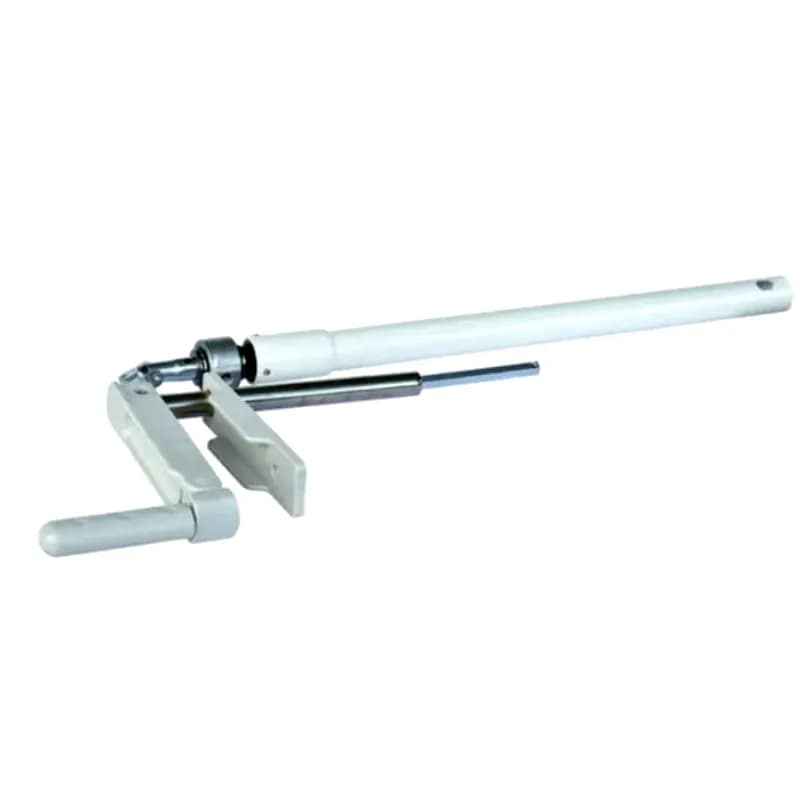
Crank and positioning systems. Manual adjustment depends on the crank handle, universal joint, hexagonal shaft, and transmission parts. A weak ABS or iron handle may crack near the insert, while an improperly formed transmission part can make the bed difficult to raise. The ABS crank with in-place protection is designed to reduce damage from over-rotation, but the surrounding transmission path must still be aligned.
Side rail and guardrail systems. Guardrail lock failures are a patient safety risk. Folding rails, horizontal tube designs, and die-cast aluminum connectors must hold position without excessive free play. A Stamped Hospital Bed Parts supplier should verify lock engagement, release force, and weld integrity on a sample batch. If the rail must pass an impact or cyclic test, that requirement should be stated before production.

Bed panel connection points. Connecting ears, swing arms, and fixing plates carry repeated load during backrest and knee movement. A small dimensional error in these stamped parts produces noise, uneven panel alignment, or premature wear on the frame. The supplier should test assembly with a matching frame, not only inspect the part in isolation.
Sourcing and Inspection Workflow
A structured workflow reduces the chance of approving a supplier based on one good sample. The following sequence is practical for hospital procurement and distributor buying teams.
- Drawing review. Confirm that the supplier can interpret the required material, tolerance, finish, and assembly interface.
- Sample approval. Approve shape, fit, and function on the actual bed model before batch release.
- First-article report. Obtain measured dimensions, material evidence, and surface treatment results.
- Pre-production risk check. Confirm that safety-critical parts receive additional inspection or testing.
- Batch incoming inspection. Check dimensional sampling, coating adhesion, weld appearance, and packaging.
- Spare-part continuity. Verify that the supplier maintains drawings and tooling so repeat orders remain consistent.
For international orders, confirm how the parts will be packed and whether packaging protects edges, coated surfaces, and threaded or locking features. Export-grade cartons with foam separation are common for parts such as guardrails, casters, and cranks. Wooden boxes are typically used for heavier assemblies or bulk orders.
The supplier should also be clear about minimum order quantity and after-sales support. Many custom hospital bed parts are produced with a minimum of 50–100 pcs depending on tooling and stamping complexity. A one-year mechanism and structure warranty is a common baseline, but the commercial terms should state what is covered and whether replacement parts are supplied against a drawing revision.
Material selection changes both durability and cleanability. <Essential Materials for Quality Medical Bed Parts Manufacturing> covers steel, ABS, and surface treatment choices for medical bed components.
Turn a Custom Bed Parts Inquiry Into a Comparable Quote
Instead of asking only for a price, route the inquiry through a technical filter. A comparable quote should include the specification, drawing revision, material, finish, tolerance class, target quantity, packaging, lead time, warranty, and required compliance documents.
Yingyun Hardware has been engaged in hospital bed and bed accessory manufacturing since 2006. The team supports product development, quality control, and global customer cooperation across bed panels, side rails, casters, cranks, IV accessories, and related hardware.
Send the part drawing and hospital target market to:
- Email: [email protected]
- Phone/WhatsApp: +8613528198959
Include the expected delivery market, such as Europe, the United States, the Middle East, Africa, or Southeast Asia, because the required documentation and labeling can vary.
Frequently Asked Questions
What should I send to a custom bed parts supplier first?
Send a dimensioned drawing or clear photographs with measurements, the material and finish, the intended bed model, load capacity, target quantity, and any required certifications. This allows the supplier to identify whether the part can be reused from existing tooling or needs new development.
What is the difference between custom and standard hospital bed parts?
Standard parts are produced to existing dimensions and mounting patterns. Custom parts are modified in size, material, finish, hole position, or load capacity to fit a specific hospital bed design. Both should still fall within the medical bed system’s validated design envelope.
How do I verify that a custom bed parts supplier can meet hospital safety standards?
Request the quality management certificate, material test reports, first-article inspection data, and evidence of risk-based process controls. For medical devices and safety-related components, confirmation against IEC 60601-2-52, ISO 14971, and applicable regional regulations is more useful than a general “certified factory” claim [1][2].
What MOQ and lead time should I expect for custom bed parts?
Many custom casters, cranks, guardrails, and bed accessories carry a minimum order of 50 pcs, while some stamped metal parts and hardware components require 100 pcs or more. Standard custom parts often ship within 15–20 working days, but new tooling or complex stamping may extend that timeline.
Can a supplier produce both stamped metal parts and plastic components?
A capable hospital bed parts supplier commonly coordinates both. Stamped steel panels and mounting hardware are paired with ABS or PP components such as headboards, side rail covers, casters, and crank handles. Confirm that the supplier controls both processes and can provide batch traceability for each material type.
References
[1] IEC 60601-2-52, Medical electrical equipment — Part 2-52: Particular requirements for the basic safety and essential performance of medical beds, International Electrotechnical Commission.
[2] ISO 14971, Medical devices — Application of risk management to medical devices, International Organization for Standardization.
[3] ISO 13485, Medical devices — Quality management systems — Requirements for regulatory purposes, International Organization for Standardization.
[4] U.S. Food and Drug Administration, Quality System Regulation, 21 CFR Part 820.
[5] Regulation (EU) 2017/745, Medical Devices Regulation, European Parliament and Council.
[6] ISO 9001, Quality management systems — Requirements, International Organization for Standardization.
If you’re interested, check out these related articles:
Ultimate Guide to Cleaning and Maintaining Your Adjustable Hospital Bed
Can Adjustable Hospital Beds Be Customized for Homecare Needs
Choosing a Reliable Hospital Bed Parts Manufacturer: A Comprehensive Guide
Essential Safety Features for Adjustable Medical Beds