
Choosing a medical IV pole OEM manufacturer requires more than comparing the unit price. The decision affects infusion safety, nurse workflow, cleaning compatibility, spare parts continuity, and how easily the pole integrates with hospital beds and ward furniture. A qualified manufacturer should be treated as a clinical equipment partner, not only a metal fabricator. This guide explains the specifications, material choices, base design, customization documentation, quality checks, and supplier terms to confirm before placing an OEM order.
Key Specifications to Lock Before Sourcing
Start the sourcing process with measurable requirements, not a verbal description of a standard pole. A clear specification sheet reduces the risk of receiving poles that look acceptable but fail after months of clinical use.
| Specification Field | What to Request | Why It Matters |
|---|---|---|
| Height adjustment range | Minimum and maximum hook height in millimeters | A range that is too short limits infusion setup and creates unsafe reaching during fluid changes |
| Pole tube diameter | Exact outer tube diameter, commonly 16 mm or 19 mm | Hook adapters, pump clamps, and bed sockets must fit without slipping |
| Hook configuration | Number of hooks and whether hooks are fixed or rotating | Hook count changes how many lines one pole can safely organize |
| Base design | Base type, diameter, material, and total base weight | A narrow or light base increases the risk of tipping when loaded on one side |
| Caster type | Caster diameter, material, and brake arrangement | Hard casters may roll easily but slide on wet floors; locking casters affect safe positioning |
| Surface finish | Grade, polishing, and cleaning compatibility | Rough welds and unsealed joints trap contamination and accelerate corrosion |
Do not treat a catalogue photo as a technical release. Request dimensions and material certificates for the exact production version.
Material and Finish Choices That Affect Service Life
Stainless steel tube selection directly influences how an IV pole withstands disinfectant cleaning and humid ward environments. Type 304 stainless steel offers stronger corrosion resistance under frequent chemical exposure. Type 201 stainless steel can work in cost-sensitive projects, but it is less forgiving in coastal climates, high-humidity areas, or spaces using aggressive cleaning agents.
The surface condition matters as much as the grade. A polished, continuous tube with smooth weld seams is easier to clean and less likely to trap residue around hooks and adjustment joints. For components such as knobs, hook caps, or protective sleeves, ABS and similar plastics should be specified only where they can withstand repeated impact and disinfection without cracking or discoloring.
Stainless steel grade selection is not only a cost decision because it changes cleanability and corrosion behavior in clinical cleaning routines. <Essential Materials for Quality Medical Bed Parts Manufacturing> covers how material choices affect long-term performance in medical bed parts.
Base Design, Casters, and Stability in Clinical Use
IV pole stability is determined by the complete assembly, not by pole height alone. A five-leg base with a wider stance generally provides more tipping resistance than a compact four-leg base when several infusion pumps or bags are hung from one side. The base should be heavy enough to keep the center of gravity low, but still light enough for staff to move the pole during patient transfers.
Casters need to match the floor surface. Softer treads can reduce vibration on tile and improve grip on wet floors, while harder treads may roll more easily but can slide during contact. At least two locking casters are useful for bedside positioning, and the brake should remain easy for nursing staff to operate with a foot. After assembly, test the pole with a realistic one-sided load, not an empty pole.

OEM Customization and Product Documentation
OEM orders normally involve more than printing a logo on a standard pole. Common customization points include the number of hooks, tube diameter, finish color, base shape, packaging format, and labeling. The manufacturer should confirm which dimensions are fixed by tooling and which can be changed without affecting strength or fit.
Documentation matters before production begins. Request a pre-production sample, an approved drawing, a material specification, and a packaging plan. If the IV pole is supplied as part of a larger hospital furniture package, confirm the interface details with the bed or trolley: socket diameter, retaining method, and corner clearance. A manufacturer that already produces related bed accessories can often keep hole positions, finishes, and quality standards consistent across the product family.

The same document control should extend to mating hardware such as hand cranks and mechanical adjustment parts. For example, an OEM program may need one material version for standard wards and another material version for high-humidity or magnetic-resonance-related environments.

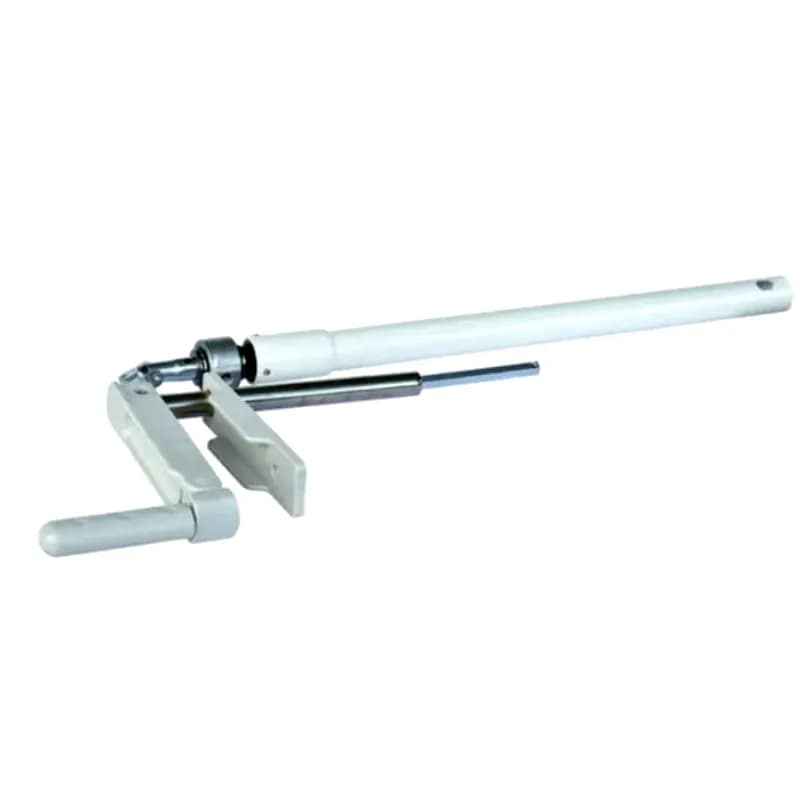
For bed-mounted IV pole sockets, check the stamped bed panel or frame drawing before approving the pole tube diameter. An apparently small mismatch between the socket and pole can create visible wobble and wear on both parts.

From the supplied product library, Yingyun Hardware provides stainless steel IV poles with 2-hook and 4-hook options, 16 mm or 19 mm outer tube diameters, an MOQ of 50 pieces, and a lead time of 15 to 20 working days. That product-line example shows the type of data an OEM buyer should receive before sampling.
Quality Control, Testing, and Acceptance Checks
A manufacturer’s inspection plan should cover the failure modes that actually affect clinical use. Ask how the factory verifies tube straightness, weld quality, hook alignment, telescoping fit, caster attachment, and finish continuity. The supplier should be able to explain which checks are performed in process and which are completed on finished goods.
For acceptance, use a defined sample procedure rather than checking one convenient sample. Confirm how the manufacturer handles surface defects, bent hooks, loose adjusters, or missing packaging parts. A one-year warranty on mechanism and structure is useful only when the defect response and replacement terms are also clear.
A supplier audit should confirm that dimensional checks, weld inspection, and surface finish testing are performed on the actual production line. <Ensuring Quality Control in Hospital Bed Parts: A Comprehensive Guide> covers the inspection points that help separate documented quality control from verbal assurance.
Supplier Evaluation and Ordering Terms
Before comparing prices, screen the manufacturer as a production partner. Review its product range, factory capabilities, export documentation experience, packaging standards, and response time. A manufacturer that already supplies hospital beds, bed panels, guardrails, casters, and cranks can often manage a mixed medical furniture order more efficiently than a single-product workshop.
Confirm the commercial terms in writing. The key points are the sample approval process, MOQ, production lead time after drawing confirmation, payment schedule, packaging protection, freight responsibility, and warranty response. For OEM orders, artwork or packaging approval can become the real schedule driver, so include those steps in the lead time calculation.
Confirming the lead time rule before order placement prevents installation schedules from slipping after artwork or packaging approval. <Understanding Lead Times for Hospital Bed Parts Manufacturing> covers how production stages and customization affect realistic delivery planning.
Sourcing Support for Medical IV Pole OEM Projects
To evaluate a medical IV pole OEM solution efficiently, send the manufacturer your requested tube diameter, height range, hook count, base style, caster requirement, finish preference, target quantity, and destination market. Clear specifications allow the factory to confirm the working drawing, sample plan, packaging method, lead time, and freight estimate without unnecessary back-and-forth.
For OEM medical IV poles and related hospital bed accessories, contact ZhongShan YingYun Hardware Products Co., Ltd at [email protected] or +8613528198959.
FAQ
What is the difference between 201 and 304 stainless steel for medical IV poles?
Type 304 stainless steel offers stronger corrosion resistance in frequent cleaning and humid conditions. Type 201 can be a lower-cost option for controlled indoor environments, but it is more likely to show surface staining when exposed to aggressive disinfectants or high humidity. The final choice should match the ward environment and cleaning protocol.
How many hooks should a medical IV pole have?
Two-hook poles are common for basic infusion support, while four-hook poles provide more line organization in intensive care or multi-infusion settings. The right number depends on how many lines, pumps, or bags need to be managed at one bedside. Hook count should be confirmed with the clinical workflow before ordering.
What MOQ and lead time should I expect for OEM IV poles?
Many export-oriented manufacturers work with a minimum order quantity around 50 pieces for standard production. Typical production lead time may be 15 to 20 working days after drawing confirmation, but custom finish, packaging, or artwork approval can extend the schedule. Confirm the exact lead time rule for the specific order.
How can I verify IV pole stability before a bulk order?
Request a pre-production sample and test it with a realistic one-sided load on the intended floor surface. Check the base footprint, caster locking, tube adjustment mechanism, and hook alignment. Do not approve bulk production until the sample matches the approved drawing and performs acceptably in the planned clinical use.
If you’re interested, check out these related articles:
Essential Materials for Quality Medical Bed Parts Manufacturing
Ensuring Quality Control in Hospital Bed Parts: A Comprehensive Guide
Leading Hospital Bed Parts Manufacturers: A Comprehensive Guide
Top Wholesale Hospital Bed Parts Manufacturers & Suppliers
Unlocking Comfort and Care Benefits of Adjustable Hospital Beds