
Selecting a hospital bed manufacturer in China involves more than comparing catalog photos and price sheets. With nearly two decades of hands-on engineering work in bed frame fabrication, caster integration, and quality control at Yingyun Hardware, I have seen how seemingly small production differences directly impact patient safety and bed longevity. A manufacturer’s capability is rarely visible on a website. It lives in the gauge of steel used for bed panels, the type of TPR compound selected for casters, the welding jig consistency, and the documentation that accompanies every shipment. This article walks through the technical and operational details that procurement professionals, hospital administrators, and medical equipment distributors need to evaluate when sourcing hospital beds from China, drawing on real production experience rather than generic checklist advice.
Understanding Hospital Bed Manufacturing in China
China is the world’s largest exporter of hospital beds and related furniture, yet the manufacturing landscape is fragmented. A factory that produces stamped bed panels for a basic three-crank manual bed may not have the testing equipment for a five-function electric ICU bed. When I speak with buyers, one of the first points I clarify is the difference between a general metal fabrication shop and a dedicated medical bed manufacturer. The latter invests in specific jigs for bed frame welding, maintains tensile testing on Liuzhou steel sheet before stamping, and runs cycle tests on crank mechanisms and actuators.
Production capacity often determines what kind of project a factory can support. A manufacturer that runs 50 units per day on a single assembly line will struggle with a 500-bed urgent order unless the production planning is verified. Experienced procurement teams ask for photos of active production lines, not just finished goods in a showroom, because the condition of welding stations and the organization of material staging reveal more about repeatable quality than any certificate.
Evaluating Key Technical Capabilities of Hospital Bed Manufacturers
When a buyer asks me what separates a capable manufacturer from one that just claims capability, I point to the range of bed functions and materials under one roof. A factory that only produces single-crank manual beds may be a cost-effective choice for that product, but if your project later requires electric three-function beds with Trendelenburg tilt, having a supplier that understands both manual crank linkage geometry and electric actuator integration saves re-sourcing time later.
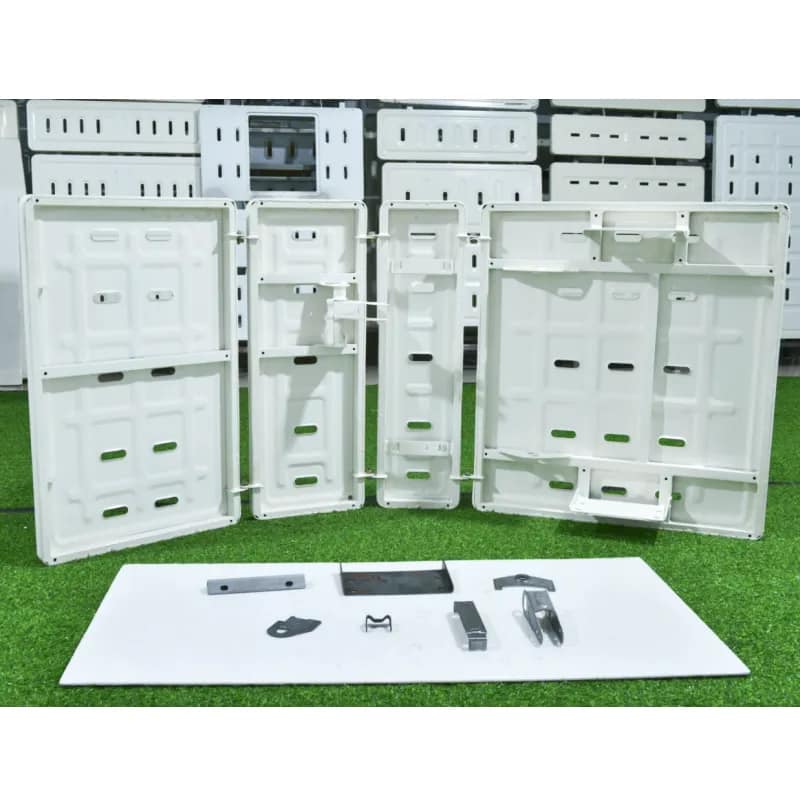
Material selection is the foundation of bed reliability. For instance, the bed panels we stamp at Yingyun Hardware use Liuzhou steel sheets of 0.8 mm to 0.9 mm thickness. This may sound like a small detail, but a thinner gauge or inconsistent gauge from coil to coil will produce vibration and noise under patient movement, and over time the panel may deform at the high-stress points around the backrest hinge. Our stamped bed panels are available in widths from 820 mm to 900 mm and in two-section or four-section configurations for manual and electric beds, each designed to distribute weight evenly across the frame.

Casters are another critical area. We offer TPR full-wrapped casters, central-locking double-face casters, and 5-inch 304 stainless steel brake casters. The difference between a generic caster and a medical-grade caster is most apparent in the braking mechanism. A central-locking system with a metal pedal and a hex shaft linkage, like our YY-C22/C23 series, provides positive lock on all four wheels simultaneously, preventing bed movement during patient transfer. For hospitals in humid tropical climates, I always recommend specifying TPR tread material rather than hard rubber because TPR resists hydrolysis and cracking after repeated floor cleaning with disinfectants.
| Bed Type | Functions | Typical Configuration |
|---|---|---|
| Single-crank manual | Backrest adjustment | Stamped bed panel, ABS head/foot board, 125 kg load |
| Three-crank manual | Backrest, knee, height | Aluminum alloy side rails, central-locking casters |
| Five-function electric | Backrest, knee, height, Trendelenburg, reverse Trendelenburg | ABS panels, five independent motors, 250 kg load, battery backup |
| Homecare electric | Backrest, knee lift | TPR casters, simple remote control, collapsible design |
Quality Certifications and Production Standards
ISO 13485 certification for medical devices is a baseline requirement, but I encourage buyers to look beyond the certificate itself to the scope of certification. A manufacturer with ISO 13485 that covers design, production, and final inspection of hospital beds is significantly different from one where the scope is limited to assembly. During our factory’s certification maintenance, the audit covers incoming material inspection records, welding procedure qualification, and traceability of each bed’s serial number to the batch of raw material used.
CE marking for the European market requires a technical file that includes risk analysis per ISO 14971, biocompatibility evaluation of patient-contact materials like ABS panels and mattress platform surfaces, and electromagnetic compatibility testing for electric beds. For the US market, FDA registration as a medical device establishment adds another layer of documentation, particularly around complaint handling and corrective action procedures. A manufacturer that can show a completed FDA registration and a recent surveillance audit report is likely capable of meeting documentation requirements for tender submissions.
Factory Processes: Stamping, Welding, and Assembly
The core of a hospital bed factory is the metalworking line. Stamping bed panels requires progressive dies that can hold consistent form across thousands of strokes. When I inspect a stamping shop, I look at the die maintenance logs and the presence of a coordinate measuring machine to check dimensional drift. A factory that cannot show before-and-after measurements for its high-wear dies will eventually deliver bed panels with burrs or slightly misaligned mounting holes—problems that compound during assembly and make side rail installation difficult.
Welding is even more telling. Hospital bed frames carry dynamic loads as patients adjust position and as the bed is moved. Cold lap or incomplete fusion in a weld at the junction of the backrest hinge and the main frame can propagate a crack within a year of service. Our welding stations use jigs that are inspected every shift, and we perform sectioning tests on sample welds to verify penetration depth. For critical load-bearing welds on the “7” shape force arm and swing arm components, we use a non-magnetic stainless steel crank system with in-place protection for beds used in MRI-proximate areas.

If your project involves specific bed panel dimensions outside standard widths, or if you need guardrail designs matched to existing furniture in your facility, these details should be discussed before tooling begins. At Yingyun Hardware, we have produced custom bent-tube guardrails with 2 to 10 columns, door-style guardrails with locking buttons, and pediatric bed ABS head and foot boards in custom colors. Sharing a dimensioned drawing early saves both time and rework. For buyers planning a new hospital wing or nursing home project, confirming that the manufacturer can provide a complete bed package including bedside cabinets, overbed tables, and IV poles from a single source simplifies installation and after-sales accountability.
Your Next Steps: Partnering with a Reliable Hospital Bed Manufacturer
Choosing a hospital bed manufacturer is not a one-time transaction. It is a relationship that continues through installation training, spare part supply, and future bed fleet expansion. A manufacturer that cannot produce a spare parts catalog with part numbers, or that changes component suppliers without notification, will cost you more over five years than you save on the initial order price.
Based on two decades of manufacturing for hospitals and distributors in Africa, the Middle East, Southeast Asia, and the US, I recommend prioritizing three things in your evaluation: verifiable production records, a single-source parts and accessories supply, and direct engineering communication rather than sales-only contact. Before finalizing a supplier, ask for a video call that includes a walk through the stamping shop and the test area, not just the showroom. Request a sample bed or component with the certificate of conformance signed by the quality manager. These steps reduce the risk of receiving beds that look correct but fail under real clinical use.
To begin discussing your hospital bed project, send your target specifications and quantity to [email protected] or call +8613528198959. We can provide technical data sheets, loading diagrams, and container optimization advice specific to your region.
Common Questions About Sourcing Hospital Beds from China
How long does it take to manufacture and ship hospital beds from China?
Standard manual bed orders of 50 to 200 units typically require 15 to 45 working days for production depending on the model, plus 3 to 5 weeks for ocean freight to major ports. Electric beds with custom color matching or special accessories may extend to 45 to 60 working days. We always confirm a production schedule and provide weekly progress updates so that hospital renovation timelines can be planned accurately.
What is the minimum order quantity for a hospital bed factory?
For standard models, MOQ usually starts at 20 to 50 pieces per model because of the setup time required for stamping dies and powder coating lines. For fully customized beds with new plastic tooling for ABS head and foot boards, the MOQ may be 100 pieces or more to amortize the mold cost. Many manufacturers, including ours, offer a mixed container with different bed types to reach an economically efficient shipment for smaller clinics.
Can a manufacturer in China provide CE, FDA, or ISO documentation?
Yes, established manufacturers maintain product technical files and can provide the Declaration of Conformity, FDA establishment listing confirmation, and ISO 13485 certificate with the current audit scope. I recommend requesting the certificate number and verifying it on the issuing body’s database before finalizing the order. For large institutional tenders, third-party inspection agencies such as SGS or TÜV can be engaged during production, and a manufacturer that resists third-party inspection should raise a red flag.
What if a bed component fails after delivery?
Under our one-year mechanism and structure warranty, we ship replacement parts free of charge for any manufacturing defect. All bed models have a serial number linked to the bill of materials, so we can identify the exact caster, crank, or actuator batch and send the correct spare part quickly. We stock common spare parts like casters, crank handles, IV pole sleeves, and guardrail lock buttons in our warehouse for immediate dispatch. For specific warranty claim procedures, send your bed serial number to [email protected] and we will confirm the replacement part and shipping timeline.
If you’re interested, check out these related articles:
Ensuring Quality Control in Hospital Bed Parts: A Comprehensive Guide
Are Adjustable Hospital Beds Covered by Insurance or Medicare
Choosing a Reliable Hospital Bed Parts Manufacturer: A Comprehensive Guide
Essential Certifications for Medical Bed Parts Manufacturers