
A medical equipment technical datasheet is not a marketing brochure. It is the document that procurement teams, biomedical engineers, and clinical staff rely on to confirm that a device meets clinical requirements, safety standards, and environmental conditions before a single order is placed. In nearly twenty years of manufacturing hospital beds and accessories at Yingyun Hardware, I have seen too many importers and healthcare facility managers sign off on a purchase after reading only the first page of a datasheet, only to discover later that the bed’s width cannot pass through existing door frames or that the casters will seize in a tropical ward. The real value of a technical datasheet is in the details most buyers skip.
A datasheet for a medical bed, for instance, does not just list dimensions. It defines how that bed will function in a specific clinical environment. A 2170 mm overall length and 970 mm width may look standard, but if your facility’s corridors are 1100 mm wide, that bed with side rails folded down will scrape walls. The standard doorway in many older hospitals is 900 mm, not the 1050 mm some electric beds require when fully assembled. When I work with hospital project teams, I always ask them to pull the datasheet’s overall width with rails up and down, then measure the actual clearance at every door, elevator, and turning point on the patient transport path. I have lost count of projects where the “standard” bed was too wide for the hospital’s actual layout.
The functional specifications section usually draws the most attention, and rightly so. Backrest tilt angle, Trendelenburg and reverse Trendelenburg angles, knee section articulation, and height adjustment range directly affect patient care quality and staff ergonomics. In our own five-function electric ICU bed, the backrest tilts to 75° ±5°, the knee board to 40° ±5°, and the Trendelenburg angles reach at least 12°. But I have seen datasheets from other manufacturers that report only the motor stroke without verifying the actual measured angle under full 250 kg load. The difference is not trivial. A backrest that claims 80° on paper may only achieve 72° when a patient is on the mattress. That gap makes a real difference for a patient with respiratory compromise who needs a seated position. When comparing datasheets, I recommend looking for two things: first, whether the angle specifications are stated “under load” or “without load”; second, whether the tolerance is given. A datasheet that reports “Backrest tilt 0–75° ±5° at 250 kg” is far more informative than one that just says “0–75°”. Without the load condition and tolerance, you are reading a design intent, not a verified specification.
The material specifications section is where durability claims become verifiable. A bed frame built from Liuzhou steel with ABS engineering plastic head and foot boards is a common configuration, but not all ABS is the same. In our ordinary ABS headboard, we use a snap-on structure that allows disassembly within 30 seconds, which matters during a code blue when immediate access to the patient’s head is required. The thickness and coating of the steel frame matter for corrosion resistance in humid regions. A datasheet that specifies “powder-coated steel with Antibacterial Great Wall Aksu coating” tells you more about infection control than a generic “anti-rust treatment”. In one hospital project in West Africa, the client initially selected a bed based on price, but the datasheet did not specify stainless steel hardware. Within six months, the crank mechanisms had corroded. We later supplied units with 304 stainless steel cranks and fasteners specified clearly in the datasheet, and those beds have been in service for over five years without hardware failure.
Load capacity is another specification that buyers often misread. Most standard hospital beds are rated for 250 kg safe working load. That number includes the patient, the mattress, any accessories, and the dynamic forces from CPR compressions or patient movement. A datasheet that states “250 kg” without clarifying whether that is static or dynamic load is incomplete. In our stamped bed panels, we use 0.8–0.9 mm thick willow steel, and the structural validation includes dynamic testing. I have seen beds where the welds on the head section failed under repeated loading cycles, not because the static capacity was wrong, but because the datasheet did not reflect fatigue testing. For bariatric applications, it is critical to confirm not just the bed’s total capacity but also the capacity of each caster. A 250 kg bed with 100 kg casters will fail at the wheels first. The datasheet should list caster load ratings individually; if it does not, ask for that data before committing.
Caster specifications deserve their own section because they affect patient safety, staff effort, and maintenance costs. For an ICU bed, you need central-locking, silent casters with a braking mechanism that a nurse can engage with a single foot motion while both hands are occupied with IV lines and monitoring cables. Our YY-C51 5-inch 304 stainless steel casters with TPR tread have a dual-wheel central-locking design that resists flat-spotting even when the bed is stationary for months. When we worked with a maternity ward that used vinyl flooring, the client initially chose hard nylon casters based on price. Those casters marked the floor within the first month. Switching to TPR (thermoplastic rubber) eliminated the marking and also reduced rolling noise to below 45 dBA. That noise specification is something I always check now, especially for beds used in overnight care settings where a squeaky caster can wake patients on the entire ward. The type of caster stem, the mounting plate dimensions, and the swivel lock function all belong in the datasheet. If any of these are missing, you are guessing about compatibility.
Electrical specifications for powered beds are another area where incomplete datasheets create risk. An electric five-function bed requires five independent actuators, each with its own duty cycle and electrical protection. The datasheet should list the motor voltage (commonly 24V DC for patient safety), the IP rating of the control box and handset, the battery backup capacity (how many full cycles on a single charge), and the standby power consumption. In regions with unstable grid power, the battery backup specification becomes the most important number on the page. We had a hospital in a region with frequent outages where the backup battery in the selected bed lasted only three full cycles before needing recharge. The datasheet did specify the battery capacity, but the procurement team had not cross-referenced that number with the anticipated outage frequency. The beds were replaced with a model that provided eight cycles. This kind of mismatch is avoidable if the datasheet is read with the local operating environment in mind.
IV pole and accessory compatibility also appears in a good datasheet. The presence of IV pole sockets at the bed corners (20 mm diameter, metal-stamped in our design) is a small note in the specification list, but it matters during a transport when a patient has three infusion pumps running simultaneously. The datasheet should indicate how many sockets exist, their diameter, and whether they accept both round and square-section poles. Similarly, the drainage hook positions and load capacity (our hooks support up to 2 kg each) should be itemized. If the datasheet only says “accessories available separately”, it is not a complete specification; it is a product listing.
Finally, a complete medical equipment technical datasheet must include the relevant compliance and testing standards. For our hospital beds, we reference ISO 13485 for medical device quality management and provide documentation for CE marking. The packaging specification (wooden box, export-grade carton, foam layers) is also part of the datasheet because it affects container loading calculations. We typically pack 50 units of a manual three-crank bed in wooden crates, with gross weight exceeding 80 kg per unit. The lead time (40–45 working days for that model) is specified because it directly affects project planning. A datasheet that omits packaging, weight, and lead time forces the buyer into an extra round of emails that could have been avoided.

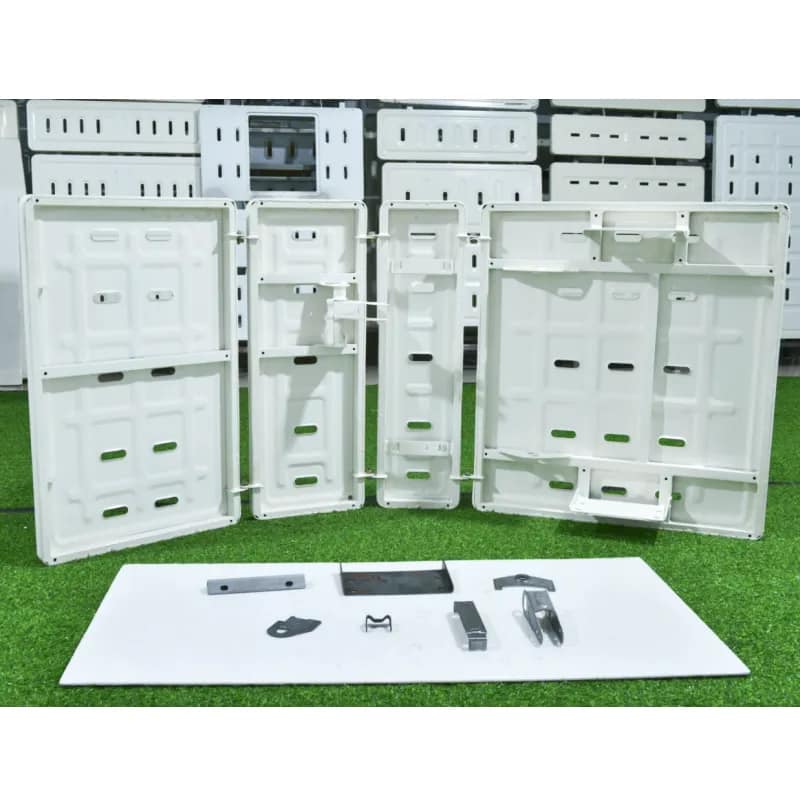


If your next hospital bed project involves tight door clearances, high-humidity environments, or specific patient weight requirements, it is worth cross-checking the datasheet dimensions, material grades, and load-testing conditions before finalizing your order. At Yingyun Hardware, our technical team can provide full datasheet packages including dimension drawings, material certificates, and load-test reports for any model in our range. Send your project requirements and target specifications to [email protected] or call +8613528198959 for a side-by-side comparison that accounts for your actual operating conditions.
Questions Hospital Buyers Ask About Medical Bed Specifications
In my experience, the most reliable test of a bed’s load capacity is whether the datasheet specifies dynamic testing, not just static weight.
When a bed is listed as 250 kg safe working load, that rating should ideally come from a test that includes repetitive motion cycles with a distributed load, not just a static weight placed in the center. We conduct in-house load testing on bed panels and frames at full rated capacity with the backrest cycling through its full range, and I always look for that level of detail in a technical file. If a supplier’s datasheet only gives a single weight figure without mentioning test methodology, I advise asking whether the rating is static or dynamic. For patients who will be in the bed for extended periods or those receiving frequent position changes, a static-only rating can be misleading. A bed that holds 250 kg statically may show deformation after a few months of daily articulation if the structure was not validated dynamically.
A common misconception is that ABS end panels and side rails are interchangeable across brands, but in practice the attachment system determines compatibility.
The headboard and footboard on a hospital bed secure into slots on the bed frame using a specific hook and locking mechanism. Our ABS end boards use a snap-on structure that mates with a hook seat and a welded bracket on the frame; the dimensions of that interface are not standardized across manufacturers. I have seen hospitals try to fit one brand’s headboard onto another brand’s bed because they looked similar, only to find that the mounting hooks were offset by 10 mm or the locking tab was incompatible. Before ordering replacement boards or mixing brands, pull the datasheet for both the board and the bed and verify the hook seat dimensions. If that drawing is not available, request it from the supplier. For OEM projects, we customize the hook seat to match the client’s existing fleet when needed.
When comparing electric and manual cranks, it depends on the care setting and the caregiver-to-patient ratio, not just upfront cost.
An electric five-function bed with powered Trendelenburg and height adjustment will reduce the time a nurse spends repositioning a patient from several minutes to under 30 seconds, which can be the deciding factor in an ICU with a 1:2 nurse-patient ratio. In a nursing home with a 1:8 ratio during night shifts, the same bed may improve care quality significantly by allowing residents to adjust their own position. However, in a rural clinic with unreliable power, a manual three-crank bed with stainless steel cranks that are easy to turn under load is often the more appropriate choice. I generally recommend that buyers calculate the cost of the bed not as a line item but as a function of staff time over the expected service life, which is typically 7–10 years. A bed that costs 20% more but saves 15 minutes of staff time per patient per day can pay for itself within the first year if you assign even a modest hourly cost to nursing time.
For long-term care facilities upgrading from manual to electric beds, the door width and floor type should be checked against the datasheet before selection, because many electric beds are wider and heavier than their manual counterparts.
A manual two-crank bed may have an overall width of 970 mm with rails down, while an electric five-function bed with the same patient surface width can measure 1030 mm due to the motor mounting and central-locking caster mechanism. If the facility was built with 1000 mm door frames, that extra 60 mm means the electric bed will not pass through without disassembly. Similarly, electric beds typically weigh 20–30 kg more than equivalent manual beds, which affects floor loading and caster performance on soft surfaces. The datasheet should list the overall width both with guardrails raised and lowered, as well as the total weight without mattress and accessories. Measure the narrowest doorway on the patient transport path first, and keep 50 mm clearance on each side for safe passage.
Share your facility’s door dimensions, corridor layout, and patient weight profile with our team at [email protected], and we will return a comparison of which bed configurations fit your physical constraints and clinical needs without guesswork.
If you’re interested, check out these related articles:
Electric vs Manual Adjustable Beds: A Comprehensive Comparison
How to Choose the Right Adjustable Medical Bed for Your Clinic: A Comprehensive Guide
Unlocking Comfort and Care Benefits of Adjustable Hospital Beds
Top Wholesale Hospital Bed Parts Manufacturers & Suppliers