
As a medical hardware engineer who has spent nearly twenty years designing and manufacturing hospital beds and their components, I know that bed selection for a rehabilitation center carries a different set of demands than a general ward. In a rehab setting, the bed is not just a place for rest. It is a platform that patients use to reposition themselves, practice transfers, and progress through mobility milestones, often with a therapist working beside them. The bed must be stable enough for safety exercises yet adjustable enough to support patients at varying levels of ability, and it must hold up under far more adjustment cycles than a standard acute care bed. This guide walks through the structural and functional details that matter most when you are evaluating hospital beds for rehabilitation centers, grounded in how these products are actually built and tested inside a manufacturer’s facility.
Essential Bed Functions for Rehabilitation Therapy
In a rehabilitation program, bed adjustments are not occasional convenience features. They are tools that directly support clinical goals. The backrest angle matters for gradually building sitting tolerance in patients recovering from spinal surgery or stroke. The knee break section is used to prevent sliding when the backrest is raised, but it also helps position patients for lower extremity exercises. Height adjustment, often overlooked, is critical. A bed that lowers to within 430 mm of the floor allows a patient to practice sit-to-stand transfers with a safer foot position, while a maximum height around 840 mm lets the therapist work without stooping.
From a manufacturing standpoint, the smoothness and reliability of these adjustments depend heavily on the crank or motor system. Our three-crank manual bed, for example, uses a Liuzhou steel bedtop and a galvanized screw mechanism with two-way limit protection. Each crank independently controls backrest tilt up to 75 degrees, knee board tilt up to 40 degrees, and overall height within a 430–760 mm range. These are simple, field-serviceable systems that do not rely on electricity, which makes them practical even in facilities with intermittent power. Electric three-function beds add a motorized height adjustment and Trendelenburg positioning. The load capacity across our manual and electric lines is 250 kg, which is a specification I recommend checking carefully against the actual patient population and any planned bariatric use.
Manual vs Electric Beds: Matching Power to Patient Mobility
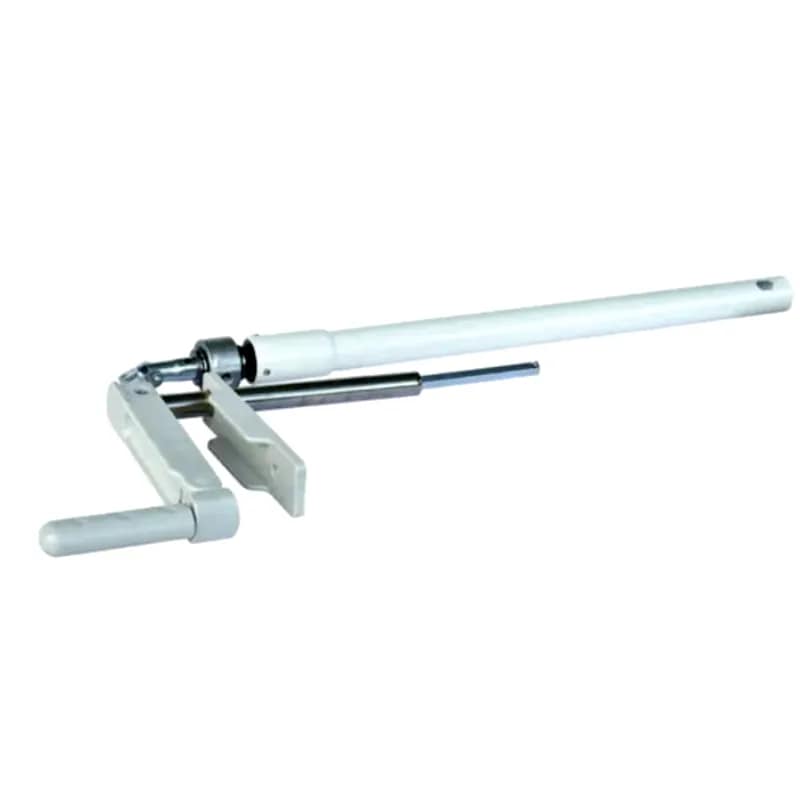
The choice between manual and electric is not just about budget. It is about the therapist’s workflow and the patient’s progress. In our experience supporting rehab facility projects, manual crank beds suit lower-acuity programs where patients can follow verbal instructions and adjust themselves or where nursing staff have time to operate the cranks between therapy sessions. The crank handle itself is a point of differentiation. We offer an ABS crank with an in-place protection mechanism that prevents back-driving under patient weight, and a stainless steel version with non-magnetic properties for MRI-adjacent rooms.
Electric beds become necessary when the care model demands frequent, fine adjustments timed with therapy. A patient working on incremental sitting tolerance under therapist supervision needs the backrest to move in small, controlled increments, ideally at the press of a button. Our electric three-function bed runs five independent motors, with a noise level kept under 45 dB to avoid startling patients during transfers. The battery backup is not a marketing bullet point; it is a safety requirement in case of grid outage during a lift operation. I have seen rehab centers standardize on electric beds for their main therapy gym and keep manual beds in overnight observation rooms, a hybrid approach that balances capital cost against clinical efficiency.
Structural Components That Withstand Daily Therapy Use
The part that most procurement checklists gloss over is how the bed’s structural construction holds up over time. Rehabilitation centers average far more adjustment cycles per bed per day than a general ward. The crank system’s worm gear, the steel thickness of the bed panels, and the durability of the guardrail locking mechanisms all face accelerated wear.
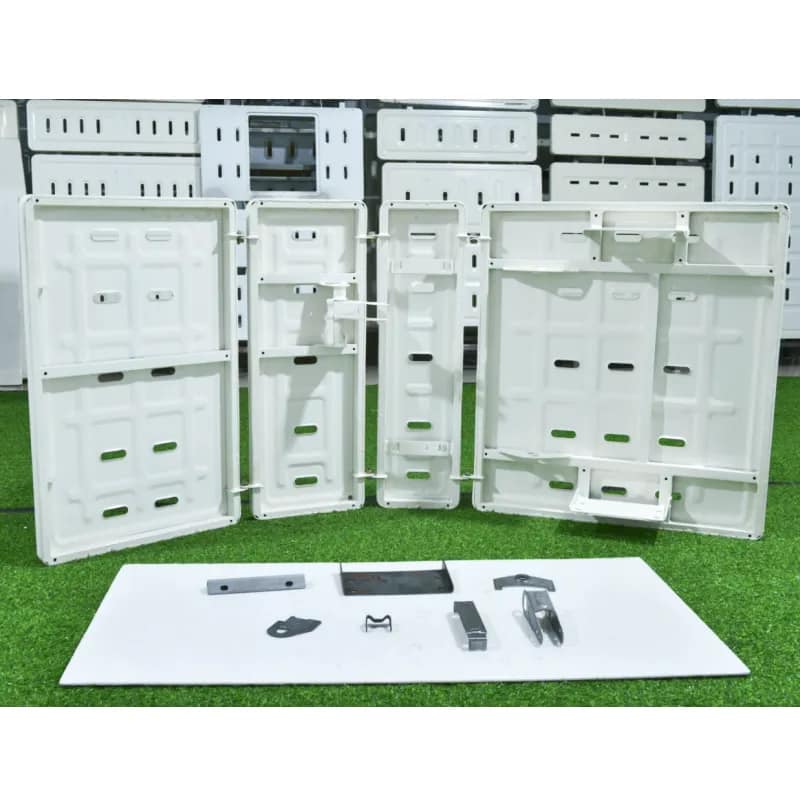
Stamped bed panels made from 0.9 mm willow steel with a curled-edge design provide a rigid platform that resists warping. We produce these in four-section configurations for width options from 820 mm to 900 mm, and each section is replaceable if damage occurs. ABS panels, in contrast, offer a smoother, easier-to-clean surface and are often preferred for head and footboards. The headboard and footboard on our beds use an ABS snap-on structure that can be disassembled in under 30 seconds, which is a small detail with big implications for emergency airway access during a code.
Guardrail selection directly affects both patient safety and the bed’s usable lifespan. A horizontal tube folding guardrail made from iron and plastic offers the strength needed to support a patient’s weight during a transfer, while a curved tube or aluminum alloy model is lighter for staff to operate dozens of times daily. I recommend the ABS European-style guardrail for rehab centers where patients actively use the rail as a stability aid, because the integrated locking button and die-cast metal-nylon connector hold position more reliably than a friction-only design after repeated cycles.
If your program serves patients who routinely exceed 150 kg, confirm the guardrail’s static load rating with the manufacturer. It is not the same as the bed frame’s total load capacity. Contact us at [email protected] to discuss guardrail load testing data for your specific use profile.
Casters are the foundation the bed sits on, and they are one of the biggest long-term maintenance cost drivers. Central-locking casters with TPR tread, such as our 5-inch double-face model, allow a therapist to lock all four wheels from one pedal, saving time when repositioning a bed before a therapy exercise. The pedal mechanism itself is made from aluminum alloy, not plastic, which matters when it gets stomped hundreds of times a week.
Safety and Fall Prevention in the Rehabilitation Setting
Fall prevention in rehab is more nuanced than just raising the side rails. A patient who is learning to stand independently will still need the security of a rail while gaining the confidence to release it. Our door-type guardrail with a semi-open design allows the patient to exit the bed laterally without climbing over a rail, which reduces fall risk during assisted transfers. The rail locks with a button mechanism, not a friction detent, so it does not drift out of position mid-exercise.
The bed frame’s stability during a patient’s weight shift onto the rail is also a function of the bed’s own mass and the caster swivel design. A lighter bed with narrow caster spacing may tip more easily. Our beds use a 25×50×1.5 mm rectangular steel tube frame and wide-set central-locking casters with a 5-inch tread diameter, a combination that has proven stable even under the lateral force of a 250 kg patient using the rail to pull themselves up. For facilities in tropical climates, where high humidity accelerates steel corrosion, the 304 stainless steel caster housings and TPR tread are worth the incremental cost over zinc-plated alternatives.

Procurement Considerations for Rehabilitation Center Beds
Beyond function and durability, the practical terms of procurement have a direct impact on project timelines and total cost. Our manual and electric beds are packed in wooden export-grade crates with foam cushioning. The minimum order quantity of 50 units per model is standard for direct-factory orders, but we can customize the bed size, color, and accessories even for smaller volumes through our OEM service. Lead time for manual beds is typically 15–20 working days, while electric beds with motor integration require 40–45 working days, so plan your ordering window accordingly.
Warranty coverage is one year for the mechanism and structure, which covers the crank assemblies, motors, and frame welds. I recommend factoring in the cost of a small spare parts inventory, especially for items like the crank handle, a set of four casters, and a pair of guardrail locking buttons. These are the components that wear first under heavy rehab use and having them on-site prevents a bed from sitting out of service for days.
Choosing a Bed That Supports Clinical Progress
Rehabilitation is, at its core, about small daily gains. The bed that supports those gains needs to feel stable under uncertain patient movements, adjust quickly at the therapist’s request, and not fail under the cumulative load of constant repositioning. I have seen facilities cut costs on bed quality only to face rising maintenance bills and, more concerning, delayed therapy because equipment was out of service. A well-made bed with the right structural components is not a commodity. It is a clinical asset that pays its way in patient progress.
Yingyun Hardware has manufactured hospital beds and bed accessories since 2006, and we work directly with healthcare providers and distributors worldwide to supply beds configured for specific clinical environments. If you are planning a rehabilitation center bed procurement or need technical data to support a specification decision, I encourage you to send your requirements to [email protected] or call +8613528198959. Share the patient weight range, expected daily adjustment cycles, and any transfer or access constraints, and we will recommend the bed configuration that matches your clinical workflow.
Common Questions About Rehabilitation Center Beds
What bed width is best for rehabilitation exercises?
Most rehab beds are 900 mm to 1000 mm wide, which gives the patient enough room to roll and reposition while keeping side rails within reach. A 900 mm width works for standard rooms and doorways, but if your facility has wider door frames and you plan to use the bed for active exercise, the extra width helps. We offer bed panels in 820 mm, 840 mm, and 900 mm widths, and the bed frame can be built to match.
How often should rehabilitation beds be serviced?
At a minimum, every six months for a bed that sees daily therapy cycles. The inspection should cover crank mechanism lubrication, caster brake function, guardrail lock integrity, and bed panel fastener torque. I advise facilities to keep a log because a creaking crank or a sticky brake can warn of wear before a failure interrupts care.
Can I get beds with specific guardrail and caster configurations?
Yes, and this is where working with a manufacturer directly pays off. We can supply beds with horizontal tube, curved tube, wood-grain, door-type, or aluminum alloy guardrails, and the casters can be configured as full-wrapped, central-locking, or stainless steel depending on your flooring and mobility needs. If your rehab program uses a specific transfer technique that requires a certain rail height or gap, share that detail so we can adjust the rail mounting position.
How do I compare bed durability between different manufacturers?
Look past the frame warranty and ask for data on the specific components that fail most often: crank worm gear cycle count, guardrail locking mechanism endurance, and caster brake pedal life. A one-year warranty tells you the manufacturer’s confidence in the average load, but the component-level testing data tells you whether the bed will survive a high-cycle rehab environment. In our own production, we test crank mechanisms and guardrail locks to withstand repeated use well beyond the rated patient load, and we can provide test reports for your engineering review. Send your durability data request to [email protected] and specify the bed model and usage profile.
If you’re interested, check out these related articles:
Identifying Reliable Brands for Adjustable Hospital Beds
Are Adjustable Hospital Beds Covered by Insurance or Medicare