
Choosing a hospital bed spare parts supplier is not just about pricing or speed. It is about verifying that every metal bracket, caster, and guardrail can withstand years of daily use without compromising patient safety. With nearly two decades of experience manufacturing hospital bed components, I’ve seen how differences in stamping accuracy, material grade, and assembly process directly affect bed performance and the quality of care. This article walks through the technical and operational factors you should evaluate when sourcing reliable spare parts, drawing on real manufacturing practice rather than generic procurement theory.
What to Look for in a Hospital Bed Spare Parts Supplier
Start by examining how a supplier communicates their production process. A trustworthy supplier will openly share technical specifications, material data sheets, and production floor details. Beware of companies that claim to manufacture but subcontract fabrication. In our industry, I’ve encountered facilities that show a polished showroom but rely entirely on third-party workshops for actual stamping and welding. This introduces quality variability that a hospital environment cannot afford.
Request a live video tour or schedule an on-site visit. Pay attention to machine maintenance, tooling storage, and in-process inspection stations. A supplier that cannot show you how they control flatness on a stamped bed panel or measure weld penetration is not prepared for consistent output. Look for at least a decade of continuous manufacturing history. Stability matters because tooling wear and operator turnover directly affect part repeatability. Also ask about their inventory philosophy. A supplier that keeps raw steel stock and common semi-finished parts on hand can shorten lead times when your ward needs urgent replacements.

Manufacturing Capabilities That Indicate Reliable Production
A supplier’s core production processes tell you more than any certificate. When evaluating a hospital bed spare parts supplier, focus on three manufacturing fundamentals: metal stamping, welding, and surface treatment.
| Manufacturing Step | What to Verify | Why It Matters |
|---|---|---|
| Metal stamping | Tolerance consistency within 0.2 mm, absence of burrs | Parts must fit precisely during assembly and load transfer without stress concentration |
| Welding | Penetration depth, uniformity along the seam, no cracks or porosity | Load-bearing joints on bed frames and side rails rely on weld integrity for patient safety |
| Surface treatment | Powder coating thickness and adhesion, corrosion-resistance testing | Clinical cleaning agents and humidity accelerate rust if coating is inadequate |
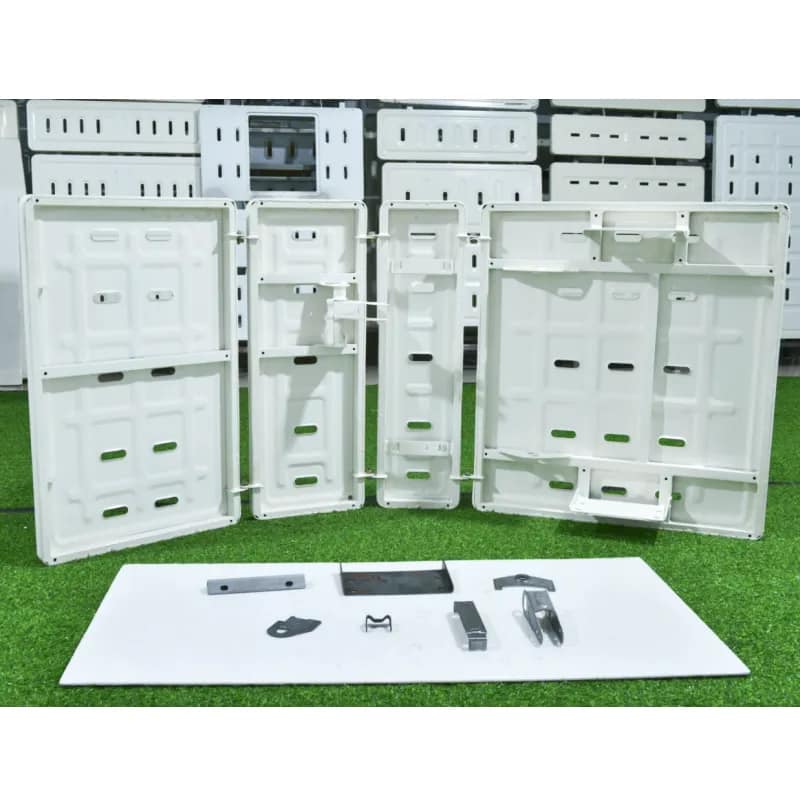
What Stamping Accuracy Means for Bed Panels
Stamped bed panels look similar across suppliers until you measure them. In our factory, I require flatness variation under 0.2 mm across the panel surface. Anything more creates uneven contact points that accelerate mattress wear and transfer uneven pressure to the patient. The steel grade matters too. For load-bearing panels we use cold-rolled Liuzhou steel at 0.9 mm thickness, which consistently supports 250 kg without permanent deformation. When a supplier cannot specify the steel grade and thickness used in their panels, assume they are cutting corners.
Welding Quality and Load-Bearing Safety
Welds on a hospital bed frame are subjected to dynamic loading every time the patient shifts, the bed is adjusted, or staff lean on a side rail. I look for continuous, uniform weld beads with full root penetration. Intermittent tack welding or visible porosity is a sign that the frame will develop stress cracks within a few years. In one batch inspection I participated in early in my career, a poorly welded bed foot frame cracked under 180 kg during testing, well below the rated 250 kg. The failure point was a single weld joint where the operator had set incorrect current. That kind of variability is what you avoid by working with a supplier that has documented welding procedures and in-house destructive testing.
Material Selection and Its Impact on Part Durability
The longevity of any spare part depends on material choice as much as fabrication skill. The following table outlines the most common materials and their hospital-appropriate applications.
| Material | Typical Use | Key Benefits |
|---|---|---|
| Cold-rolled steel (Q195, Liuzhou) | Bed frames, bed panels, crank handles | High strength, stamping-friendly, cost-effective |
| 304 stainless steel | IV poles, casters, some guardrail tubes | Corrosion resistant, easy to sanitize |
| Aluminum alloy (die-cast) | Guardrail connectors, handrails | Lightweight, good strength-to-weight ratio |
| ABS engineering plastic | Headboards, footboards, bedside cabinets | Impact resistant, easy to clean, color-stable |
| TPR / PP | Caster wheels, bumpers | Quiet rolling, floor protection, wear resistance |

When sourcing casters, I recommend specifying TPR over harder plastics. TPR treads roll silently and do not leave marks on linoleum floors, which is critical in night-shift ward environments. For parts that will be autoclave-sterilized, stainless steel or high-temperature ABS is necessary. If the supplier cannot confirm the specific material grade and suggests a generic “steel” or “plastic,” you are exposed to substitution risk.
Quality Certifications and Inspection Protocols
Certifications are a starting point, not a guarantee. The core standard for medical device component manufacturers is ISO 13485. This requires a quality management system that covers design control, process validation, and traceability. Ask for a copy of the certificate and verify its scope. A certificate that covers only “metal furniture” is not the same as one that explicitly includes “medical bed components.”
How to Verify a Supplier’s ISO 13485 Certification
Request the certificate number and issuing body, then check online. Pay attention to the expiry date and any surveillance audit notes. I’ve seen suppliers display expired certificates or those belonging to a different legal entity within a group. A legitimate manufacturer will have no issue providing this information.
In-House Testing vs. Third-Party Lab Reports
Some suppliers outsource all testing. While acceptable for occasional validation, consistent quality control requires in-house capability. In our factory, we conduct load testing on every production batch and keep records for traceability. Ask what testing equipment they have: a universal testing machine, a salt spray chamber for corrosion resistance, and a durometer for casters are all reasonable expectations for a bed component manufacturer. Relying solely on a one-time external lab report means the parts you receive could differ from the tested sample.
OEM Flexibility and Customization Support
For hospitals and distributors with specific requirements, the ability to customize spare parts is often the deciding factor. Customization covers dimensions, materials, colors, surface finishes, and branding.

Custom ABS bedside cabinets, for example, can be color-matched to a hospital’s visual identity and fitted with drawer configurations that match nursing workflows. Stamped bed panels can be produced in non-standard widths and with welded or snap-on connections depending on whether the end user needs rapid disassembly for emergency procedures.
From Drawing to Production: The OEM Process
When a client sends us a drawing or a sample part, we begin with a feasibility review. I personally assess whether our existing tooling can be adapted or if new stamping dies are needed. We then produce a first-article sample, fully inspect it against the specification, and ship it for client approval before mass production begins. This step adds a few weeks to the overall lead time but prevents costly mismatches in a container-load of parts. If your supplier skips the first-article approval step on a custom order, you are accepting the risk that the entire shipment may not fit.
Supply Chain, Lead Times, and After-Sales Considerations
Even the best components are useless if they arrive late or without support. Standard lead times for hospital bed spare parts range from 15 to 45 working days, depending on whether tooling exists and the surface treatment complexity. Urgent orders can often be accommodated if the raw material is in stock. When discussing timelines, I always recommend confirming whether the quoted lead time includes final inspection and packaging, as some suppliers quote only machine time.
Minimum order quantities (MOQs) vary. Small stamped parts like crank handles or connecting ears typically start at 100 pieces, while larger assemblies like complete bed panels may be feasible at 50 sets. For initial trial orders, many manufacturers, including ours, offer flexibility on MOQ to build a new relationship.
Packaging is another detail that matters. Hospital bed parts shipped internationally must be secured against salt-air corrosion and container vibration. We use wooden crates for complete beds and export-grade cartons with polyethylene foam for individual components. Crushed cartons and scratched parts on arrival are often a result of poor packaging, not shipping damage.
After-sales support should include at least a one-year warranty on structural and mechanical components. Ask the supplier for a written warranty statement that clearly defines what is covered and the claim procedure. A supplier that is vague about warranty terms is unlikely to support you when a batch of guardrails shows premature corrosion.

Moving from Evaluation to Partnership
Sourcing hospital bed spare parts is a long-term commitment. A difference of half a millimeter in a stamped hole or a few percentage points in coating thickness may seem trivial on a drawing, but in a ward where beds run 24 hours a day, those details become patient comfort and caregiver efficiency. Finding a hospital bed spare parts supplier that combines manufacturing precision with transparent communication is not always straightforward, but it is the single most reliable path to a consistent supply chain. At Yingyun Hardware, we have spent nearly twenty years building in-house expertise across stamping, welding, and assembly, and we manufacture bed panels, guardrails, caster systems, and metal hardware to specifications that reflect real clinical use. Send your part numbers and quantity requirements to [email protected] or call +8613528198959 for a technical consultation and quotation.
Common Questions About Hospital Bed Spare Parts Sourcing
How long does it take to receive custom hospital bed spare parts?
It depends on the part complexity and whether new tooling is required. Standard stamped parts with existing tooling can ship within 15 to 20 working days. Custom-designed components that require new stamping dies may take 40 to 45 working days. We always confirm the timeline after reviewing your drawing. If your schedule is tight, reach out early with your deadline and we will evaluate whether an expedited production slot is available.
What is the minimum order quantity for spare parts?
MOQs vary by product category. Small metal stampings like crank components or connecting ears usually start at 100 pieces. Larger assemblies such as stamped bed panel sets are feasible at 50 sets. For new partnerships, we can often accommodate smaller trial orders. The best approach is to submit your target quantities together with your specification so we can propose a workable initial batch.
Can I get a sample before placing a bulk order?
Yes, and we strongly recommend it. For standard parts, we ship samples from current inventory. For custom parts, we produce a first-article sample following the agreed drawing. That sample undergoes full dimensional inspection and is sent for your approval before any full production begins. This step adds a few weeks to the lead time but virtually eliminates surprise upon delivery.
How do you ensure replacement parts match the original specifications?
We work from your provided drawings, sample parts, or specifications. For parts that integrate with a specific bed model, we verify key interface dimensions on the sample using calipers, height gauges, and test fitting where possible. Our quality team records every measurement and photographs the sample prior to shipping. This documentation serves as the baseline for production quality control.
What after-sales support do you provide for spare parts?
We offer a one-year warranty that covers structural and mechanical integrity of our components. If a part fails due to manufacturing defect, we replace it and investigate the root cause in our production records. Beyond warranty, our engineers are available to discuss installation, compatibility, or technical adaptation questions. If your facility has specific performance requirements that standard parts cannot meet, we can discuss a revised specification. Send your requirements to [email protected] and we will confirm feasibility and delivery terms.
If you’re interested, check out these related articles:
Comparing Prices for Hospital Bed Parts Manufacturers Effectively
Essential Materials for Quality Medical Bed Parts Manufacturing
Identifying Reliable Brands for Adjustable Hospital Beds
Electric vs Manual Adjustable Beds: A Comprehensive Comparison
Top Wholesale Hospital Bed Parts Manufacturers & Suppliers