
A hospital equipment purchase agreement template is more than a legal formality for healthcare facilities procuring beds, patient furniture, and accessories. After nearly two decades in medical hardware manufacturing, I have seen contracts that protected the buyer and others that left them with equipment failing in the ward within the first year. The difference often comes down to the technical clauses most generic templates omit. This article outlines the essential technical specifications and quality verification measures every hospital equipment purchase agreement should include, from a manufacturer’s perspective, so procurement teams can secure equipment that meets clinical demands and regulatory standards.
Why a Detailed Hospital Equipment Purchase Agreement Matters
Medical equipment procurement is not a simple commercial transaction. Hospital beds, overbed tables, transfer stretchers, and bedside cabinets must perform reliably in 24/7 clinical environments where patient safety and infection control are non-negotiable. A generic purchase agreement that only covers price, quantity, and delivery date leaves the buyer exposed to equipment that fails under continuous use, falls short of safety standards, or requires costly after-sales support that nobody factored into the contract.
I have seen facilities receive hospital bed casters that locked up after three months of floor sanitization with quaternary ammonium disinfectants, because the contract never specified chemical resistance requirements. A detailed agreement ties supplier obligations to documented performance parameters, shifting the burden of proof to the manufacturer and giving the buyer clear recourse when equipment does not perform as promised.
Key Legal Clauses for Hospital Equipment Contracts
While local counsel should always review the final document, procurement teams need to know which clauses are non-negotiable in a hospital equipment purchase agreement template. At minimum, the contract should include:
Inspection and acceptance criteria. The agreement must state that the buyer or a third-party inspector may examine goods before final acceptance, and define what constitutes a non-conforming delivery. Without this clause, the buyer may be forced to accept equipment with cosmetic defects or minor non-compliance.
Delivery terms and incoterms. For cross-border purchases from manufacturers in China or elsewhere, shipping responsibility, insurance, and risk transfer point must be clearly defined. I often recommend FOB origin port for buyers who want control over ocean freight and insurance, but many hospital procurement teams prefer CIF to simplify logistics.
Payment terms tied to milestones. Instead of 100% advance payment or full payment on delivery, the agreement should tie installments to document submission, pre-shipment inspection, and successful installation. This protects the buyer from cash-flow exposure and creates leverage for quality enforcement.
Liability, warranty, and indemnification. A warranty clause should cover at least 12 months for mechanical and structural components, and specify whether the manufacturer supplies replacement parts, on-site service, or both. Liability limits should be reasonable and clearly exclude personal injury claims caused by product defects.
Technical Specifications to Include in Your Hospital Bed Purchase Agreement
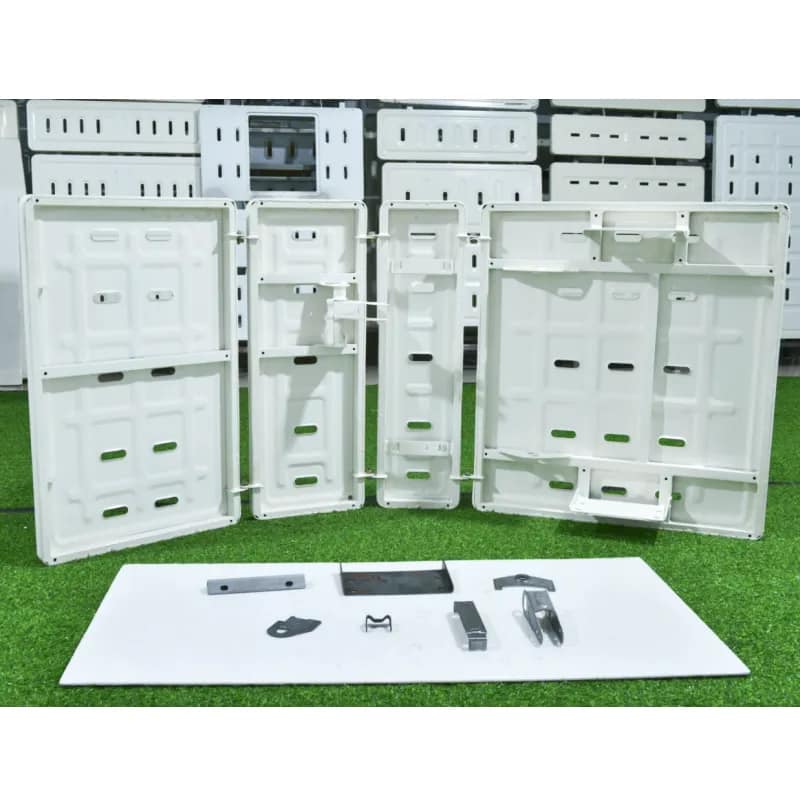
This is where most purchase agreement templates fall short. A hospital bed is an engineering product, not a commodity. If the agreement lacks measurable technical specifications, the supplier can deliver a bed that meets the purchase order wording but fails in actual use. Based on two decades of manufacturing hospital beds, I recommend the following specification categories.
Bed frame and panel specifications. Define the material, thickness, and surface treatment. For example, stamped bed panels should specify willow steel of at least 0.9mm thickness with powder coating. Our standard stamped panels, used in thousands of beds across Asia and the Middle East, are fabricated from 0.9mm willow steel, forming a rigid platform tested to a 250kg load. Without specifying material grade, you may receive panels that dent under patient repositioning.
Caster specifications. Casters determine mobility, floor protection, and braking safety. An agreement should state caster type (e.g., central-locking or individual), material (TPR or polyurethane), and load rating. A 5-inch TPR centre-lock caster with a stainless steel bracket, rated for a minimum dynamic load of 120kg per caster, is a standard that eliminates many cheap alternatives that squeak or delaminate on textured hospital flooring.
Guardrail specifications. Patient fall prevention depends on guardrail locking mechanisms and structural rigidity. The contract should specify whether guardrails are die-cast aluminum, alloy steel, or ABS, and whether the locking mechanism passes a pull-force test of at least 50kg. I have seen facilities replace entire guardrail sets within two years because the original purchase agreement only said “side rails included.”
Electrical components and controls. For electric beds, specify motor IP rating, noise level (≤45dB for ICU models), battery backup, and handset protection class. In a recent project, a hospital avoided a major recall because their purchase agreement required the supplier to pre-certify the linak-style actuator system for continuous duty cycle, a detail absent from the generic contract template they had initially received.

Infection control and material compatibility. The agreement should require that all external surfaces—ABS headboards, footboards, and panels—are compatible with hospital-grade disinfectants, including quaternary ammonium compounds and diluted sodium hypochlorite. We manufacture ABS components from engineering-grade plastic that withstands repeated cleaning without colour fading or surface degradation, but if the contract does not require chemical resistance testing, the supplier can use cheaper materials that crack after six months of exposure.
Component traceability and documentation. Each major component, from casters to IV pole sockets, should carry a manufacturer’s batch code traceable to raw material certifications. In a purchase agreement, require the supplier to provide material certificates for steel, plastic, and electronic components. This documentation supports quality audits and simplifies replacement part ordering down the line.
Verifying Supplier Credentials Before Signing an Agreement
A technically detailed purchase agreement is only as strong as the supplier who signs it. Before committing to a manufacturer, verify the following:
Quality certifications. Ask for ISO 13485 (medical devices quality management) and ISO 9001 certificates, and verify their validity directly with the issuing body. For markets requiring CE marking or FDA registration, request the relevant technical file summary and declaration of conformity.
Factory audit capability. If your procurement volume exceeds 100 units, a factory audit is the single most effective risk mitigation measure. Look at the stamping line, welding stations, and final assembly area. Consistent jig and fixture usage, in-process inspection records, and component traceability labels are signs of a manufacturer that can deliver reproducible quality.
Client references in your region. Request contact details of two or three existing buyers in your geographic market, preferably with similar bed configurations. Calling a reference gives you real-world feedback on warranty response, parts availability, and communication.
Sample evaluation clause. Include a clause in the purchase agreement giving you the right to evaluate a pre-production sample or the first-off-the-line unit before the main shipment releases. This sample should be identical to the production units, not a handcrafted showroom piece.
After-Sales Terms That Strengthen Your Hospital Equipment Purchase Agreement
After-sales support is where many buyer-manufacturer relationships break down. A robust hospital equipment purchase agreement template will address the following:
Warranty period and scope. We provide a one-year structural and mechanism warranty as standard, covering manufacturing defects in the frame, crank system, casters, and electric actuators. Clarify whether the warranty includes labour, on-site service, or parts only. For export orders, clarify who bears the freight cost of warranty replacement parts.
Spare parts supply commitment. The agreement should commit the supplier to maintaining spare parts availability for at least five years after the last production run. This obligation protects hospitals from being unable to repair beds when the model is discontinued. We have supported spare part requests for bed models that ceased production seven years ago, simply because the component was a standard crank system or caster from our catalogue.
Technical documentation and training. Require the supplier to provide assembly instructions, maintenance manuals, and a recommended spare parts list with part numbers. If the order includes more than 50 beds, request on-site or video training for biomedical engineering staff.
Defect reporting and response time. Define how the buyer reports a defect, what evidence is required (photos, video, serial number), and the supplier’s maximum response time for confirming corrective action. A 48-hour acknowledgement and a seven-day preliminary analysis is a reasonable standard for overseas manufacturers.

If your procurement involves ICU beds or specialised equipment, confirming these after-sales terms before finalising the purchase order saves months of frustration later. A quick technical review of your draft agreement against the points above often reveals gaps. Share your requirements and draft agreement with us at [email protected] or call +8613528198959, and we will review the technical sections from a manufacturer’s perspective before you commit.
Common Questions About Hospital Equipment Purchase Agreements
What technical specifications are most often overlooked in hospital bed contracts?
The single most common omission is caster and wheel specifications. Many contracts say “casters with brakes,” which covers anything from a cheap injection-moulded wheel to a hospital-grade TPR centre-lock assembly. I have personally inspected beds where the casters started shedding rubber particles on the ward floor within three months because the contract never mentioned material or dynamic load rating. Always specify caster type, material, load capacity, and whether the brake is individual or central-locking.
How can I verify that a Chinese hospital bed manufacturer’s certifications are genuine?
Ask the supplier to provide the certificate number and issuing body, then look up the certificate on the certification body’s public database. For ISO certifications, you can often verify through the accreditation forum website. For CE marking, request the technical file summary and the Notified Body certificate. In projects I have supported, buyers who took an extra 24 hours to verify these numbers avoided dealing with expired or fabricated certifications.
What should I do if the delivered equipment does not match the contract specifications?
First, document the discrepancy with photographs, measurement records, and a side-by-side comparison with the agreed specifications in the purchase agreement. Notify the supplier in writing within the time window specified in the acceptance clause, and state clearly whether you reject the shipment or accept it with an agreed price adjustment. If the discrepancy involves safety-critical components like guardrails or electrical systems, do not put the equipment into service until the supplier resolves the issue.
Can I negotiate payment terms that protect my hospital’s budget?
Yes, and you should. The most balanced structure is a deposit (typically 30%) upon order confirmation, a further payment (30%) against presentation of pre-shipment inspection photos and test reports, and the remaining balance (40%) after installation and acceptance at the hospital site. This structure gives the manufacturer working capital while keeping significant leverage for the buyer. For large purchases, deferring a portion until successful training completion adds an extra quality incentive.
Is it reasonable to ask for a pre-production sample for a bulk hospital bed order?
Absolutely. A pre-production sample is the most effective way to verify that the factory interprets your specifications correctly. I have seen cases where a single sample evaluation revealed incorrect guardrail height because the buyer’s drawing used floor-to-top-rail measurement while the factory assumed mattress-deck-to-top-rail. Request the sample, evaluate it against your clinical requirements, and approve it in writing before authorising full production. If your hospital project involves custom bed configurations, share your layout and specification sheet with our team at [email protected] and we can confirm feasibility and sample timing.
If you’re interested, check out these related articles:
What is an Adjustable Hospital Bed and How Does It Work: A Comprehensive Guide
Top Wholesale Hospital Bed Parts Manufacturers & Suppliers
Choosing a Reliable Hospital Bed Parts Manufacturer: A Comprehensive Guide
Identifying Reliable Brands for Adjustable Hospital Beds