
When a patient transitions from a clinical setting to home-based care, one of the first equipment decisions is selecting the right bed. A homecare bed vs hospital bed comparison reveals that the terms are often used interchangeably, but the engineering, safety features, and intended use differ markedly. At Yingyun Hardware, we have spent nearly two decades building both categories, and I have seen procurement teams repeatedly conflate the two, only to find that the bed they purchased cannot handle the demands of a home environment, or conversely, pays for clinical-grade functions no one will ever use. This article clarifies the structural, functional, and safety tradeoffs so you can match the bed to the care setting without overpaying or under-specifying.
What Distinguishes a Homecare Bed from a Hospital Bed
The core difference lies in the design brief: a hospital bed is built for 24/7 clinical workflows, frequent cleaning with aggressive disinfectants, and operation by rotating staff who may not read a manual twice. A homecare bed is engineered for a single user over months or years, operated by a family caregiver or the patient, in a setting where floor space is limited and the bed needs to integrate into living quarters without looking institutional.
From a manufacturing perspective, this changes everything. Hospital beds use thicker-gauge steel in the frame and bed panels; our single-crank manual hospital bed, for example, uses Liuzhou steel with a 250 kg load capacity and ABS head and footboards that snap off in 30 seconds for emergency access. The manual three-function hospital bed adds independent knee lift and full-bed height adjustment from 430 mm to 760 mm, giving nursing staff ergonomic working heights and Trendelenburg positioning. Homecare beds, in contrast, typically use lighter frames, simpler crank or two-motor electric systems, and lower height ranges because the caregiver is not cycling through 10 patients per shift.
The side rails tell the same story. Hospital bed guardrails, like our aluminum alloy and ABS models, lock rigidly and withstand repeated loading from patients pulling themselves up. Homecare bed rails often use a simpler folding design—still compliant with IEC 60601-2-52 safety dimensions—but with fewer locking cycles rated over the bed’s lifetime. For a patient who needs a stable grip during transfers, this cycle life difference becomes a real safety consideration after the first year of use.
Functional Differences That Directly Affect Daily Care
If you pull up specifications for both bed types, the backrest and knee-break angles look similar: typically 0–75° for the backrest and 0–40° for the leg section. The difference is how those angles are achieved and what happens at the extremes.
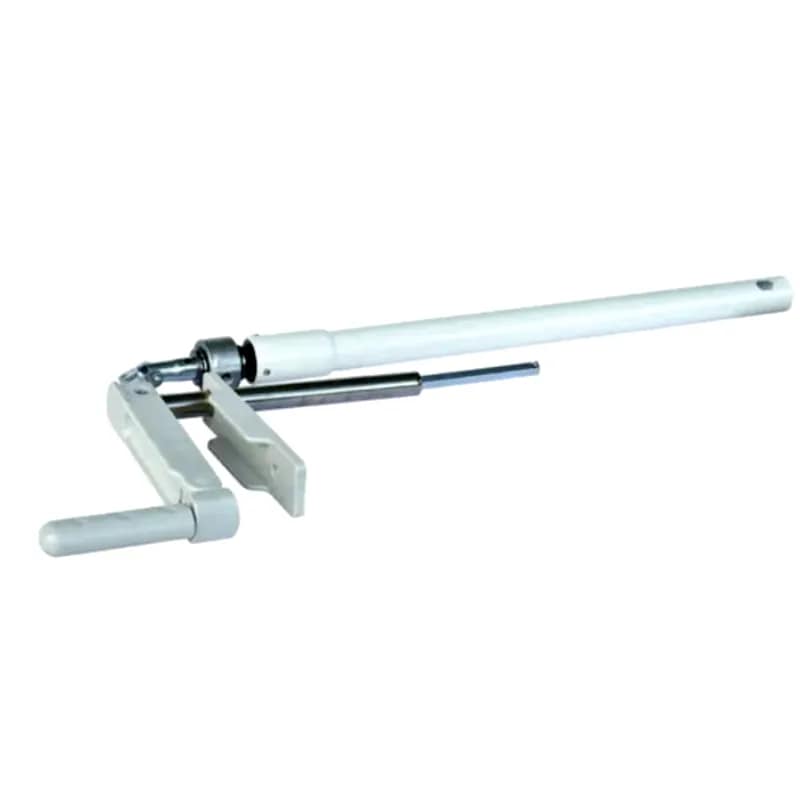
Manual hospital beds use a screw-driven crank mechanism with bidirectional limit protection. Our iron crank with in-place protection, for instance, prevents over-extension and makes the adjustment feel deliberate and controlled, which matters when a patient with fragile bones is in the bed. Electric hospital beds run motors at noise levels below 50 dB, and the five-function ICU bed adds reverse Trendelenburg and forward tilt—positions that are rarely necessary in a home setting but can be critical for respiratory patients in a ward.
Homecare electric beds usually omit full-bed height adjustment to keep cost and weight down. A typical two-function electric homecare bed lifts the back and knee, but the mattress platform stays at a fixed height around 430–480 mm. For a family caregiver, that means bending further to make the bed or assist with transfers. Over the course of a long-term care arrangement, that fixed platform height can accelerate caregiver back strain. For this reason, when a purchasing agent for a nursing home asks whether a homecare-style bed is adequate, I always ask about the caregiver-to-patient ratio and whether height adjustment will be used multiple times a day. If the answer is yes, the hospital bed with its wider height range and motorized lift pays for itself in reduced staff injury.

Mobility is another functional gap. Hospital beds roll on 125 mm or 150 mm central-locking casters, often with a TPR tread that is smooth, wear-resistant, and quiet on vinyl flooring. Homecare beds may use smaller 75 mm or 100 mm casters, sometimes without a central lock, because the bed is not expected to be moved frequently inside a room. I have seen homecare beds where the casters were barely adequate on thick carpet, making repositioning a two-person job. If the home has uneven flooring or door thresholds, the caster size and locking mechanism make a practical difference.
Safety Features and Fall Prevention
Fall risk is the common denominator across every care setting, but the protection strategy shifts. In a hospital, bed-exit alarms, four-section folding side rails, and low-bed positions below 300 mm are standard. A hospital bed guardrail like our door-type design with a locking button allows the patient to exit safely while the rail remains in place on the opposite side, reducing the impulse to climb over. The same guardrail on a homecare bed may be a two-bar folding rail that does not extend the full length of the mattress, leaving a gap at the foot end where a confused patient can slide out.
In our experience, the most overlooked safety factor is the gap between the mattress and the side rail. International standards now specify a maximum gap of 60 mm to prevent entrapment. Hospital bed rails are designed around that standard with tight tolerances across all bed positions. Homecare beds from less regulated sources may have rail attachments that do not maintain that gap when the backrest is elevated, because the mattress compresses and the rail pivot point stays fixed. We design our guardrail fixed plates and swing arms to keep the rail parallel to the mattress edge throughout the articulation range, but I have audited competing products where the gap opened to over 100 mm at full backrest elevation—a serious entrapment hazard that a procurement checklist alone will not flag.

The bed panel structure also contributes to safety. Stamped steel bed panels with a curled-edge design, like our 900 mm four-section stamped panels, distribute weight evenly and do not trap limbs between panels when the bed articulates. In some homecare beds, the panel sections are thinner and the connecting ears are stamped from lighter-gauge steel, which can deform after a few years, creating pinch points. If the patient is bedbound or has reduced sensation, these small mechanical failures become pressure injury risks that no caregiver can see by looking at the bed fully assembled.
Durability and Maintenance: What the Warranty Doesn’t Tell You
Both hospital and homecare beds come with one-year mechanism warranties as a baseline, but the real cost of ownership appears in years two through five. Hospital beds are built for 10,000 or more adjustment cycles, with motors rated for continuous duty and cranks that survive daily use by multiple staff. A manual hospital bed in a busy ward might see the backrest adjusted 20 times a day; after three years, that is over 20,000 cycles. The crank mechanism in our beds uses a hexagonal steel universal joint with in-place protection that prevents loosening over that cycle life.
Homecare beds typically see 5–10 adjustments per day, so the same mechanism would last decades. The failure point shifts to less obvious components: caster axle wear, guardrail pivot fatigue, and hand controller cable fraying. Because the bed is in a private residence, a broken hand controller can leave the patient stuck in a seated position for days while a replacement part ships. In a hospital, maintenance staff swap the controller in minutes. I recommend that anyone purchasing a homecare bed confirm that spare parts—particularly the hand controller, actuator motors, and casters—are available as off-the-shelf items, not special-order components with eight-week lead times. At Yingyun, we stock replacement casters, cranks, and guardrail components precisely because homecare users cannot tolerate long downtime.

The bed frame finish also ages differently. Hospital bed frames are powder-coated with antibacterial formulations and designed to withstand daily wiping with quaternary ammonium compounds. Homecare bed frames may use a simpler powder coat that resists occasional household cleaning but can start to show rust at welded joints in humid climates after two or three years. If the bed is going to a coastal region, I suggest specifying 304 stainless steel for at least the head and footboard brackets, even if the main frame remains painted steel.
Choosing the Right Bed for Your Care Setting
The decision tree I use with our customers starts with two questions: who will operate the bed, and will the bed need to function for multiple patients over its lifetime? For a single patient receiving care at home from one or two family members, a manual or two-function electric homecare bed with an ABS headboard and a simple folding guardrail is usually sufficient. It costs less, fits through a standard 800 mm doorway, and does not require an electrician to install.
When the same bed will serve a small nursing home or a rehabilitation center with rotating residents, the calculation flips. The bed needs to survive 10 times the adjustment cycles, withstand cleaning protocols that would degrade a residential finish, and accommodate a wider range of patient sizes. A three-function manual hospital bed with full height adjustment and a 250 kg load capacity becomes the minimum. If any residents are bariatric or have conditions requiring Trendelenburg positioning, a five-function electric bed with a 250 kg load rating is the starting point, not an upgrade.

It’s worth confirming the bed’s compatibility with your existing mattresses and accessories. Hospital bed platforms at 900 mm width use standard medical mattresses, while some homecare beds come in an 840 mm width that may not accept off-the-shelf pressure-relief mattresses. This small dimensional difference can trigger a costly mattress replacement if overlooked during procurement. Similarly, IV pole sockets at the bed corners are standard on hospital bed headboards; homecare beds may omit them, leaving no mounting point for an IV pole when the patient later requires infusion therapy at home.
If your program involves a mix of patient types or you are building a fleet of beds for a care network, getting the platform width, guardrail configuration, and caster specification right at the design stage avoids downstream retrofits. The bed frame determines the attachment geometry for every accessory, so a mistake in the base model cascades into rail incompatibility, wrong caster stem length, or headboard fit issues that are expensive to resolve after delivery.
Common Questions About Bed Selection for Care Facilities
Are electric homecare beds as durable as manual hospital beds?
Electric homecare beds use domestic-grade actuators that are lighter and quieter than the clinical actuators in hospital beds, but their rated cycle life is typically one-third to one-half of a hospital actuator. For a single patient, this is more than adequate. For a facility bed that adjusts 50 times a day, the actuator lifespan will be reached in under three years. Manual hospital beds with screw-driven cranks have no actuator to wear out, which is why they remain common in cost-sensitive wards where electricity is unreliable.
Can I use a hospital bed at home without it looking clinical?
Yes, provided you select the right finishes. Wood-grain laminate on the head and footboard, like our wood-grain ABS panels, transforms the appearance dramatically. Switching from aluminum side rails to a full-height wood-grain board at the foot end, combined with domestic-looking bedding, makes the bed blend into a home bedroom. The underlying frame remains the same hospital-grade steel, but the visual impact shifts from clinical to residential.
What is the minimum doorway width for these beds?
A standard hospital bed frame is 970–1030 mm wide with the side rails down. Through a 900 mm doorway, it will pass with the rails folded. Some older homes have 760 mm doorways, which require a 840 mm narrow-width bed platform. We manufacture both 900 mm and 840 mm platform widths specifically to address older building stock. Always measure the narrowest clearance along the path from the delivery entrance to the bedroom, including internal door frames, before ordering.
How do I verify the bed meets safety standards for my country?
Request the technical file from the manufacturer and check for compliance with IEC 60601-2-52 for medical beds, or ISO 13485 for the quality management system. For CE-marked products, the Declaration of Conformity should list the specific standards. For FDA clearance in the US, ask for the 510(k) number. As a manufacturer, we provide these documents with every container shipment because customs clearance in many countries requires them. If a supplier hesitates to share the technical file, treat that as a serious red flag.
Should I buy a bed with the mattress included?
A bundled mattress may seem convenient, but the mattress specifications matter as much as the bed frame. A bed with a 250 kg load capacity paired with a mattress rated for 150 kg creates a mismatch that can lead to mattress bottoming out and pressure injuries. If you need a pressure-relief mattress, it is better to specify the mattress separately and confirm that the bed platform dimensions, cutouts, and articulation match. If you are uncertain about mattress compatibility with the bed models you are considering, share your platform width and intended mattress type with us at [email protected] or call +8613528198959, and we will confirm the configuration before finalizing the order.
If you’re interested, check out these related articles:
Understanding Lead Times for Hospital Bed Parts Manufacturing
Essential Safety Features for Adjustable Medical Beds
Essential Certifications for Medical Bed Parts Manufacturers