
One of the quietest risks in hospital procurement is assuming that every supplier of stamped bed panels, casters, and guardrails operates to the same standard. A procurement team can spend weeks comparing bed frame specifications and motor functions, only to have a project delayed because a single batch of casters failed under load or a crank mechanism seized after six months of use. The real differentiator is not the catalog — it is how the hardware accessories exporter manages material selection, precision manufacturing, and quality verification before a single component leaves the factory. After nearly twenty years of engineering medical hardware for hospital beds, I have seen how the right sourcing decision prevents the kind of field failures that compromise patient safety and strain maintenance budgets, and this article is built for procurement professionals who need to separate credible exporters from catalog operations.
What Is a Hardware Accessories Exporter in the Hospital Bed Supply Chain
A hardware accessories exporter in this space is not simply a trading intermediary. In practice, the exporters that deliver consistent quality are manufacturers first — they run their own stamping lines, machining centers, and assembly stations. They produce the steel bed panels that support patient weight during head and knee articulation, the casters that must roll smoothly across tile and linoleum while locking firmly at a touch, the guardrails that withstand repeated raising and lowering, and the dozens of smaller stamped and machined parts (swing arms, transmission components, connecting ears, bed foot covers) that make up the mechanical skeleton of every hospital bed.
From our factory floor in Zhongshan, the difference is visible in the tooling. When we produce a stamped bed panel from Liuzhou steel — typically 0.9mm thickness for the main sections, formed into four-section configurations at 820mm, 840mm, or 900mm widths — the die maintenance schedule directly determines whether panel number 5,000 fits the bed frame as precisely as panel number one. Exporters that do not control their own tooling cannot guarantee that fit across production runs. For procurement teams, this means the first question during supplier evaluation should be: do you own the stamping dies and the press lines, or are you subcontracting?
Beyond panels, the scope of a capable exporter extends to ABS components (headboards, footboards, bedside cabinets), aluminum alloy and iron guardrails in multiple configurations (European style, foldable horizontal tube, bend tube, straight tube with wood grain finish), central-locking and full-wrapped caster systems in TPR and PP materials, IV poles in 201 and 304 stainless steel, and manual crank systems with in-place protection mechanisms. Each of these categories requires different production disciplines — injection molding for ABS parts, CNC machining and welding for metal frameworks, and assembly-line quality checks for moving mechanisms. A procurement team evaluating an exporter should look for evidence of in-house capability across the categories they intend to order, because mixing suppliers across a single bed program introduces compatibility risks that no amount of specification alignment can fully eliminate.

Material Specifications That Determine Hardware Longevity
If I were to identify the single most common cause of premature component failure in hospital beds, it would be material substitution at the production stage that a buyer never sees. A bed panel specified at 0.9mm cold-rolled steel arrives at 0.7mm. A stainless steel IV pole ordered as 304 grade is supplied as 201. An ABS headboard that should contain UV-stabilized polymer is molded from a lower-cost regrind that yellows and becomes brittle within three years of ward use.
For stamping-grade steel used in bed panels, the material standard matters. Our panels are produced from Liuzhou steel or equivalent cold-rolled sheet, with thickness tolerance held to ±0.05mm across the production lot. This is not a cosmetic specification — when a four-section bed panel carries a 250kg load capacity, the thickness directly determines whether the panel deflects under a patient’s weight or maintains its engineered contour. In our factory, incoming steel coils are checked with a thickness gauge at the start of every production batch, and the calibration records are part of the quality documentation package we provide to buyers who request it.
For casters, the difference between TPR (thermoplastic rubber) and lower-cost PVC is dramatic in daily use. TPR casters, like our 5-inch 304 stainless steel central-locking models, maintain their elasticity and quiet rolling characteristics after thousands of sterilization cycles involving quaternary ammonium compounds and chlorine-based cleaners. PVC hardens under repeated chemical exposure, leading to flat spots, increased rolling resistance, and eventually cracking. In an ICU where bed mobility directly affects emergency response time, a caster that does not roll smoothly is a clinical liability.
The same material discipline applies to guardrails. Our aluminum alloy and iron guardrails use imported Great Wall Aksu antibacterial powder coating — a specification I mention not as a brand endorsement but because the coating technology matters: it bonds to the metal substrate at a molecular level, resisting the chipping and corrosion that expose raw steel to hospital-grade disinfectants. A guardrail that rusts at the weld points after two years of daily cleaning is a direct consequence of skipped surface treatment processes that a buyer would only discover during on-site inspection.

How OEM and Customization Capabilities Reduce Project Risk
The procurement reality for hospital bed hardware is that standard catalog dimensions almost never match a project’s exact requirements. A hospital in Southeast Asia may need bed panels at 850mm width instead of 840mm to fit existing frame inventories. A nursing home chain in Europe may require guardrails with a specific bar count and spacing to comply with local entrapment-prevention regulations. A distributor in the Middle East may want headboards color-matched to their brand identity in a wood-grain ABS finish with anti-collision corners.
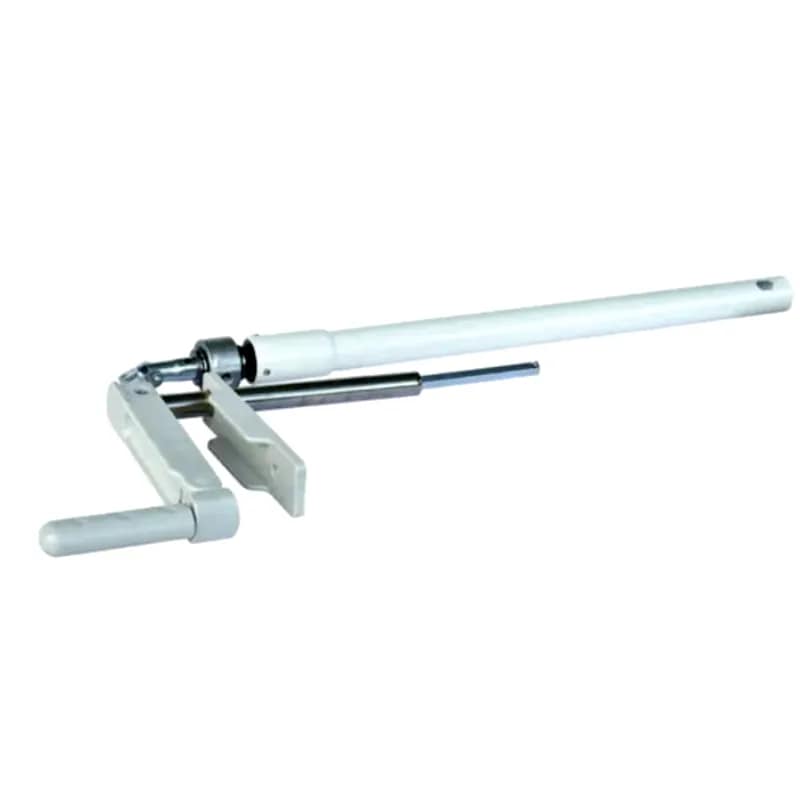
This is where the OEM capability of the exporter becomes the determining factor between a project that runs on schedule and one that stalls. We have produced bed panels in custom widths (820mm, 840mm, 850mm, 900mm), custom section counts (two-section for single-crank beds, four-section for multi-function configurations), and custom thicknesses based on targeted load ratings. Guardrail variations span European-style ABS and PP models, aluminum alloy straight-tube designs, bend-tube configurations, and door-type guardrails with locking buttons — each adjustable in bar count, height, and color. Crank systems are available in ABS, iron, and non-magnetic stainless steel variants for MRI-adjacent applications. The MOQ of 50 pieces per model means procurement teams can test a configuration in a pilot ward before committing to a full fleet order.
The practical advice I give to buyers is to structure OEM discussions around three questions: First, what is the lead time for custom tooling if a new die or mold is required? For simple modifications to existing designs, the answer should be measured in days, not months. Second, will the exporter provide pre-production samples with full dimensional inspection reports before bulk production begins? Third, is the OEM pricing structured transparently — with the customization cost separated from the base unit cost — so that volume-based negotiations remain straightforward?
Quality Verification Before Shipment: What a Credible Exporter Should Provide
A hardware accessories catalog and a website with ISO logos tell a procurement team very little about what actually happens before a container is loaded. Over two decades in this industry, I have developed a short checklist of verification practices that credible exporters follow — and that buyers should demand evidence of:
Incoming material inspection. Every coil of steel, every batch of ABS resin, every shipment of TPR compound should be checked against the material certificate. In our facility, incoming steel is measured for thickness and surface quality before it enters the stamping line. ABS resin is verified for melt flow index to ensure consistent injection molding parameters.
In-process dimensional checks. For stamped parts — bed panels, connecting ears, swing arms, transmission components — dimensional verification should occur at set intervals during the production run, not only at the end. A drift in die alignment between unit 200 and unit 2,000 can produce parts that still look acceptable but no longer fit their mating components within tolerance.
Load testing. Bed panels and complete bed assemblies should undergo static load testing at 1.25× the rated capacity before shipment certification. Our panels are rated at 250kg; the test protocol applies 312.5kg at the center point and at articulation hinge positions with deflection measured against engineering limits.
Mechanism cycling. Guardrails, crank systems, and caster locking mechanisms should be cycle-tested to verify that they maintain function after repeated use. A guardrail that locks securely on cycle 1 but develops play by cycle 500 has a design or assembly problem that will surface in the field. We test guardrail locking mechanisms through 2,000 cycles as part of pre-shipment sampling.
Surface finish adhesion. The powder coating or ABS surface should pass cross-hatch adhesion testing per ISO 2409 or equivalent. This is especially relevant for components exposed to frequent cleaning with disinfectant solutions — a coating that delaminates under chemical exposure creates both a corrosion site and an infection control concern.
The following table summarizes the key verification points by component category:
| Component | Critical Check | Common Failure Mode |
|---|---|---|
| Stamped bed panels | Steel thickness ±0.05mm | Deflection under load from underspec material |
| Casters (TPR/PP) | Rolling resistance after chemical exposure | Hardening and cracking of PVC substitutes |
| Guardrails (metal) | Weld integrity and coating adhesion | Rust at joints from skipped surface prep |
| ABS head/foot boards | Impact resistance at corners | Brittle fracture from regrind material |
| Crank mechanisms | Gear engagement and limit stop function | Stripped gears from poor machining tolerance |
| IV poles | Tube straightness and base stability | Wobbling and tipping from thin-wall tubing |

After the midpoint of a procurement evaluation, the question shifts from “what does this exporter make?” to “how does this exporter verify what they make?” If your program involves components that carry patient weight or provide fall protection — bed panels, guardrails, casters — it is worth confirming the specific test protocols and documentation the exporter provides before finalizing your supplier shortlist. Reach out at [email protected] with your component categories and we can share the applicable quality documentation.
Logistics, Packaging, and After-Sales Support for International Orders
A well-manufactured bed panel that arrives dented because of inadequate packaging is effectively a defective product. For international shipments of hardware accessories — particularly stamped steel panels, casters, and assembled guardrails — packaging engineering is as important as production engineering.
Our standard packaging for hospital bed components uses export-grade corrugated cartons with high-density foam inserts, organized by unit count per carton. Casters are packed eight units per carton, each separated by foam dividers to prevent marring during transit. Bed panels are secured with edge protectors and stacked with interleaving material to prevent contact abrasion. Complete bed assemblies ship in wooden crates with reinforced corner blocks. The packaging is designed not only to survive container loading and ocean transit but to allow the buyer to receive individual cartons in a condition suitable for direct delivery to ward-level installation sites.
Container loading capacity is a practical concern that directly affects per-unit landed cost. For example, a 40-foot high-cube container can accommodate approximately 80–100 complete manual hospital bed sets depending on the model and disassembly configuration. For component-level orders — casters, guardrails, cranks — the volume efficiency is higher because the packaging can be optimized for dense stacking. Procurement teams planning large-scale projects should request container utilization estimates early in the quotation process to avoid logistics cost surprises.
Lead time management is another area where exporter capability varies significantly. Our standard lead time for hardware accessories is 15–20 working days for in-stock components and 40–45 working days for complete bed systems. The distinction matters: a project that requires both stamped bed panels (15–20 days) and assembled electric five-function beds (40–45 days) needs a phased delivery schedule that aligns the arrival of components with the assembly timeline at the destination. An exporter that only quotes a single lead time for all items is likely not managing production scheduling at the SKU level.
After-sales support for hardware accessories typically covers mechanism and structure for one year. For casters, this means replacement if the brake mechanism fails. For guardrails, it covers locking mechanism defects and weld failures. For crank systems, it covers gear stripping and handle breakage under normal use. The warranty is only as useful as the exporter’s responsiveness — a buyer should verify, before ordering, how warranty claims are processed and whether replacement parts are shipped via air freight at the exporter’s cost during the warranty period.

Common Questions About Sourcing Hospital Bed Hardware Accessories
What is the minimum order quantity for custom hardware accessories?
For most hardware components — casters, guardrails, cranks, IV poles, and stamped metal parts — our standard MOQ is 50 pieces per model. This applies to both standard catalog items and OEM customization within existing design families. For complete bed systems, the MOQ is typically 50 units per model as well. If a project requires entirely new tooling (a die for a non-standard bed panel width, for example), the MOQ may be higher to amortize the tooling investment, but we structure this transparently so the buyer understands which portion of the cost is tooling and which is per-unit production. In programs we have supported, the 50-piece MOQ has allowed distributors to test a product in their market before scaling to container-quantity orders.
How do I verify that the steel thickness matches the specification?
The simplest method is to request a dimensional inspection report from the exporter’s quality control records, ideally with photographs of thickness gauge readings taken during incoming material inspection. For on-site verification, a handheld ultrasonic thickness gauge can measure steel thickness non-destructively at multiple points on a stamped panel. I recommend buyers include a clause in their purchase agreement that allows random sample testing upon receipt, with the exporter responsible for replacement and freight costs if samples fail to meet specified tolerances. This is standard practice in industrial procurement and should not be a difficult request for a credible exporter to accept.
Can an exporter provide both manual and electric bed components?
Yes — and this is actually a useful litmus test for evaluating an exporter’s manufacturing depth. Producing stamped panels and manual crank systems requires stamping, welding, and machining capability. Adding electric bed components — motor fixing seats, actuator brackets, control box housings — adds precision sheet metal fabrication and often CNC machining to the required skill set. An exporter that handles both has the engineering capability to ensure that mechanical and electrical subsystems are designed for compatibility rather than assembled from disparate suppliers. We manufacture components across the full range: from single-crank manual bed panels to five-function electric ICU bed frames with Trendelenburg capability.
What packaging standards prevent damage during international shipping?
The packaging must be engineered for the specific component geometry and weight. Lightweight casters can ship in corrugated cartons with foam dividers. Heavy bed panels require edge reinforcement, non-abrasive interleaving, and palletization with strapping that prevents load shift during container handling. For complete beds, wooden crates with internal bracing are the standard. We also photograph the packaging of every shipment before container sealing — these images are available to buyers as part of the shipping documentation. If your facility has specific receiving constraints (narrow doorways, no forklift access), share these during the order planning phase and the packaging can be adjusted accordingly.
Does the exporter provide installation support or technical documentation?
Technical documentation — assembly drawings, torque specifications for fasteners, wiring diagrams for electric beds, and maintenance schedules — should be provided as standard with every order. For large projects, we can also provide remote installation guidance via video call or, for sufficiently large orders, on-site technical support. The key is to establish documentation requirements during the quotation stage, not after delivery. Share your installation team’s technical capability honestly: if they are experienced with medical equipment assembly, the standard documentation package is usually sufficient. If they are general contractors, request simplified assembly guides with pictorial steps. The documentation support you need should directly shape the pre-order conversation with any hardware accessories exporter.
If you’re interested, check out these related articles:
Essential Safety Features for Adjustable Medical Beds
Essential Materials for Quality Medical Bed Parts Manufacturing
Essential Certifications for Medical Bed Parts Manufacturers
How to Choose the Right Adjustable Medical Bed for Your Clinic: A Comprehensive Guide