
When a hospital in Africa orders beds from an overseas supplier, the difference between a successful delivery and a costly, delayed shipment often comes down to a few practical decisions made early in the procurement process. These decisions are not complicated, but they are specific, and they carry consequences that can affect patient care for years. I have spent nearly two decades working on the manufacturing side of hospital bed production, and I have seen how the same questions come up again and again from buyers in Africa: Which bed configuration will actually hold up in a busy government hospital? How do you verify quality before the beds leave the factory? What are the shipping and after-sales realities that no one mentions in the brochure? This article answers those questions directly, drawing on real product and project experience rather than generic best-practice checklists.
Why Hospital Bed Choice Matters for African Healthcare Facilities
Hospitals across Africa operate under conditions that are often very different from those in Europe or North America. Power supply can be unstable. Many facilities lack maintenance capacity for complex electronic equipment. The physical environment, from dust to humidity to unpredictable facility infrastructure, places a real load on hospital furniture. In our experience at Yingyun Hardware, the bed specifications that work well for a Northern European clinic may be completely wrong for a regional hospital in West Africa.
Take the electric versus manual decision. A fully electric five-function ICU bed offers superior clinical positioning and one-button adjustments, but if the local power supply is unreliable and spare electronic parts are not stocked locally, the bed may be out of service for weeks when a single component fails. A well-built manual three-crank hospital bed can deliver many of the same patient positioning benefits with far less operational risk. We have supported projects where the decision to use manual beds for general wards, reserving electric beds only for ICU, directly reduced equipment downtime and saved the facility money over the first two years.
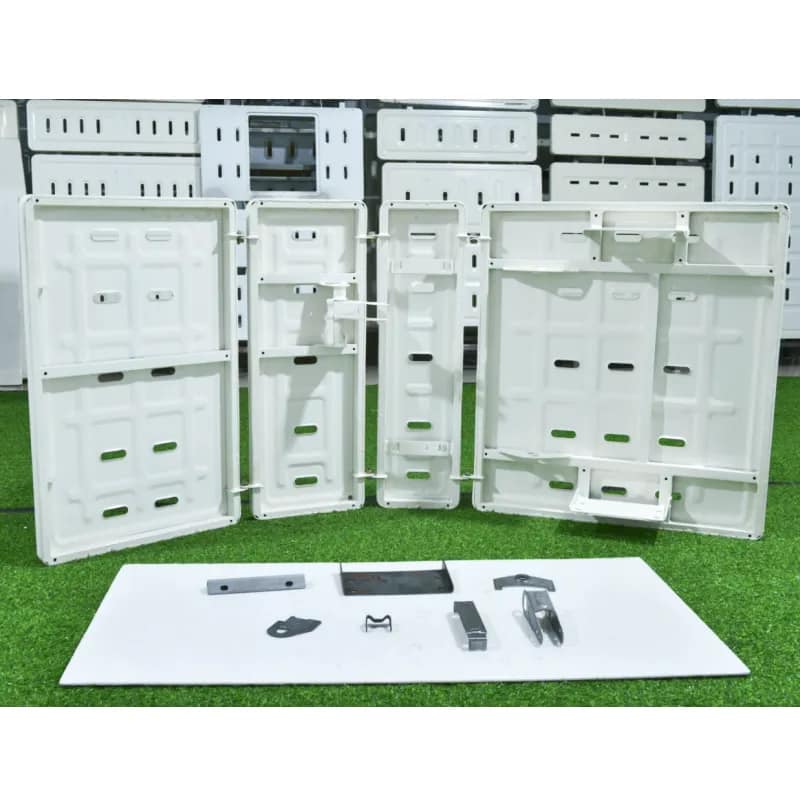
Bed panel material also matters. Stamped willow steel bed panels are strong and easy to clean, and they hold up well in hot, humid climates. ABS plastic panels resist corrosion and are lighter, but lower-quality ABS can become brittle over time when exposed to direct sunlight or temperature swings. We do not recommend one material as always better. The right choice depends on whether the beds will be used in an air-conditioned private ward or an open-air ward with partial protection from the elements.
On the functional side, load capacity is a specification that many early procurement lists overlook. In a general ward, a 250 kg capacity bed handles the vast majority of patients without any issue. But for facilities treating larger patients or planning bariatric services, beds rated for higher loads are mandatory. We have supplied beds with 250 kg load capacity as standard for many African hospital projects, and this has proved sufficient for typical adult care in government and private hospitals across the continent.
Quality and Certification Standards That Matter for Export to Africa
One of the most important, and most misunderstood, aspects of hospital bed export is quality documentation. Hospital buyers often ask for CE certification, which is the European standard, but they sometimes think that a CE mark on a component or on the bed itself guarantees that the entire product meets a single universal quality level. That is not how certification works. A bed manufacturer may have CE certification for certain product lines under the Medical Device Directive or Medical Device Regulation, but the certificate applies to specific products under specific conditions. When we prepare documentation for export to Africa, we always provide the specific product-level certificates, test reports, and technical datasheets that match the exact configuration the buyer is ordering, not a generic company-level certificate that could apply to anything.
Beyond certification papers, I recommend that any buyer planning a large import order request a pre-shipment inspection sample. This does not require a third-party inspection firm in every case, though larger government tender projects may require it. At a minimum, asking the manufacturer to provide photos or video of a finished bed from the batch, with measurable details like weld quality, surface finish, and label placement, gives you a concrete reference point. The cost of correcting a specification mismatch after arrival is many times higher than catching it before shipping.
For African importers, another critical document is the Certificate of Conformity for specific destination countries. Some countries in Africa require a pre-export verification of conformity program, and the manufacturer must coordinate with an approved inspection company. Experienced exporters know which countries currently require this and how to arrange it. A buyer who is new to importing should ask the supplier early whether they have experience with the destination country’s import requirements. If the supplier cannot name the correct procedure for a specific African market, that is a sign that they may be relying on the importer to solve problems later.

The bed’s internal mechanism is also a quality indicator. The crank system on a manual bed is straightforward, but a poorly made crank will bind or fail over time. We use an ABS crank handle with an in-place protection feature that prevents over-rotation and damage. The quality of the universal joint and hexagonal steel connection directly determines how smoothly the bed adjusts under load. These are not visible on the outside when the bed is assembled, but they are the difference between a bed that remains reliable for years and one that becomes a maintenance headache within months.
Logistics Planning for Hospital Bed Shipments to Africa
Shipping hospital beds to Africa is a volume business. A standard 40-foot container can hold roughly 15 to 25 units of a typical manually cranked hospital bed, depending on the exact model, packaging, and whether mattresses or accessories are included. Actually, the exact number varies with bed dimensions, disassembly method, and stacking height, so getting a precise container loading plan from the manufacturer before production is essential. Over the years, I have seen buyers lose thousands of dollars because they assumed a certain quantity per container and then discovered at the port that they needed an additional container, or that the freight cost per unit was higher than budgeted.
Packaging deserves more attention than it usually receives. Hospital beds are heavy steel structures. If the packaging is not designed for ocean freight, the bed frame, headboard, and footboard can shift during transit and damage the powder coating or even bend structural members. At Yingyun Hardware, we pack beds in wooden boxes with internal foam protection, which adds to the weight and cost but prevents damage that would be far more expensive to repair at destination. For bulk orders, we also offer modular disassembly so that the bed can be packed flat, reducing the container volume per unit. This can cut shipping costs meaningfully, especially on long routes to West or Central Africa.
Lead time is another number that needs to be viewed carefully. Many manufacturers quote a production lead time of 30 to 45 days for standard manual beds, but that lead time starts only after all specifications are confirmed and the order deposit is received. If the buyer requests custom color panels, special guardrail designs, or custom logo printing on the headboard, these additions can extend the timeline. We always recommend that buyers plan for a total timeline of 12 to 14 weeks from order confirmation to delivery at destination port, assuming sea freight of 35 to 45 days to major African ports plus customs clearance.

Customs clearance is not trivial, and the importer plays a central role here. The exporter should provide a full commercial invoice, packing list, bill of lading, and certificate of origin. But the arrangement of local customs brokerage, duty payment, and any required local inspection is the buyer’s responsibility. I always suggest that first-time importers contact a local clearing agent before the order ships, so that the tariff code and duty rate are confirmed early. Last-minute surprises at customs can lead to expensive storage fees at the port.
If your project has specific import compliance requirements that you are unsure about, a short email to the exporter asking how they handle customs documentation for your country can reveal whether they are truly experienced. If possible, share your shipment details with us at [email protected] and we can outline what supporting documents we provide for your market.
Choosing a Hospital Bed Manufacturer and Supplier for African Markets
Not all exporters who offer hospital beds actually manufacture them. Some are trading companies that source from multiple factories, which can be fine for small orders, but for large or ongoing purchases the lack of direct factory oversight introduces risk. An actual manufacturer can control the raw material, verify dimensions at each production stage, and provide direct warranty support. I believe that for any order above 15 or 20 units, the buyer should ask two simple questions: “Can I visit your production facility?” and “Can you show me a recent inspection report from a batch that matched my specifications?” If the answer to the first question is no, or the answer to the second is vague, that is a clear signal to look further.
Factory minimum order quantities, or MOQ, are a practical filter. Many manufacturers of electric hospital beds set MOQs of 50 units or more, but manual beds and bed parts can often be ordered in smaller lots. At Yingyun Hardware, we can ship single samples for evaluation before the buyer commits to a full container, which gives the hospital team a chance to physically inspect the bed, test the casters, operate the crank, and check the welds. A sample order costs more per unit than a full container, but it answers questions that no brochure or video can resolve.
After-sales support is not just about getting replacement parts. It is also about technical guidance. When a hospital in Uganda or Ghana receives beds and finds that a guardrail does not lock smoothly or a caster wheel squeaks, the local staff needs a clear troubleshooting guide, ideally with photos or a short video, not just a generic manual. We have found that responding with step-by-step visual troubleshooting within 24 hours makes an enormous difference in whether the hospital views the supplier as a long-term partner or a one-time seller. Before placing an order, ask the supplier: “How do you handle an urgent technical problem after delivery? Can I speak directly to an engineer?” If the reply is just a warranty statement with no clear contact process, consider what that will feel like when a bed is out of service.

Supplier transparency also shows in how they handle product specifications. A good manufacturer will not just email a generic datasheet. They will provide a specification that includes the bed frame material and tube thickness, the bed panel material and thickness, the caster type and brake mechanism, the paint or powder coating standard, and the tested load capacity with supporting documentation. Our company produces stamped bed panels in multiple widths: 820mm, 840mm, and 900mm, with a choice of two-section or four-section configurations. That kind of detail matters because the panel width and section count affect patient comfort, ease of cleaning, and compatibility with existing mattresses and bedside rails. A supplier that cannot explain these details in plain language may not be the supplier you want for a bulk order.
Cost Considerations and Bulk Purchase Strategies
The unit price of a hospital bed exported to Africa is influenced by a number of factors that are easy to list but sometimes harder to quantify before the order starts. Bed function is the most obvious driver. A single-crank manual bed is the most economical, often starting at a price point that works for tight budgets. A three-function manual bed adds knee lift and height adjustment, while a five-function electric bed with Trendelenburg and reverse Trendelenburg positions represents the highest cost per unit. The cost difference between a manual three-crank and a basic electric bed can be a factor of two or three, and that gap widens when optional features like battery backup, nurse call system integration, or digital weight scale are added.
What many buyers overlook is that bed accessories and spare parts are not trivial line items. Side rails, IV poles, overbed tables, and bedside cabinets are often purchased in the same shipment, and their total cost can equal 20 to 30 percent of the bed budget. Our company offers a range of guardrail types, from basic aluminum alloy straight-tube designs to European-style ABS guardrails and wood-grain finishes. The price per set varies with material and complexity, but all share a common attachment mechanism that allows quick installation. I have found that ordering guardrails and casters from the same manufacturer that supplies the beds simplifies compatibility and reduces the chance that a rail or wheel from a different source will not fit.
Bulk purchasing can lower the per-unit cost, but only if the order size matches the manufacturer’s optimal production batch. For manual beds, an order of 50 units often hits a good balance between production efficiency and price. Larger orders, especially 100 units or more, can bring the per-unit cost down further, though the savings are usually in the packaging and shipping optimization rather than in the metal cost. I advise buyers to request a price quotation that separates the bed cost from the packaging and inland freight cost, so they can see exactly where the volume savings occur.

Caster selection is another quiet cost driver. A basic single-face TPR caster functions acceptably on flat hospital floors, but in many African hospital environments the floors are not always perfectly smooth. Larger diameter casters with a double-face design and central-locking brake system roll more easily over small obstacles and lock more securely when the bed must stay stationary. The cost difference per caster is small, but multiplied across a large order, it adds up. Spending that extra amount up front can prevent the nursing staff from struggling with beds that do not move when needed or, worse, move when they should not.
Common Questions About Exporting Hospital Beds to Africa
What hospital bed standards are accepted in Africa?
There is no single uniform standard across all African countries. CE marking aligned with the European Medical Device Regulation is widely accepted in many private hospitals and government tenders. Some countries also accept FDA 510(k) clearance if the beds are sourced from a U.S. supplier. The most practical approach is to consult the specific country’s medical device regulatory authority or work with a local distributor who knows which certificates the tender documents require. As a manufacturer, we always provide the relevant CE certificates, ISO 13485 quality system documentation, and product-specific test reports in English, which covers the great majority of African import requirements.
Should I choose manual or electric beds for a government hospital project?
The answer depends on the facility’s power situation, maintenance capability, and clinical needs, not on a single rule. In a teaching hospital with reliable backup generators and a biomedical engineering team, electric beds for ICU and high-dependency units make sense. In a district hospital where power cuts happen weekly and the maintenance staff has limited electronics training, manual three-crank beds will be more reliable and far easier to keep in service over the years. I have worked with projects where the budget called for a mixed fleet, with electric beds only in critical care areas and manual beds everywhere else. That approach balances clinical requirements with operational realities.
How long does a hospital bed last in a busy African hospital?
With proper use and basic maintenance, a well-built manual hospital bed should last at least 7 to 10 years in a general ward. The steel frame and stamped bed panel are inherently durable. The wear items are the moving parts: crank mechanisms, caster wheel bearings, and the lock mechanisms on side rails. If the hospital trains its porters and housekeeping staff to avoid forcing stuck adjustments and to report unusual noise or resistance early, those parts can be repaired or replaced at a fraction of the cost of a new bed. Electric beds require more active maintenance. Motors, control boxes, and handset cables are more vulnerable to power surges, physical impact, and liquid spills. A hospital that invests in electric beds should also invest in a small stock of critical electronic spares and a maintenance contract or training for at least one local technician.
Can I get hospital beds customized for my facility’s size and color requirements?
Yes, customization is standard for orders above a certain quantity, and it does not always carry a large price premium. Common customizations include headboard and footboard color matching to a hospital’s branding, logo printing on the ABS panels, specific bed dimensions to fit older ward layouts, and guardrail height or configuration changes for pediatric or elderly patient safety. At Yingyun Hardware, we customize bed panel width, headboard and footboard design, side rail style, and caster type based on the customer’s written specification. What matters is that the customization request is clearly documented before production begins, because changes made after the bed frame cutting and welding stage are expensive and slow. If your hospital needs a specific dimension or a special guardrail design, share the requirement with us at [email protected] or call +8613528198959, and we can provide a technical feasibility check and cost estimate before any commitment is made.
If you’re interested, check out these related articles:
Are Adjustable Hospital Beds Covered by Insurance or Medicare
Identifying Reliable Brands for Adjustable Hospital Beds
Choosing a Reliable Hospital Bed Parts Manufacturer: A Comprehensive Guide
Top Wholesale Hospital Bed Parts Manufacturers & Suppliers