
Finding a hospital bed spare parts manufacturer that delivers consistent quality, precise specifications, and reliable after-sales support is a challenge procurement teams face daily. A substandard caster wheel or a poorly stamped bed panel doesn’t just disrupt maintenance schedules—it directly compromises patient safety and care. In nearly two decades of manufacturing hospital bed components at Yingyun Hardware, I’ve seen how the right manufacturing partner changes everything: fewer field failures, shorter lead times, and inventory predictability. This article outlines the practical criteria that matter most when selecting a spare parts manufacturer, drawn from real production floor experience.
Why Material Traceability Matters for Hospital Bed Spares
When a bed panel bracket fractures or a guardrail locking mechanism fails, the root cause often traces back to the material used. Many procurement documents list only a generic material name, but compliance-grade certifications make the real difference. In our factory, for instance, we use Liuzhou steel for bed panels—not simply “steel”—because its specific tensile strength and thickness tolerance are matched to the load and deflection requirements of a hospital bed frame. For caster wheels, TPR (thermoplastic rubber) and PP combinations are chosen not for cost alone but because they offer low rolling resistance and quiet operation in clinical corridors.
A reliable manufacturer should be able to provide material mill certificates or batch-specific composition reports for critical components. If the manufacturer cannot trace the heat number of the steel in a bed panel or the Shore hardness of a caster tread, downstream quality becomes a guess. That uncertainty is exactly what hundreds of facility inspections are designed to catch retroactively—and it’s far cheaper to catch it at the sourcing stage.

Key Specifications to Verify with a Manufacturer
Specifications define whether a spare part will perform as expected, and they must go beyond basic dimensions. We routinely see procurement requests that list only “5 inch caster” without specifying the mounting stem size, swivel radius, brake force, or load rating. The gap between a 5‑inch TPR caster that supports 80 kg and one that supports 120 kg can be the difference between smooth mobility and premature floor marking—or worse, a bed that doesn’t lock securely during patient transfer.
For common hospital bed spare parts, the following verification points serve as a practical checklist:
| Component | Specifications to Confirm |
|---|---|
| Caster wheel | Material (TPR/PU/PP), diameter, swivel type, brake mechanism, load capacity per caster, stem dimensions and mounting style |
| Stamped bed panel | Steel grade and thickness, panel segment dimensions, hole patterns and connecting ear compatibility, coating type (antibacterial powder) |
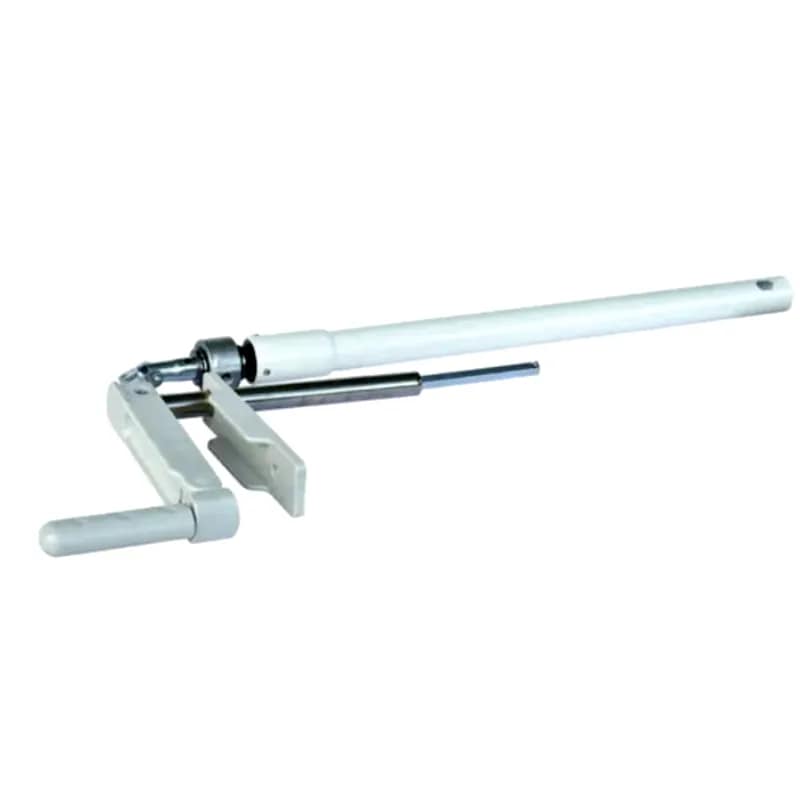
| Manual crank | Handle material (ABS, iron, stainless steel), crank throw length, universal joint type, in-position protection mechanism, corrosion resistance for wash-down areas |
| Guardrail | Material (aluminum alloy, steel, ABS), rail bar count and spacing, locking mechanism type, fold‑down clearance, die‑cast aluminum vs. plastic component durability |
Ask for a full technical datasheet, not a catalog image. The differences in specification details are where sourcing mistakes hide.
Evaluating Production and Quality Control Processes
A manufacturer’s production floor tells more than its sample room. Over the years, I’ve visited more than a dozen metal stamping and medical furniture factories in China, and the facilities worth relying on share a few clear markers. Laser cutting with automated nesting maximizes material yield and reduces edge burrs; CNC bending guarantees repeatable angles on transmission arms and swing parts; and dedicated jigs for welding bed frame connectors prevent the misalignment that causes guardrail mounting holes to shift later.
Quality control is equally structural. We operate a three‑stage inspection protocol: incoming material hardness and thickness sampling, in‑process dimensional checks every two hours on stamping and welding stations, and a pre‑packing functional test for moving parts (casters, cranks, folding guardrails). This isn’t aspirational—it’s the minimum needed to catch a blunt burr on a connecting ear or a hairline crack in a bed foot cover before it reaches a ward. If a factory cannot describe their QC frequency and tolerance limits in specific numbers, assume their process is reactive rather than preventive.
OEM and Customization Capabilities for Spare Parts
Standard spare parts fit many beds, but not all. When a facility runs a mix of hand‑me‑down beds from different vintages, or a distributor wants its own brand on the headboard, the manufacturer’s ability to adapt becomes the deciding factor. We’ve produced bed panels in widths of 820 mm, 840 mm, 900 mm, and even narrow 550‑1000 mm simple strips, because different markets have different frame dimensions. For casters, stem diameters and lengths can vary dramatically between European, American, and Asian bed designs. A manufacturer that only offers one size will force the buyer to modify the bed frame—which introduces risk and additional cost.
Customization extends beyond dimensions. Color‑matching headboards and footboards, adding wood‑grain finishes, laser‑engraving hospital logos on ABS panels, or even supplying non‑magnetic stainless steel cranks for MRI‑adjacent wards are all well within the capability of a strong OEM partner. The critical question to ask is: Does the manufacturer control the entire stamping, welding, and coating process in‑house? Subcontracted steps multiply lead time and dilute quality oversight. In‑house control of the full production chain is what makes a 15‑day lead time for a custom bed panel realistic rather than aspirational.

After‑Sales Support and Spare Parts Availability
Even the best‑designed spare part will eventually need replacement or support. What happens six months after a shipment lands? A manufacturer that can maintain an inventory of common spares—casters, crank handles, guardrail locking switches—can ship replacement components within days, not weeks. That’s not a marketing promise; it’s a logistics commitment backed by stocked ready‑guardrail sets and a warehouse organized by SKU, not just by project.
Warranty terms also reveal a manufacturer’s confidence. A structural warranty of one year on mechanisms and welds is standard, but the real value is in the technical support behind it. When a hospital in Nigeria emails a video of a caster not swiveling properly, our team is expected to diagnose whether it’s a bearing issue or an incorrect stem fitment—and ship the correct replacement. That depth of after‑sales support is a capability that procurement teams should test before ordering, not discover through absence.

Sourcing Hospital Bed Spare Parts with Confidence
When a hospital bed spare parts order arrives with dimensions mismatched or a weld that fails within three months, the procurement cost multiplies: downtime, patient discomfort, re‑shipping, and trust erosion. The antidote is choosing a manufacturer that treats specification accuracy, material traceability, and process transparency as non‑negotiable. If your next order involves bed panels, casters, guardrails, or crank systems, share your part numbers or technical drawings with our engineering team—we’ll confirm dimensions, validate compatibility, and provide lead times based on real production capacity. Reach us at [email protected] or call +8613528198959.
Common Questions About Hospital Bed Spare Parts Manufacturing
What certifications should a spare parts manufacturer hold?
CE marking is the most commonly requested for medical equipment components exported to Europe, and ISO 13485 indicates a quality management system tailored to medical devices. However, for purely mechanical spare parts—casters, bed panels, cranks—ISO 9001 combined with material‑specific test reports often meets procurement requirements. Always confirm the certification directly applies to the product category you’re buying, not just the overall facility.
How do I verify a factory’s production capability without visiting?
Request a live video walk‑through of the production floor. Focus on the stamping presses, welding stations, and any jigs or fixtures used for assembly. Ask to see the production line running a similar part, not a sample room. The factory’s willingness—or hesitation—to show the actual shop floor in motion is in itself a powerful qualification.
What are the most common spare part compatibility problems?
Mounting hole mismatch on bed panels is at the top, especially when mixing beds from different original manufacturers. Guardrail mounting bracket spacing can also differ by as little as 10 mm, preventing installation. Always provide the exact center‑to‑center distance of mounting points and a photo of the existing frame.
Can I get custom packaging or private‑label branding?
Yes, OEM labeling is standard. We regularly apply hospital logos to headboards, print custom carton markings, and use branded hardware packaging. The minimum order quantity for custom branding is typically 50 to 100 pieces per SKU, and it adds roughly 7–10 days to the lead time.
Is it possible to order mixed container loads of different spare parts?
Yes, and it’s a common arrangement for facilities that are doing fleet maintenance. We consolidate bed panels, casters, guardrails, and cranks into the same shipment, which reduces per‑unit freight cost. If you’re unsure how to structure a mixed bill of materials for container optimization, our logistics team can propose a loading plan. Share your part list and we’ll advise on the most efficient configuration.
If you’re interested, check out these related articles:
What is an Adjustable Hospital Bed and How Does It Work: A Comprehensive Guide
Essential Safety Features for Adjustable Medical Beds
Essential Certifications for Medical Bed Parts Manufacturers
Ensuring Quality Control in Hospital Bed Parts: A Comprehensive Guide