
When a hospital bed refuses to move up or down, the problem goes beyond inconvenience — it compromises patient safety, strains nursing workflows, and can delay critical care. In my nearly twenty years in hospital bed manufacturing, I have found that most height adjustment failures are not the result of catastrophic damage but of neglected mechanical wear, improper use, or simple electrical faults. A systematic troubleshooting approach, grounded in how these mechanisms actually work, restores function quickly and avoids unnecessary part replacement. This article walks through that process for both manual and electric beds, drawing on real-world failure patterns we see at Yingyun Hardware and the components we supply to healthcare facilities worldwide.
How Hospital Bed Height Adjustment Systems Work
Hospital bed height adjustment relies on one of two mechanisms: a manual crank system or an electric actuator. Understanding them is the first step toward diagnosing any problem.
A manual crank system uses a foldable or removable crank handle that turns a gearbox. That gearbox rotates a threaded rod (often called a screw or leadscrew) which raises or lowers the bed platform. The key components are the crank, the gear housing, the transmission arm, and the threaded rod. On many standard designs, the crank engagement point includes a “in-place protection” feature that prevents the handle from slipping out under load. At Yingyun, we produce crank systems in ABS, iron, and stainless steel versions — each with different load ratings and durability characteristics. For example, our stainless steel crank with non-magnetic in-place protection (YY-00050) is designed for MRI environments where iron components cannot be used.
Electric height adjustment uses a linear actuator driven by a 24V DC motor. Pressing a button on the hand pendant or side rail control panel signals the control box to power the motor, which extends or retracts a piston. The actuator is typically fixed to the bed frame with a motor fixing seat (like our YY-000471/YY-000472) and connected to the lifting linkage via a pivot. Limit switches cut power at the fully raised and fully lowered positions. A backup battery or manual crank override is often available for power failures.
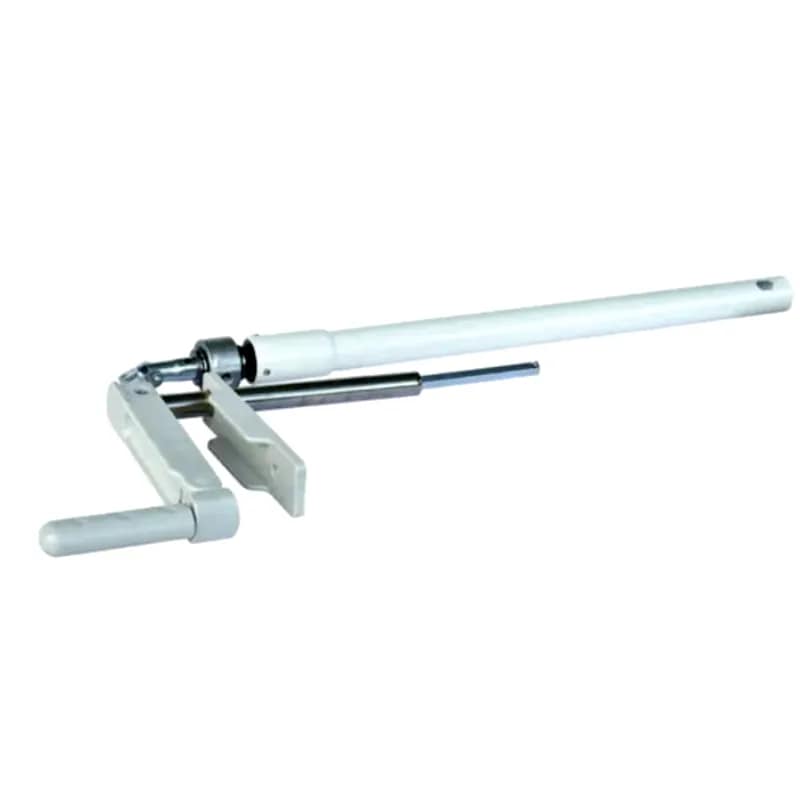
Understanding which type your bed uses, and which specific component is failing, determines the repair path.
Common Causes of Height Adjustment Failure
Based on the beds that come through our service partners, the failures cluster into a few predictable categories. The table below summarizes the most frequent causes and the typical symptoms.
| Failure Cause | Manual Crank Symptom | Electric Actuator Symptom |
|---|---|---|
| Worn or stripped gear teeth | Crank spins without engaging, grinding noise | Actuator runs but bed does not move |
| Damaged threaded rod | Bed moves unevenly or jams mid-stroke | — |
| Motor or capacitor failure | — | No response, no hum |
| Faulty control box or hand pendant | — | No function from some or all controls |
| Limit switch misalignment | — | Bed stops at wrong height, or not at all |
| Loose mounting bolts | Rattling, wobbling, or crank handle jumps | Actuator body flexes, clunking sounds |
| Wiring or connector corrosion | — | Intermittent function, slow movement |
| Overloaded bed | Crank feels excessively heavy, threads strip | Motor overheats and cuts out |
We have seen entire crank handles twisted off because a nurse tried to adjust the height while the bed was loaded beyond its rated capacity. Aligning the bed load to the specification — up to 250 kg for our manual and electric beds — is the first preventative measure.
If your bed’s height adjustment is stuck in one position, do not force the crank or hold the electric actuator button for more than a few seconds. Forcing it can strip threads or burn out the motor. Contact your bed supplier with the model and symptom details for a targeted parts recommendation at [email protected].
Troubleshooting Manual Crank Height Adjustment
Start with the simplest checks and work toward the gearbox.
First, remove the crank handle and inspect the engagement interface. A common issue is a worn square drive hole or a damaged crank pin. On our ABS crank (YY-00038), the handle includes an in-place protection mechanism that can break if the crank is forced while the bed is locked. Try a different crank handle if available.
Next, check the threaded rod for debris or corrosion. In tropical climates, rods can rust if the protective coating is scratched. Clean the thread with a dry cloth and apply a lithium-based grease — not WD-40, which attracts dust.
Turn the crank slowly while watching the gearbox. If the crank handle rotates but the rod does not move, the gear teeth inside the housing are stripped. This requires replacing the gearbox or the entire crank assembly. We keep all crank system components in stock, from the universal joint and hexagonal steel (YY-00041) to complete steel crank assemblies, with lead times as short as 15 working days.
If the bed moves but drops slightly after adjustment, the issue is likely a worn thrust bearing or a loose lock nut on the leadscrew. Tighten the lock nut against the bed frame and test again. In many cases, the bed will hold position afterward.

Diagnosing Electric Height Adjustment Problems
Electric systems require a structured electrical and mechanical check. Start with the power: confirm the bed is plugged in and that the outlet is working. Many hospital beds use an AC to DC converter or a battery system. If the bed has a battery backup, test the function on battery alone and on mains power to isolate the converter.
If no actuator responds, check the control box fuse and replace if blown. A hand pendant fault can mimic a control box failure — try an alternative pendant if one is available. The control box typically reports fault codes via a flashing LED; consult the bed’s service manual.
When only the height function fails but other movements (backrest, leg rest) work, the problem is in the height actuator circuit, the actuator itself, or the limit switch. Use a multimeter to test for 24V at the actuator connector while pressing the height button. If voltage is present but the actuator does not run, the motor or its internal capacitor has failed. Actuators are generally not field-reparable and should be replaced as a unit.
Pay attention to limit switch function. A misaligned or stuck limit switch can cause the bed to stop early or not at all in one direction. Physically inspect the switch arm and mounting. YY-000471 and YY-000472 motor fixing seats are designed to hold the actuator rigidly, preventing misalignment — if the actuator moves relative to the bed frame, the limit switch may not engage correctly.
Preventive Maintenance for Reliable Bed Height Function
Prevention is cheaper than emergency repair, especially in a busy ward. A simple maintenance routine, performed every six months, catches most failures before they affect patient care.
Lubricate the threaded rod and all pivot points with food-safe lithium grease. Check that all bolts on the crank assembly, gearbox, or actuator mounts are tight. On electric beds, inspect the wiring harness for cracks or abrasion, and test the backup battery voltage. Batteries typically need replacement every two to three years.
Review the bed’s loading log if available. Recurring overloads can bend the bed frame or stretch the actuator mounts. A bent frame puts uneven load on the leadscrew, accelerating wear.
We recommend keeping a spare crank handle and a basic service kit — a multimeter, grease, and a set of wrenches — in the facility’s maintenance department. For electric beds, having a spare actuator and control box on hand can reduce downtime.

When to Replace the Height Adjustment System
Some failures justify replacing the entire height adjustment assembly rather than attempting a repair. If the threaded rod shows visible pitting or deep gouges, the crank gearbox is stripped, or the actuator has seized with the rod extended, replacement is the safest route.
In healthcare settings where electrical safety is paramount, upgrading a manual bed to an electric three-function or five-function system can improve both patient comfort and nursing efficiency. This conversion typically involves installing actuators, a control box, and new side rails with integrated controls. At Yingyun, we supply complete electric conversion kits that include the actuators, motor fixing seats, transmission arms, and control pendants.
If the bed frame itself is corroded or bent, the height adjustment will never work smoothly. In such cases, replacing the entire bed may be more cost-effective. Our manual three-crank and electric three-function beds are designed to be drop-in replacements for aging fleet beds, with standard dimensions and mounting points.
When ordering replacement parts, always provide the bed’s manufacturer part number or the dimensional specifications of the existing component. For custom or non-standard beds, we fabricate metal parts to exact specifications — from stamped bed panels to custom swing arms and transmission parts — with a typical lead time of 15 to 20 working days.
Common Questions About Bed Height Adjustment Repairs
Can I use any crank handle on my manual hospital bed?
No. The crank handle end fitting must match the bed’s gearbox input. Hospital beds use different socket sizes, and some have safety locks. Using an incompatible handle can strip the interface. Check your bed’s manual or measure the square drive before ordering a replacement; at Yingyun, we stock handles with both plastic and iron grips and can match OEM profiles.
Why does my electric bed move down but not up?
This points to a stuck lower limit switch or a mechanical obstruction. When the bed reaches full descent, a limit switch cuts power to the down circuit. If the switch fails closed, the bed cannot raise. Unplug the bed, inspect the switch arm for debris or bending, and test continuity. In some cases, the actuator itself may have internal damage preventing upward travel — the motor runs but the piston does not move. Then the actuator must be replaced.
Is it safe to disassemble a hospital bed actuator myself?
No. Linear actuators contain high-torque motors and gear reductions in a sealed housing. Opening the actuator can expose electrical contacts and void any remaining warranty. Always disconnect power before any electrical work, and let a qualified biomedical technician or the manufacturer handle actuator diagnosis. If you can provide the actuator’s label information, we can identify the exact replacement and advise on compatibility.
Our manual beds are getting harder to crank. Is this normal wear?
Some increase in resistance over years is normal as grease thickens and surfaces wear, but a sudden or sharp increase in cranking force is a warning sign. It often means the bed is overloaded, the threaded rod is bent, or debris has entered the gear mechanism. Do not force the crank; forcing a jammed bed can break the crank handle or strip the gear teeth. Send us the bed model and a description of the resistance pattern — smooth but heavy, gritty, or binding at specific heights — and we’ll help you identify whether replacement parts or a full overhaul is needed. Reach us at [email protected] or call +8613528198959.
If you’re interested, check out these related articles:
How to Choose the Right Adjustable Medical Bed for Your Clinic: A Comprehensive Guide
Comparing Prices for Hospital Bed Parts Manufacturers Effectively
Leading Hospital Bed Parts Manufacturers: A Comprehensive Guide