
Hospitals and healthcare projects that demand reliable OEM hospital beds often start with a list of basic requirements: certifications, price, delivery time. But after nearly twenty years on the factory floor and in engineering discussions with global buyers, I’ve seen that the manufacturers who deliver real clinical value are those whose internal engineering standards go beyond the checklist. The difference between a bed that needs constant adjustment and one that quietly serves patients for a decade comes down to material-grade decisions, in-house production depth, and the engineering discipline that runs through every stamped panel and castor bracket. This article draws on direct manufacturing experience to help you identify an OEM partner whose technical foundation matches the demands of your facility, not just its paperwork.
What Certifications Should an OEM Hospital Bed Manufacturer Hold
Certifications are the first screen, but they have to be read correctly. For most international tenders, an OEM hospital bed manufacturer should hold ISO 13485 certification for medical device quality management systems, and the factory’s own production facility should be within the scope of that certificate — not just the corporate entity. I recommend asking to see the certificate’s annex or scope page to confirm it covers the physical manufacturing location you would be dealing with.
For export to Europe, CE marking under the Medical Device Regulation (MDR) is typically required. For the United States, FDA registration and 510(k) clearance for electric beds are often necessary, though exact requirements depend on the bed classification. In Africa and the Middle East, buyers increasingly expect either CE or FDA clearance, and many government tenders now explicitly ask for at least ISO 13485 plus a regional regulatory approval. I suggest verifying the certificate status on the issuing body’s website rather than relying on a PDF alone. I have personally found that legitimate manufacturers are willing to share live links or registration numbers during initial evaluation; a reluctance to do so is a warning sign that warrants deeper due diligence.

How to Evaluate a Manufacturer’s Actual Production Capability
A certificate is only one piece of the puzzle. In almost twenty years of manufacturing, I have learned that the most telling indication of an OEM partner’s competence is the extent of in-house engineering. Many companies that present themselves as manufacturers are actually assemblers or trading companies that outsource stamping, powder coating, and assembly to separate workshops. That breaks the quality control chain before the first bolt is tightened.
A genuine OEM manufacturer runs its own metal stamping line, a die-maintenance section, a powder-coating line, and an assembly area under one roof. When we host factory audits, the first area I show is the stamping workshop, because that is where the bed panel geometry and load-bearing consistency are determined. For example, our four-section stamped bed panels (820mm and 840mm widths, for single-crank or multi-function beds) are formed on-site with dies that are inspected between production runs. Without that control, bed surfaces can warp over time, and the gap between sections opens up, which becomes a pinch-point hazard.
A practical checklist item: ask whether the manufacturer owns and maintains the stamping dies in-house, and request photographs of die storage. If dies are held by a subcontractor or there is no die-maintenance programme, the manufacturer has limited control over critical dimensions. That directly affects patient safety and bed longevity in a clinical setting.
Materials, Components, and Assembly Standards That Shape Bed Service Life
When I look at a hospital bed specification, the first thing I check is not the number of functions but the raw materials and sub-assembly quality. A five-function electric bed with underspecified castors or low-grade steel will deliver more problems than a simple two-crank manual bed with well-sourced components. The frame base material matters enormously: cold-rolled steel tube of at least 1.2mm wall thickness is a minimum for a bed with a 250 kg safe working load. The bed panels themselves benefit from being stamped from Liuzhou steel sheet, which has a consistent temper that resists dimpling after repeated patient positioning cycles.
The snap-on ABS engineering plastic used for head and foot boards is another area where specification matters. In emergencies, caregivers need to remove the boards in seconds for CPR access, and only boards with well-designed snap locks allow that reliably. Our ABS models are designed to come off in under thirty seconds without needing tools. Cheap polypropylene substitutes can crack at the locking ear or become brittle after two years of cleaning with hospital disinfectants.
The table below summarizes a few key component-level specification decisions that directly affect long-term bed performance.
| Component | Specification Factor | Practical Impact |
|---|---|---|
| Bed panel material | Stamped Liuzhou steel sheet, 0.8–0.9mm thickness | Resists bending and surface dimpling; consistent load-bearing across mattress area |
| Head/foot board | ABS engineering plastic, anti-collision corners | 30-second emergency removal; less shatter risk during transport |
| Guardrail locking | Die-cast aluminum hinge with automatic locking button | Prevents unintentional drop; withstands lateral patient load |
| Medical castors | 5-inch TPR central-locking with stainless steel shell | Quiet rolling; brake holds on smooth hospital floors; corrosion resistance in humid climates |
| Crank mechanism | ABS or stainless steel crank with in-place protection | Smooth backrest adjustment; prevents caregiver strain and keeps angle position stable |
If a manufacturer is unable or unwilling to provide the exact material grades and thicknesses used, treat that as a sign that they may be substituting materials between batches — a common cost-cutting approach that undermines fleet consistency.
How Customization Separates a True OEM Partner from a Rebadger
Customization goes much deeper than choosing a color or adding a logo. In a genuine OEM relationship, your facility’s layout, door widths, patient demographics, and nursing workflows should drive the bed configuration. For example, a rehabilitation hospital in Southeast Asia with narrower corridor dimensions might require a bed with a frame width of 950mm instead of the standard 1030mm. That adjustment requires modifying steel cutting lengths, swing arm geometry, and guardrail positioning — changes that only an in-house engineering team can manage without pushing lead times into chaos.
I have worked on projects where the end customer needed a full four-piece bed panel set with an orthopedic leg split function, a specific antimicrobial powder coating color, and a dual-function manual crank for backrest and knee adjustment only — no height variation. Because the factory owned the dies, the riveting fixtures, and the surface finishing line, we could iterate the prototype within twenty-one days. A trade-only supplier would typically have to route design changes through three different subcontractors and would either refuse the modification or deliver it late and over budget. When assessing an OEM manufacturer, ask to see examples of customized builds that differ materially from the standard catalogue — not just a new paint code, but a tailorable specification that required engineering involvement.
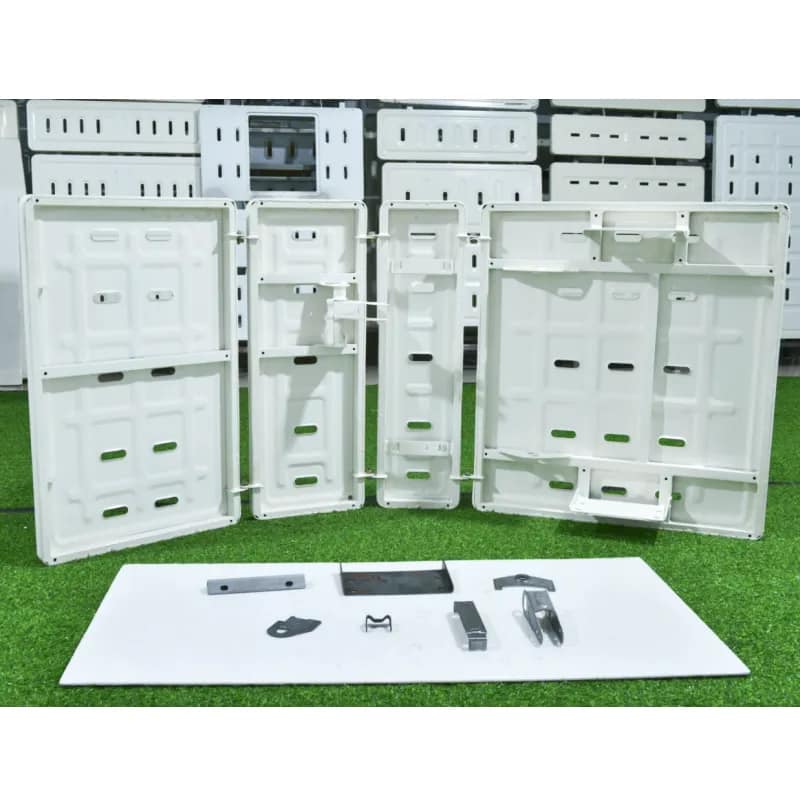
If your program involves a specific bed width, a unique side-rail design, or a non-standard patient weight, it is worth confirming whether the factory has in-house die modification capability before committing to a purchase order. Share your layout constraints and patient demographic profile with a technical contact rather than a sales representative — you will receive a much more honest time-and-cost estimate. Reach out to discuss the feasibility of your custom configuration at [email protected].
Lead Times, Minimum Order Quantities, and Shipping Considerations
OEM hospital bed manufacturing timelines are driven primarily by two things: the availability of raw material (steel tube, ABS granulate, electronic controllers) and the customization depth. A standard configuration from an existing production run might ship within 15–20 working days for smaller components like castors or guardrails, while a fully customized electric five-function bed can require 40–45 working days, sometimes more if the order includes a new powder coating color that needs to be sourced separately.
Minimum order quantities are another reality that buyers should understand from the outset. For standard accessories like single-face castors or IV poles, a manufacturer might offer an MOQ of 50 pieces. For complete beds, the MOQ tends to be higher — typically 50 pieces per configuration — because the factory needs to set tooling for a single production batch. That being said, some manufacturers (ours included) will accept a mixed container of different bed types to reach the container load without requiring 50 of each model, which can help new distributors or smaller hospitals manage their initial inventory risk.
Shipping has its own costs: a manually cranking bed packed in a wooden box is approximately 0.8 cubic meters and weighs over 80 kg. A full 40-foot container can carry roughly 80–110 beds depending on the mix of manual and electric models. I strongly advise reviewing the container loading plan with the factory before production is completed, because uneven packing can lead to freight cost overruns. Also, confirm that the bed frame has been designed for knock-down assembly at destination — our beds are packed with clear pictorial instructions and the necessary tools to reassemble within thirty minutes per unit, which saves substantial on-site labour costs.
What After-Sales Support and Warranty Should Cover
A manufacturer’s attitude toward after-sales support says more about its production confidence than any brochure can. A warranty that covers one year on mechanisms and structure is standard, but the real measure is whether the manufacturer stocks spare parts and can ship them in small quantities quickly. For hospital beds, the components that most frequently require replacement are castor wheels (due to floor cleaning wear), side rail locking mechanisms, and crank handles. I recommend asking the manufacturer to provide a recommended spare parts list with part numbers and unit prices before the first order ships. This allows the facility to keep a small stock of high-wear items and avoids emergency air-freight costs later.
Additionally, ask directly whether the manufacturer offers remote video assistance for troubleshooting electrical issues on electric beds. A competent factory will have an engineer available who can walk the on-site biomedical technician through voltage checks at the control box or motor connector, potentially avoiding the need to return a bed for repair. This kind of technical support is a practical requirement that often gets overlooked in the evaluation phase until the first bed stops working on a Sunday night.
Common Questions About Hospital Bed OEM Requirements
Do I really need ISO 13485 if the manufacturer already provides product test reports?
Yes. Test reports from a third-party lab verify that the sample product meets a specific standard at a specific moment. ISO 13485 certification verifies that the manufacturer has an ongoing quality management system that repeats that level of quality batch after batch. Without that system, you are betting that the next container will match the test report. That is a bet I would caution against making, especially for public health tenders where recertification or re-inspection can be triggered at the port of entry. If your tender requires objective evidence of quality system maintenance, confirm the certificate number and its validity period directly with the issuing certification body.
How can I tell the difference between a real manufacturer and a trading company?
The quickest filters are factory floor photographs and die inspection records. A real manufacturer can show you a photograph of its stamping line with the date stamp and the specific die set used for the bed panels you are ordering. A trading company will typically show product showroom photos or generic factory images. If the manufacturer is willing to walk you through the facility via a video call and point out specific tooling, that is a strong indication of authenticity. I have found that even a twenty-minute video walk through the production line eliminates most of the guesswork from the selection process.
What is a realistic minimum order quantity for a custom hospital bed project?
For a fully custom design, the initial batch typically starts at 50 pieces because the factory invests significant engineering time in tooling adaptation and first-piece inspection. However, if your customisation only involves colour changes, a specific guardrail style, or a different headboard pattern — modifications that reuse existing dies — the MOQ can sometimes be lowered to 20–30 pieces, especially if the order can be combined with other standard production runs. The most productive conversation to have with a manufacturer is to explain your annual volume forecast, so they can amortize tooling costs over multiple shipments and bring the first-batch MOQ within a manageable range.
Should I expect a warranty longer than one year for electric ICU beds?
One year on the mechanism and structure is the industry norm in the hospital bed manufacturing sector because the variables affecting bed longevity in clinical use are very broad — cleaning chemicals, cleaning frequency, operator handling, and power supply stability all play a role. What matters more than the warranty duration is whether the manufacturer provides a spare parts catalogue with clear ordering codes and can dispatch critical electrical components (like a motor or control box) within a few working days of receiving a request. I advise asking for a side-by-side comparison of after-sales service response timelines rather than focusing solely on warranty length. A bed that can be repaired in four days with factory parts is more valuable than one with a three-year warranty that takes two months to resolve.
If your procurement team is evaluating multiple hospital bed OEM manufacturers and needs to verify production capability, material specifications, or lead time feasibility before finalising a tender response, share your requirement list and we can walk you through our relevant factory documentation. Simple questions often save weeks of back-and-forth later. Reach out at [email protected] or call +8613528198959 to discuss.
If you’re interested, check out these related articles:
Comparing Prices for Hospital Bed Parts Manufacturers Effectively
Can Adjustable Hospital Beds Be Customized for Homecare Needs
Ultimate Guide to Cleaning and Maintaining Your Adjustable Hospital Bed