
For healthcare facilities managing beds with non-standard dimensions or high patient turnover, off-the-shelf guardrails often introduce fit problems that compromise safety. Hospital bed guardrails that leave gaps wider than 120 mm can trap limbs, and rails that do not lock firmly create fall risks. A custom guardrail design, built to your exact bed specifications and clinical workflows, removes those variables. Drawing on two decades of manufacturing experience, I’ll explain the specifications, materials, and production steps that make a custom guardrail project succeed — from the first dimension check to final installation.
The Importance of Custom Guardrail Design for Patient Safety
Standard guardrails are manufactured to fit a limited range of bed widths and mattress thicknesses. When a hospital upgrades its beds or mixes models from different suppliers, the original rails rarely match. I’ve evaluated beds where the side rail stopped 8 cm short of the head panel, leaving a space that a confused patient could slide through. In another case, a folding guardrail installed on a bariatric bed flexed outward under the patient’s weight because it was designed for a lighter frame.
These failures are not hypothetical; they are a direct result of using one-size-fits-all railings. A custom guardrail is measured against your exact bed frame, mattress height, and even the floor clearance required for casters. It also accounts for patient population: pediatric beds need closer bar spacing, while bariatric units demand reinforced hinge points. When you work with a manufacturer who produces the complete bed and its accessories, the rail becomes part of an integrated safety system rather than an afterthought.
Key Design Specifications for Hospital Bed Guardrails
Getting the dimensions right is the foundation of a custom guardrail project. The height of the rail above the uncompressed mattress, the length of the rail relative to the bed deck, and the spacing between vertical bars all need to fall within clinically accepted ranges. Industry guidelines (such as those in IEC 60601-2-52) advise that gaps between rail elements and the bed structure be less than 120 mm to prevent head entrapment. I’ve found that aiming for a maximum gap of 100 mm gives an additional margin for mattress compression.
Locking mechanisms are another critical specification. A rail that can be unintentionally lowered during a patient’s repositioning defeats its purpose. For most manual guardrails, a simple button lock with a metal spring catch works reliably, but for electric beds with frequent adjustments, a dual-action release that requires two distinct movements reduces accidental drops. The load capacity of the rail in the raised position — typically 70 to 100 kg lateral force — must be verified with a pull test that the manufacturer should document.

Finally, consider how the guardrail interfaces with the head and foot boards. A custom design can incorporate a swan-neck or cut-out profile so the rail does not block access to bed controls, IV pole sockets, or drainage hooks. This is where a manufacturer with in-house metal stamping and welding capabilities can make adjustments that would be impossible for an aftermarket supplier.
Material Choices and Their Impact on Durability
The material you select determines not only the guardrail’s lifespan but also its cleanability and resistance to hospital-grade disinfectants. I’ve worked with three main material categories and each has its place.
| Material | Advantages | Typical Use | Limitations |
|---|---|---|---|
| ABS engineering plastic | Lightweight, easy to clean, color options, impact-resistant | General wards, pediatric units | Lower tensile strength than metal |
| Aluminum alloy | Corrosion-resistant, moderate weight, can be anodized | Coastal/ humid environments, premium wards | Higher cost than steel |
| Iron/steel with powder coating | High strength, lowest cost, can be welded into complex shapes | Bariatric beds, high-load settings | May rust if coating is damaged or in wet conditions |
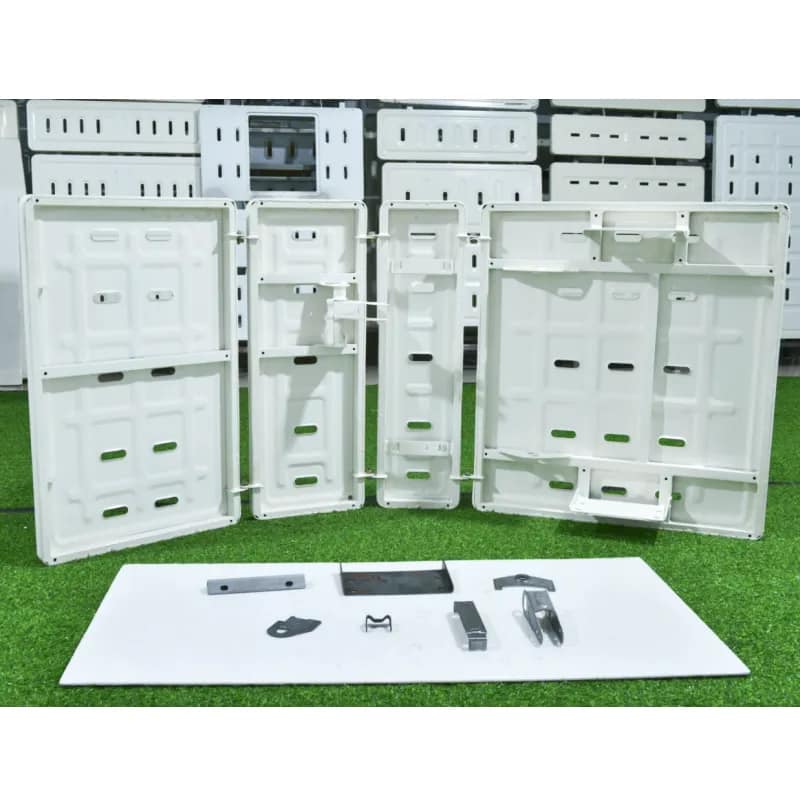
In many of our projects, we combine materials: an aluminum alloy top rail for the visible surface and a steel inner frame for strength. Powder coating over the steel frame, using an antibacterial additive like ionized silver, helps maintain a hygienic surface during daily cleaning. Stamped metal parts, such as the connecting ears and guardrail fixed plates, should be at least 2.5 mm thick to avoid deformation over repeat cycles.
If your facility is in a coastal region with high humidity, the long-term corrosion resistance of the rail coating becomes a key decision point. It is worth confirming the salt-spray test results for the specific powder coating formulation before finalizing your specification — reach out at [email protected].
Working with a Manufacturer to Customize Guardrails
A custom guardrail project typically begins with a set of CAD sketches or even a marked-up photograph of the existing bed. The manufacturer needs the bed’s make, model, deck width, mattress thickness, and the distance from the mattress platform to the floor. Based on that data, we propose a rail geometry and locking configuration.
The production process at our facility includes laser cutting, stamping, welding, surface treatment, and final assembly. We handle the parts in-house, including the stamped bed panels and the guardrail fixed plates, which means the same team that builds the bed frame also ensures the guardrail aligns precisely. For orders starting at 50 pieces per bed set, we can adjust rail height, color, and bar count without tooling charges that typically accompany low-volume work.

If your program involves electric beds with automatic contouring, it is worth confirming the rail’s clearance through the full range of backrest and knee elevation before finalizing the BOM.
After design approval, the lead time for a custom guardrail production run is usually 15 to 20 working days, with 40 to 45 days for a complete new bed model. We pack each set in export-grade cartons with foam protection, and a one-year warranty covers the structural mechanism.
Compliance and Quality in Custom Guardrail Projects
Before releasing a guardrail design, I recommend verifying that the manufacturer has conducted the necessary load and endurance tests. In our quality management system, we apply a horizontal force of 100 kg to the guardrail in its fully raised position and cycle the locking mechanism 20,000 times. We also perform a saline spray test on coated metal parts for 48 hours to check corrosion resistance.
Documentation is equally important. Ask for a technical datasheet that lists the materials, coatings, and test results. While third-party certification to standards like ISO 13485 is ideal, a factory audit report that covers welding quality, dimensional accuracy, and raw material traceability provides a reliable picture of production competence. I have found that suppliers willing to share their failure modes and corrective action reports are the ones most committed to continuous improvement — a detail worth weighing during your evaluation.
When you are ready to move ahead with a custom guardrail project, the best starting point is to send your bed specifications and the quantity you need. Our engineering team reviews each case and returns a dimensional drawing and quotation within three working days. Contact me at [email protected] or call +8613528198959 to discuss your requirements.
Common Questions About Hospital Bed Guardrail Projects
What if my beds have different models and widths across wards?
In programs we’ve supported, it is common to have a mix of electric and manual beds purchased over several years. A feasible approach is to identify the two or three dominant bed platforms and design a guardrail with an adjustable mounting plate that covers the dimensional range. This avoids stocking a dozen rail variants while still achieving a secure attachment on each bed type. If the variance is too large, however, it is safer to commission two separate rail designs rather than compromise on the gap standard.
Can a guardrail be retrofitted onto an older manual crank bed?
Yes, provided the bed frame has solid mounting points. Older beds often use a simple bracket system, so we fabricate a conversion plate that bolts onto the existing side panel holes. The rail’s weight must be considered: a heavy steel guardrail can make a manual crank harder to lift if it adds significant mass to the mattress platform, so in these cases we usually recommend an aluminum alloy rail.
Is the antibacterial coating on metal guardrails a long-term solution?
The coating itself is durable, but its effectiveness depends on the cleaning protocol. Aggressive quaternary ammonium compounds applied undiluted can degrade some powder coatings over many years. In facilities where I’ve seen this happen, the coating remains intact as a corrosion barrier even if the antibacterial additive becomes less effective. So the rail stays functional; the protective benefit just needs to be supported by a regular cleaning schedule.
How soon can a custom guardrail order be delivered?
For a production run of 50 to 200 sets, our lead time is 15 to 20 working days, not including international shipping. Air freight delivery from our factory to most destinations adds 5 to 7 days, while sea freight can take 3 to 6 weeks depending on the port. We always confirm production milestones by email so your procurement team can plan bed allocation accordingly. If you have a tight project timeline, sharing your delivery deadline early helps us prioritize scheduling. For a detailed timeline including shipping to your port, send your part number and quantity to [email protected] or call +8613528198959.
If you’re interested, check out these related articles:
Electric vs Manual Adjustable Beds: A Comprehensive Comparison
Top Wholesale Hospital Bed Parts Manufacturers & Suppliers
Unlocking Comfort and Care Benefits of Adjustable Hospital Beds
Choosing a Reliable Hospital Bed Parts Manufacturer: A Comprehensive Guide