
When planning a new healthcare facility, getting hospital furniture basic requirements right from the start prevents costly replacements and ensures patient safety. Furniture in a clinical environment is not just about beds and chairs; it includes everything from overbed tables and IV stands to bedside cabinets and transfer trolleys. Each piece must meet standards for load capacity, surface cleanability, and fire safety. After nearly twenty years manufacturing hospital beds and accessories, I’ve seen that poorly chosen furniture creates daily friction for nursing staff and exposes patients to avoidable risks. This article breaks down the requirements that every project planner should include in their specification sheet.
What Does Hospital Furniture Actually Include?
“Hospital furniture” covers far more than a bed and a nightstand. In a fully equipped ward, it is the complete set of physical products that patients and staff interact with directly. A standard list for a general medical-surgical ward typically includes the bed itself with side rails, a head and foot board, a bedside cabinet with drawer, an overbed table, an IV stand, wardrobes or locker cabinets, privacy screens, and visitor seating.

Beyond the ward, there are treatment room items like procedure trolleys, instrument stands, gynecological examination beds, stretcher trolleys for emergency transfers, and specialized ICU beds with integrated scales and CPR functions. Even accessories such as bed casters, crank handles, drainage hooks, and bed panel supports fall under furniture requirements because they affect daily nursing work. Missing any of these components during procurement leads to last-minute gaps that force staff to improvise, often with safety consequences.
The Core Requirements That Define Hospital-Grade Furniture
What separates hospital-grade furniture from general-use furniture comes down to four interlocking requirements: structural integrity, cleanability, patient safety, and regulatory compliance. These are not nice-to-have features; they are baseline conditions for any item placed in a clinical setting.
Structural integrity and load capacity. Hospital beds must carry patients up to 250 kg in bariatric models, with standard general-ward beds rated for at least 200 kg. An electric five-function ICU bed typically has a load capacity of 250 kg, with its frame built from rectangular steel tubing and the bed surface from stamped steel panels. Tables and trolleys need a minimum 25 kg desktop load, while transfer stretchers are expected to hold 150 kg or more without deflection. This is not a paper specification; staff move patients onto these surfaces daily under time pressure. A collapsing side rail or a sagging tabletop is a serious injury risk.
Cleanability and surface materials. Almost every surface must be non-porous, resistant to hospital-grade disinfectants, and smooth enough that fluids do not pool in crevices. ABS engineering plastic is widely used for headboards, footboards, bedside cabinets, and overbed table tops precisely because it withstands repeated chemical cleaning without degrading. Stamped steel bed panels are powder-coated with antibacterial finishes, and both materials allow full disassembly in under a minute for emergency cleaning. Bed frame designs must avoid open tube ends or unreachable corners where biological material can accumulate.
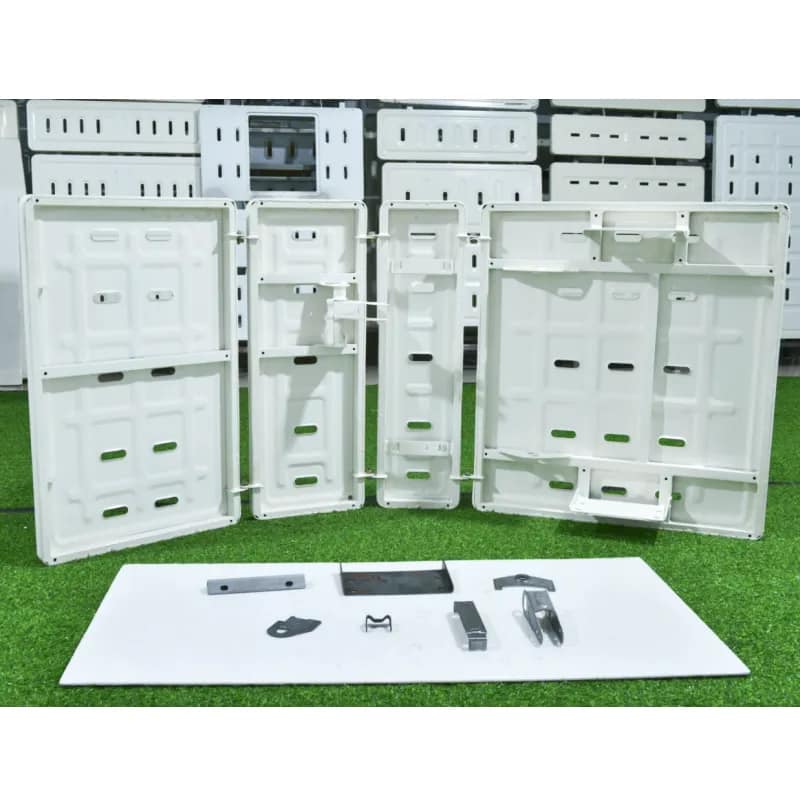
Patient safety features. Bed side rails must lock securely and not allow a patient’s head, limbs, or clothing to become trapped. Guardrail designs vary from bent tube to horizontal folding to door-type, and the right choice depends on patient mobility and fall risk. Casters must include brakes—central-locking casters with a single pedal are preferred because a nurse can secure all four wheels simultaneously without bending down multiple times. An IV pole that wobbles when a bag is half-empty is not just inconvenient; it can pull out the line or tip over entirely.
Regulatory compliance. Any hospital furniture used in EU markets should carry CE marking under the Medical Device Regulation, and in the US, FDA clearance may apply for motorized beds. Beyond medical-specific certifications, general quality management standards like ISO 13485 for the manufacturer’s quality system and ISO 9001 are the minimum anyone should ask for during supplier evaluation. Products that cannot produce test reports for load, flammability, and biocompatibility should be avoided, regardless of price.
Matching Furniture to Clinical Needs: General Wards vs. ICUs
The most common specification mistake I see is applying a single furniture list to every department. A general ward bed and an ICU bed solve fundamentally different problems.
In a general ward, the patient is generally mobile or can be repositioned with assistance. A manual three-crank bed that adjusts backrest, knee rest, and overall height is often sufficient. The bed frame uses steel tubing, side rails are aluminum alloy or iron, and the headboard/footboard snap on and off in seconds for emergency access. Bedside cabinets in these wards hold personal items, and the overbed table sits on silent casters so it can be moved easily for meals and examinations.
In the ICU, the requirements jump significantly. The bed must support continuous monitoring, weigh the patient without transfer, and allow Trendelenburg and reverse Trendelenburg positioning at angles of at least 12 degrees. Electric five-function beds with five independent motors handle all of this: backrest, leg rest, full height adjustment, and forward/backward tilt, all with one-button control and a noise level below 45 dB. Side rails on an ICU bed must be high enough to prevent any roll-out while still allowing line and tube management. For field hospitals or emergency departments, the priority shifts to rapid deployment: stretchers that fold flat, load onto trucks, and can be cleaned with a pressure washer after treating a traumatic case.

Bariatric patients need reinforced beds with wider frames and guardrails that extend fully while still passing through a standard doorway. Pediatric wards use smaller beds with completely different rail spacing to prevent entrapment. A maternity bed adds stirrups and a split leg section that a standard med-surg bed does not have. These are not minor variations; they are separate product categories with separate requirement checklists.
How to Avoid Procurement Mistakes in Hospital Furniture Selection
Even experienced project teams lose time and money on furniture procurement when they overlook details that only become visible during installation. Based on what I have observed across international projects, these are the most avoidable failures.
Specifying load capacity without considering total working load. A bed rated at 250 kg safe working load may still deflect under combined patient weight, mattress weight, and the force of a nurse leaning on the side rail during repositioning. Always ask for the test standard behind the rating rather than a single number on a brochure.
Ignoring caster compatibility. Central-locking casters are only effective if the brake pedal, axle sleeve, and hexagonal pad are all from the same system and matched to the bed frame. Mixing a central-locking caster from one supplier with a frame from another frequently results in brakes that do not engage fully or release unpredictably. We manufacture caster systems as matched sets because the tolerances between the pedal linkage and the locking mechanism are tight. If you are buying bed frames and casters separately, test the complete assembly before committing to a container order.

Not checking headboard and footboard attachment points. ABS headboards snap onto the bed frame via hook seats and connecting ears. If the frame is from one factory and the board from another, the mould dimensions may differ by just a few millimeters, but that is enough to prevent proper locking. I have seen containers arrive where half the headboards would not seat because the hook seat profile was copied from an older drawing. The solution is to either source complete beds or cross-check mechanical samples of all mating parts.
Ordering accessories separately without testing integration. An IV pole that fits the bed’s socket hole may still not lock vertically if the socket’s internal diameter varies by even 1 mm. Drainage hooks, bed extension rods, and overbed table mounts all depend on dimensional interfaces that are rarely standardized across manufacturers. The safest approach is to specify that all accessories and the bed frame come from the same supply chain, or to test at least two full units.
Skipping certification verification. When a supplier claims “CE certified” for a hospital bed, ask for the technical file reference number and the notified body that conducted the conformity assessment. A valid declaration of conformity must cite the specific standards applied, such as EN 60601-1 for electrical safety and EN 60601-2-52 for medical beds. If the supplier cannot produce these within a few days, the certificate is not genuine. This applies equally to FDA, ISO 13485, and any regional medical device listing. No documentation means no assurance.
Getting the furniture specifications right from the start avoids these failures, but when requirements are unclear or a project’s clinical needs involve conflicting priorities between departments, a detailed technical review with the manufacturer is the fastest path to a safe, complete order. If your facility is planning a full furniture package or replacing an existing fleet, send your bed count, desired functions, and any regulatory requirements to [email protected] or call +8613528198959 for a technical proposal.
Common Questions About Hospital Furniture Requirements
What materials are most common in hospital-grade furniture?
The two dominant materials are steel and ABS plastic. The bed frame is typically welded from rectangular steel tubing with a powder-coated finish for corrosion resistance. Bed panels can be stamped from steel sheet and then coated, or molded from ABS. ABS is preferred for headboards, footboards, and bedside cabinet shells because it withstands impact from mobile equipment and repeated cleaning with quaternary ammonium or chlorine-based disinfectants. Aluminum alloy appears frequently in side rail assemblies where weight matters, and TPR is the go-to material for caster treads that must roll quietly and not mark floors.
How do I know if a bed meets infection control requirements?
Look for three things. First, the surface must be sealed and without exposed welds or crevices where fluids can pool. Second, all removable parts such as the headboard, footboard, and guardrails should be able to be disconnected without tools for separate cleaning. An ABS snap-on structure that detaches in 30 seconds is an example of good design. Third, the manufacturer should be able to supply test reports for resistance to common hospital disinfectants. If a product uses open tubular construction or has fabric-lined bumpers, it should be avoided for any setting above basic assisted living.
What load rating should an ICU bed have?
While ISO 60601-2-52 defines safe working load categories, a practical minimum for an ICU bed is 250 kg. This is not only about patient weight; the bed must remain stable when staff lean heavily on the side during intubation, when a cardiac chair position concentrates weight on one section, and when accessory equipment is mounted on the frame. The actuator motors and the frame welds must both be rated to this combined load, not just the deck surface. Ask for a test report that demonstrates both uniform and concentrated load testing at the rated capacity.
Can hospital furniture be customized for specific patient groups?
Yes, and in many cases customization is necessary. Bariatric patients need bed widths exceeding 1 meter and reinforced side rails. Pediatric beds require narrower gaps between rail bars and lower overall height to reduce fall injury. Maternity beds have split leg sections and adjustable backrests for different birthing positions. In geriatric care, homecare-style beds with wood-grain finishes and lower height make the environment feel less institutional. Custom dimensions, colors, and rail configurations are common when a hospital serves a well-defined patient population. The caveat is that any customization must be validated against the same structural and safety tests as the standard model.
How important is the manufacturer’s after-sales support for furniture?
It is critical. Beds and trolleys are used 24 hours a day, and parts wear out. Casters lose their quiet roll after several years of daily movement, side rail locking mechanisms become stiff, and motor actuators eventually reach end of life. A manufacturer that cannot supply replacement crank handles, transmission arms, bed panel connectors, or a matching caster set years after the original purchase leaves the hospital with a functional problem that cannot be fixed without replacing the entire bed. When evaluating a supplier, ask for the spare parts catalogue, confirm that the parts interchange with newer models, and check that the minimum order quantity for parts is reasonable. If you are currently reviewing suppliers and want to confirm that the furniture you are considering can be supported long-term, share your specification sheet at [email protected] and we can help you verify compatibility and after-sales availability.
If you’re interested, check out these related articles:
Essential Safety Features for Adjustable Medical Beds
Can Adjustable Hospital Beds Be Customized for Homecare Needs
Electric vs Manual Adjustable Beds: A Comprehensive Comparison